



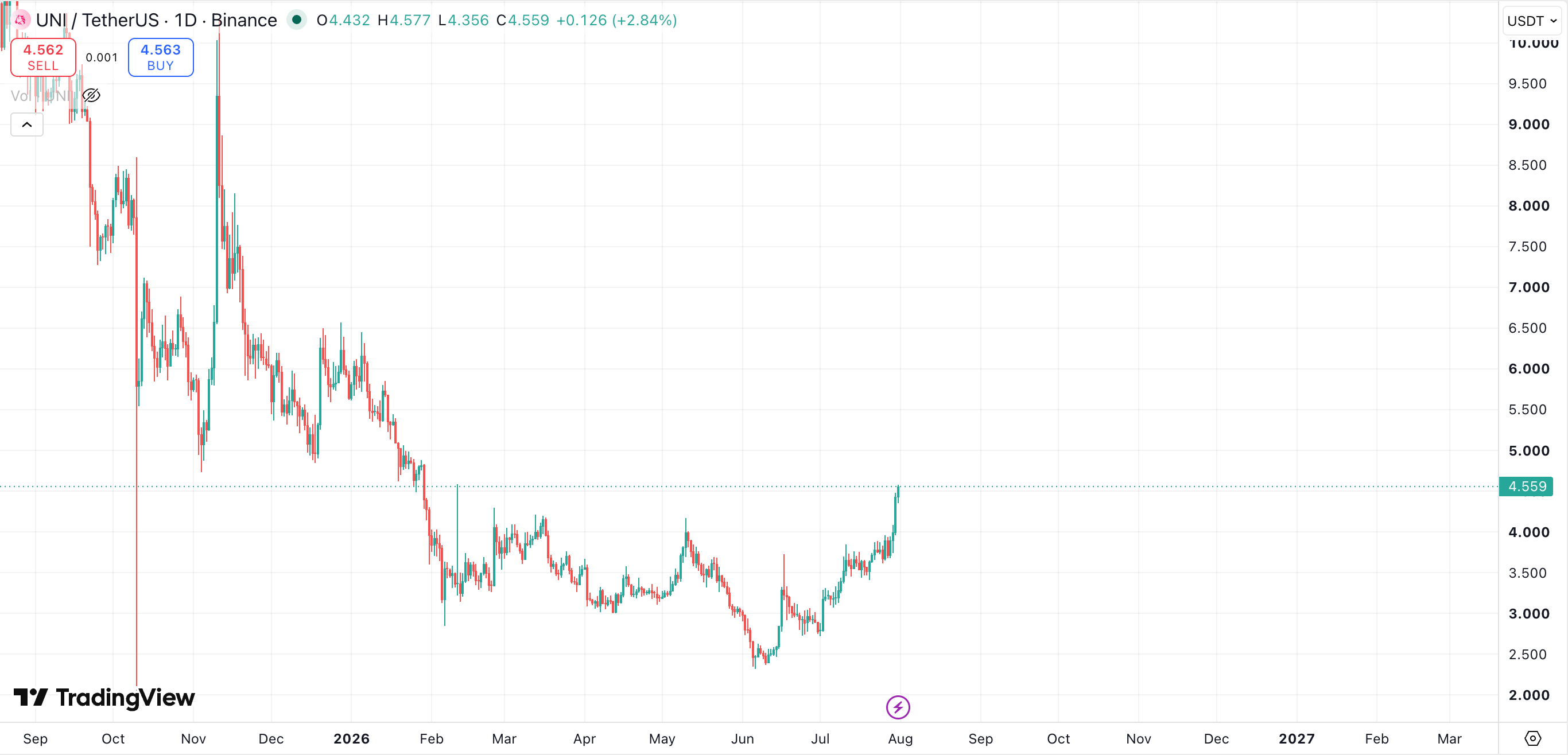
UNI stood out in a shaky crypto market through June and July. The token traded around $2.3 in early June and was nearing $4.6 by late July, almost doubling in roughly two months.
Foresight News argued that the move was not a sudden breakout with no setup behind it. The groundwork had been laid months earlier, when Uniswap finally pushed through the fee-switch structure the community had debated for years. At first, the market response faded quickly. Later, the revenue and burn numbers started to matter.
UNIfication put protocol revenue on a buyback-and-burn path
On Dec. 28, 2025, Uniswap’s governance proposal UNIfication was executed on-chain. A portion of trading fees from Ethereum mainnet v2 pools and some v3 pools began flowing to the protocol. Unichain sequencer revenue, after OP sharing and L1 data costs, was also directed into the same pool of funds.
At the same time, Uniswap burned 100 million UNI from its treasury as what the article described as retrospective compensation for the protocol’s earlier “free” era. Uniswap Labs cut fees on its front end, wallet, and API to zero, while receiving a 20 million UNI annual growth budget.
All of that protocol revenue is routed into a treasury contract called TokenJar. TokenJar has one outlet only: it sends funds through the Firepit contract to buy UNI and burn it permanently.
That was the full form of the fee switch after more than five years of debate. Since DeFi Summer, the community had argued over whether the protocol should take a share of trading fees, but proposals repeatedly ran into concerns over distribution, legal risk, and the possibility of losing LPs.
Early burn data did not give the market much to work with
When the proposal was announced, UNI jumped nearly 50% within hours. The move did not last. As the broader market weakened, UNI gave back those gains. By March 2026, it had fallen below $3.8. Through April and May it stayed around $3, and by early June it had dropped to $2.3. The fee switch was on, but quietly so.
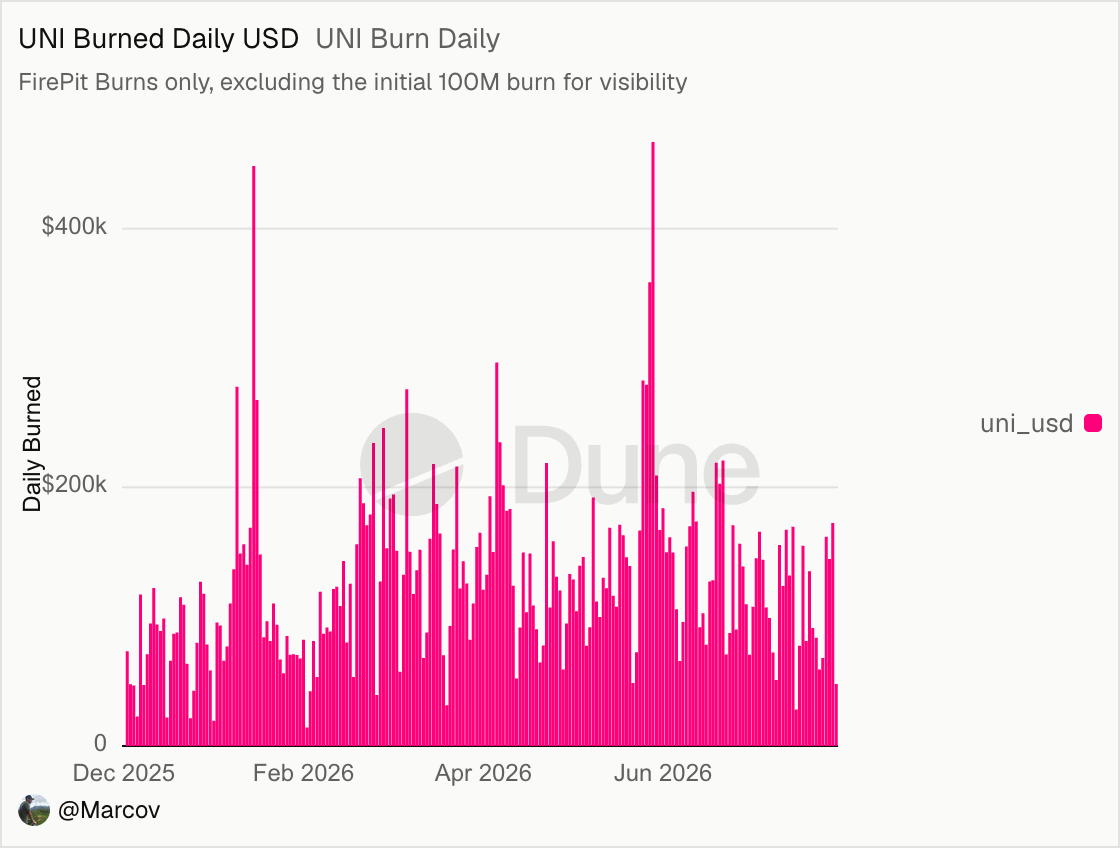
The issue was scale. Dune data cited in the article showed that in the first 12 days after the switch went live, the cumulative value of burned UNI was only about $800,000. That worked out to roughly $26 million to $27 million on an annualized basis, or about 4 million to 5 million UNI burned per year.
Against an annual 20 million UNI growth budget, those figures were not enough to make the mechanism look compelling. By May 2026, cumulative protocol revenue was about $12.3 million, while daily protocol revenue was running at roughly $73,000. The burn system was active, but it looked more like an engine idling than one driving a revaluation.
Robinhood Chain changed the volume picture in July
The shift came in July. Robinhood Chain went live on July 1, and Uniswap v2, v3, v4, and UniswapX were deployed on day one.
The chain, built for tokenized stocks, pushed Uniswap daily trading volume to $500 million within eight days. Cumulative volume crossed $1 billion on July 10. In its first week, Robinhood Chain accounted for nearly half of Uniswap’s total weekly fees, or about $11 million. Daily fees across the protocol at one point reached $5.2 million, second only to the two biggest stablecoin issuers across the network.
Uniswap founder Hayden Adams called Robinhood Chain the most active chain outside Ethereum mainnet.
v4 fee activation sharply lifted funds flowing into UNI burns
Governance action followed the volume surge. A Snapshot vote held from July 7 to July 12 decided to extend the fee mechanism to v4 pools, followed by an on-chain vote the next week. From July 10 to July 15, a temperature check was also underway on turning on protocol fees for the Robinhood Chain deployment.
On July 27, the v4 fee switch was formally activated. DefiLlama data cited by the article showed protocol revenue nearly tripled after activation. The amount of money flowing each day into UNI burns rose from about $114,000 in early July to $325,000.
Robinhood Chain alone contributed $170,000, more than half of the total. Ethereum mainnet added about $82,000. On the day the news landed, UNI gained 12% and touched $4.4.
The market moved from pricing hope to pricing cash flow
Looking back at the curve, the article’s logic was straightforward. At the end of last year, the market was pricing expectation. When the expected benefits did not show up quickly enough, the token fell back. Once burn data climbed from a few hundred thousand dollars per month to a few hundred thousand dollars per day, and once the biggest new source of trading activity was connected to the burn engine, the market had a different input to work with.
For a protocol processing more than $1 trillion in annual trading volume, token holders had previously received none of that economics directly. Now each trade contributes to a permanent automatic buyer of UNI. Foresight News framed that shift, from a governance token to a cash-flow-linked asset, as the core narrative behind the rally.
Buybacks do not work the same way for every token
The article also noted that buyback and burn mechanisms are no longer unusual in crypto. Hyperliquid’s monthly buybacks are close to $95 million. pump.fun is at about $35 million. Jupiter uses half of its operating revenue for buybacks. dYdX, Aave, and Lido are pushing similar structures as well.
But whether a buyback works, the piece said, depends less on the existence of the mechanism than on token structure. UNI is an older token that completed distribution in 2020. After six years, supply is more dispersed, there are no large unresolved unlocks hanging over the market, and roughly $830 million worth of UNI on exchanges is available for sale. In that setup, buyback demand hits the secondary market directly.
Many newer projects carry buyback-and-burn branding too, but monthly unlocks for teams and investors often exceed the amount being repurchased. In those cases, burned tokens do little to offset fresh supply, and price support is limited.
The next test is what happens after Robinhood Chain gas subsidies end
That is where older DeFi projects can still have an edge. A protocol that launched early, survived long enough, and distributed tokens years ago may have a cleaner supply picture, which gives a buyback system a better chance to matter.
For UNI, the next question is specific. The article said Robinhood Chain’s gas subsidy is expected to expire about 90 days after launch. How much trading volume remains after that point will determine whether this near-doubling marks the start of a value re-rating or another move sustained by subsidies.