

Uniswap’s fee switch is now live on V4, and the rollout has already pushed protocol revenue sharply higher while helping lift UNI back above $4.
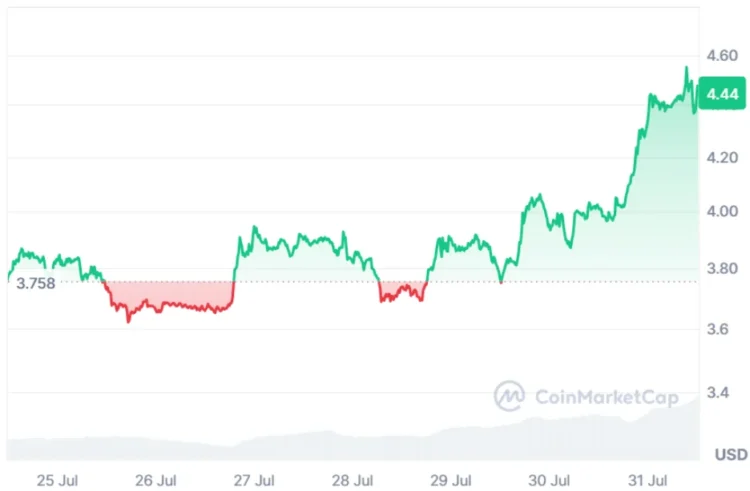
On July 30, UNI rose more than 10% on the day and extended its weekly gain to over 17%, reversing roughly three months of sideways trading, according to the source article. The immediate catalyst was the activation of the fee switch on July 27.
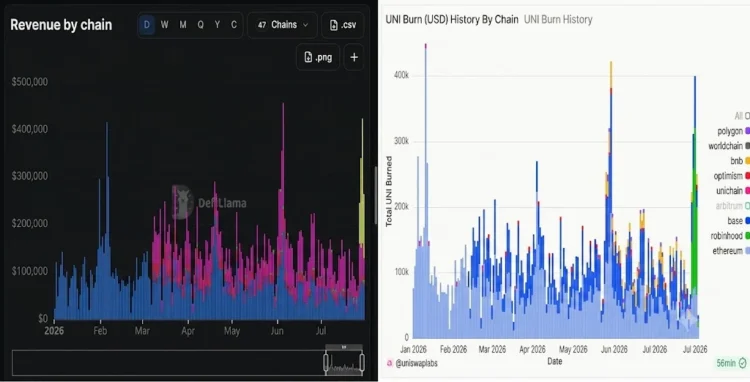
After the switch was turned on, Uniswap’s average daily protocol revenue jumped from $118,000 in early July to $318,000, an increase of about 2.7x. Robinhood Chain alone generated an average of $168,000 a day, contributing more than half of the protocol’s total revenue.
The increase in revenue was matched by a rise in UNI burns. The report said daily burns reached 106,000 UNI, after previously setting a record of 186,000 UNI. That combination of fee capture, token destruction, and price support has turned the fee switch into Uniswap’s most visible commercialization step so far.
How the fee switch changed value capture
Under standard DEX fee structures, trading fees usually flow entirely to liquidity providers, or they are collected by front-end operators. Protocols themselves often capture little direct value.
The article said Uniswap introduced a broader governance proposal called UNIfication at the end of 2025. It brought in a TokenJar pool and a Firepit burn contract to create a programmatic route for fee distribution.
In the description provided by the source, TokenJar functions like a transparent pool that only receives funds. Fees collected by the protocol accumulate there, but nobody can simply withdraw them. The only way to access the value inside is to prove that a corresponding amount of UNI has been burned.
That creates an arbitrage setup. If the value of fees sitting in TokenJar exceeds the cost of buying and burning UNI, arbitrageurs such as MEV bots can buy UNI on the market, burn it, unlock the fees, and keep the spread. The cycle runs through on-chain incentives rather than manual intervention: trading generates fees, arbitrageurs buy back and burn UNI, circulating supply falls, and token value gains support.
Since the fee switch was activated, Robinhood Chain has replaced Ethereum mainnet as the core venue for Uniswap’s protocol fee capture. The report described it as the most important catalyst behind the current acceleration in UNI deflation.
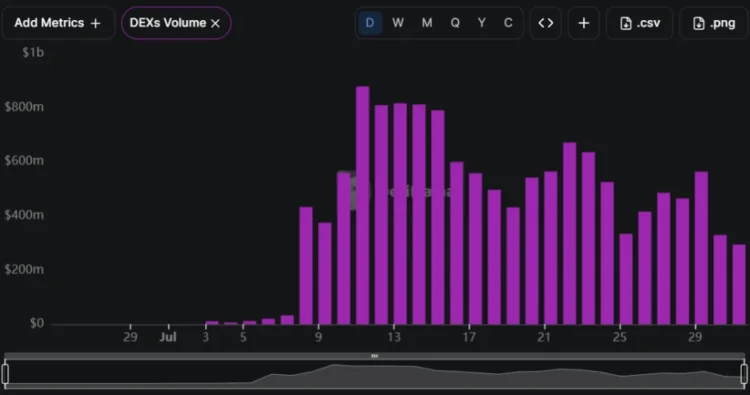
Robinhood Chain is a Layer 2 network built with Arbitrum Orbit. Since its mainnet launch on July 1, it has benefited from gas-fee subsidies and integration with Web2 user access points. DeFiLlama data cited in the article showed that within a week of deploying Uniswap V2, V3, and V4, the chain’s cumulative trading volume had already passed $6 billion.
Once the fee switch was enabled on Robinhood Chain, that activity started converting directly into protocol revenue. The chain contributed more than 52% of Uniswap’s average daily protocol income, making it the top revenue source and a major source of UNI buy pressure.
September could expose how durable the revenue really is
The problem is concentration. With so much of Uniswap’s revenue now coming from one chain, UNI burn rates are becoming tightly linked to traffic swings on Robinhood Chain.
The article cited Oak Research as saying that more than 99% of the trading volume generated on Robinhood Chain since launch has been driven by meme-token speculation, including CASHCAT. In other words, more than half of Uniswap’s current revenue is tied not to stable, long-duration trading activity, but to highly speculative meme-coin flows.
The next key date is late September. The report said Robinhood Chain’s high transaction volume currently depends on an official gas-fee subsidy. If that subsidy expires in late September as scheduled, on-chain interactions will return to their normal cost base. That could cool meme-token speculation that relies on automation and high-frequency trading.
Uniswap announced on July 30 that it was launching a beta version of Launches on Robinhood Chain, aimed at aggregating hot token launches and offering a distribution channel for them. Even so, the report argued that this does not change the near-term weakness in the protocol’s traffic mix.
Valuation pressure and the LP fee debate are building in parallel
The article also said the market has already priced in steep growth expectations for UNI. Uniswap’s fully diluted valuation was put at about $4 billion, against annualized earnings of around $41 million, implying a price-to-earnings ratio close to 100. If revenue growth fails to meet those expectations, valuation pressure could follow.
The sharper debate centers on whether protocol fee capture comes at the expense of liquidity providers. Aerodrome co-founder Alexander Cutler argued that the fee switch effectively slices into the existing fee pool. In his view, after the fee switch was turned on in Uniswap V2 and V3 concentrated liquidity pools, as much as 25% of LP income was taken away. Under the V4 structure, he said, the effective “tax rate” on liquidity interactions could be as high as 33%.
Uniswap founder Hayden Adams responded by saying V4 protocol fees use an additive model rather than a deductive one. LPs’ existing pool fee rates are not reduced, he said. Instead, protocol fees are charged to traders on top of the existing fee structure, which means LP income is not directly cut.
The report noted that Adams is correct mathematically, but said the economic question remains open. If total trading fees rise, trader costs may rise with them. That could reduce trading volume and eventually weaken the realized earnings of LPs. The article said that question will need a longer run of market data to answer.
For now, Uniswap has delivered a strong first showing in commercialization. Whether that becomes a durable model will depend on whether the protocol can expand into more sustainable on-chain use cases and whether Robinhood Chain can keep activity from falling once subsidies run out in late September.