
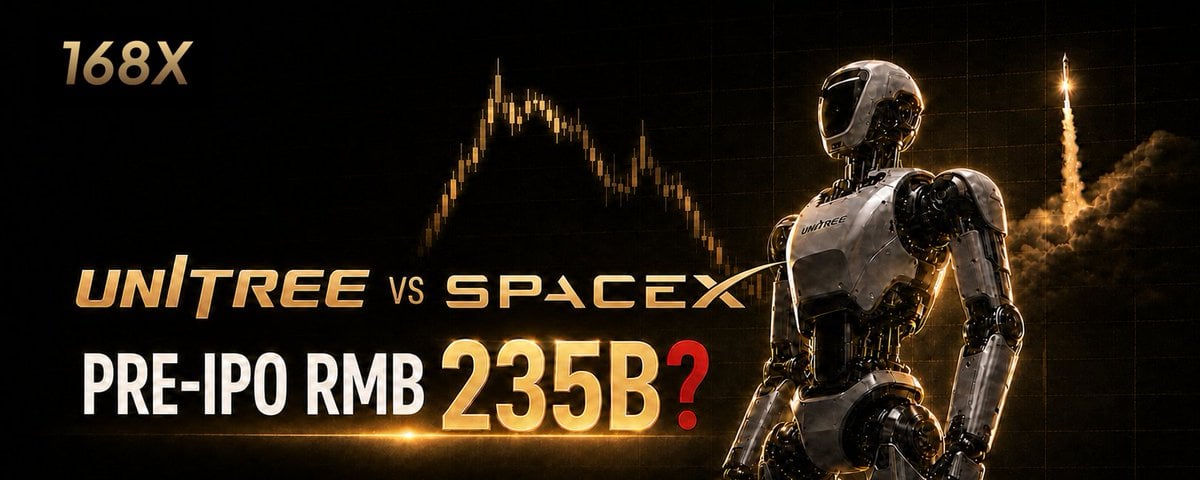
On the day before SpaceX listed, its premarket contract on Hyperliquid traded at about $167 a share. The next day, the stock was issued at $135, opened at $150, and closed at $160.95. The premarket got the first-day heat roughly right. It did not foreshadow what came next: a run to $225.64 over the following sessions, then a drop to as low as $104.83 in less than two months, cutting the peak by more than half.
PANews uses that sequence as a setup for Unitree Technology. The argument is straightforward: a premarket contract may offer a read on opening sentiment, but it does not tell investors where the stock will trade six weeks later.
Hyperliquid premarket pricing puts Unitree near RMB 230 billion to RMB 235.5 billion
As of Aug. 10, the more liquid xyz:UNITREE contract on Hyperliquid was quoted around $85 to $86 per share, while another market, para:UNITREE, was around $84. Using 404.46 million shares outstanding after the offering, the article says the market is implying a valuation of roughly $34 billion to $34.8 billion, equivalent to about RMB 230 billion to RMB 235.5 billion.
That is about 3.8 times Unitree’s IPO market capitalization of RMB 60.993 billion. In the article’s framing, the question is no longer whether Unitree will be heavily traded after listing, but how expensive the dream has already become before the open and which stage of pricing investors are stepping into.
The piece states that, unless marked otherwise, all figures are in renminbi and that it uses a real-time exchange rate of 1 USD = 6.77 CNH.
$84 is not a target price, but a sentiment gauge
The contract rules on Hyperliquid are described clearly in the piece: UNITREE is the market’s dollar quote for one Unitree A-share. After the stock formally lists, the contract will be settled automatically based on the A-share price and the offshore yuan exchange rate.
At a contract price of $84, the article calculates the following:
- $84 × 404.46 million shares = $33.975 billion
- Converted at 6.77 CNH, that equals RMB 230.011 billion
- That works out to about RMB 568.68 per share, or 3.77 times the IPO price of RMB 150.8
Using the more liquid xyz market at $85 to $86, the implied price rises to about RMB 575 to RMB 582 per share, with market capitalization at roughly RMB 232.7 billion to RMB 235.5 billion.
But the article adds a warning that it says cannot be skipped: this is not stock. The contract is cash-settled. Buying it does not make the holder a Unitree shareholder, does not grant IPO allocation, and cannot be exchanged for one share of Unitree.
It is also a very light market. As of midday Aug. 10, Unitree’s two premarket venues on Hyperliquid, xyz and para, had combined open interest of only about $11.9 million and 24-hour trading volume of about $2.13 million. In other words, less than $12 million in open positions was assigning a valuation of nearly $35 billion to a company about to go public.
The article points back to SpaceX. Before listing, Hyperliquid quoted it at around $167, and the stock closed at $160.95 on day one, a decent read on short-term temperature. But the contract did not predict the later rise to $225.64, and it did not predict the subsequent fall to $104.83 either. The conclusion in the piece is that premarket contracts can guess the opening, not the ending.
A RMB 235 billion valuation means betting Unitree can capture about two-thirds of the global market
The article then lays out Unitree’s operating base. According to the prospectus figures cited, the company posted revenue of RMB 1.699 billion in 2025 and operating cash flow of RMB 670 million. Net profit attributable on the books was RMB 278 million, but profit from core operations, excluding one-off items, was RMB 591 million.
At the IPO market value of RMB 60.993 billion, Unitree would trade at 219.23 times earnings. The article notes that this high multiple is based on the lower RMB 278 million figure, which was depressed by about RMB 349 million in non-cash share-based compensation expense. Using core profit instead brings the multiple to about 103 times.
Still, the article says those headline P/E ratios are not the central point for a company in a fast-growth phase with volatile profitability. The framework it proposes is: 2035 market size × Unitree market share × mature net margin × mature P/E multiple, then discount that value back to the present.
PANews cites Goldman Sachs as estimating the global humanoid robot market at about $37.8 billion in 2035, or around RMB 255.9 billion. Its blue-sky case is $154 billion, or about RMB 1.04 trillion. The article uses what it calls intentionally conservative mature-phase assumptions: a 15% net margin, a 25x P/E multiple, and a 12% discount rate, discounted nine years from 2026 to 2035.
Under that setup, the implied assumptions behind each price become clearer:
- At the IPO market capitalization of RMB 60.993 billion, Unitree would need 2035 revenue of roughly RMB 45.1 billion, equal to 17.6% of Goldman Sachs’ base-case market
- At the premarket range of $84 to $86, or about RMB 230 billion to RMB 235.5 billion, Unitree would need 2035 revenue of about RMB 170.1 billion to RMB 174.1 billion, equal to 66.5% to 68% of the base-case market
To move from RMB 1.699 billion of revenue in 2025 to around RMB 170 billion by 2035, the company would need a revenue CAGR close to 59% over the next decade, with little room for a slowdown.
Put plainly, the premarket contract is not just betting that Unitree becomes a leader. It is betting that Unitree can take close to two-thirds of the global humanoid robot market in Goldman Sachs’ base case.
The article says there is one way this price could look less stretched: Goldman Sachs’ $154 billion blue-sky scenario would have to materialize. In that case, a RMB 235 billion valuation would require only about 16% to 17% market share. But that would still mean getting two things right at once: a much larger industry and Unitree holding onto leadership over the long run.
That, in the article’s telling, is the core difference between the two prices. RMB 60.993 billion is prepaying for Unitree’s growth over the next decade. Around RMB 235 billion is prepaying for a blue-sky outcome that has not happened yet.
Even if the valuation looks stretched, the stock could still rise first
The next section turns to the first stage of IPO pricing: scarcity.
Unitree is issuing 40.4464 million shares, equal to 10% of the post-offering share count. Of that amount, 8.0893 million shares go to strategic placement and are locked up, while the institutional offline tranche also includes lockup restrictions. That leaves an effective tradable float at listing of only about 7.4% of total shares outstanding, or roughly 30 million shares, equal to around RMB 4.5 billion in market value.
Demand, the article says, is on a very different scale. Valid institutional subscription volume reached 73.669 billion shares, or about 2,846 times the shares available for allocation.
This is where short sellers are most likely to get the call wrong, the piece argues. An expensive valuation does not automatically lead to an immediate decline. When intense attention collides with very limited float, something already expensive can become even more expensive. The article again points to SpaceX: an IPO price of $135 did not stop the stock from opening at $150 or from rallying to $225.64. In a thin-float IPO, scarcity trades first and valuation comes later.
By that logic, Hyperliquid’s $84 to $86 quote does not prove Unitree will open at RMB 600, but the 7.4% float is a reminder that shorting the stock purely because the implied valuation is nearly four times the IPO level could be a dangerous trade.
The article also outlines the subscription mechanics:
- On Aug. 10, investors can enter code 787836 in their brokerage app
- One allotment number corresponds to 500 shares, requiring RMB 75,400 if allocated
- The maximum subscription is 6,000 shares, or 12 allotment numbers
- No prepayment is required when submitting the order
- The draw takes place on Aug. 11
- Results and payment are due on Aug. 12
The article describes the lottery-style subscription as a low-cost option in which payment is only required after winning an allocation, while buying after listing is a completely different trade.
Lockup expiry is not an automatic sell signal
If the premarket price reflects FOMO and day one reflects scarcity, lockup expiry is the supply stage and, in the article’s view, the most misunderstood one.
Many traders assume the unlock date is the same as a down day. The SpaceX example given in the article says otherwise. The sequence was: IPO at $135, rally to $225.64, fall to about $108 before unlock, then rebound to about $133 after unlock.
On Aug. 6, roughly 910 million shares held by insiders and early investors came off lockup, more than doubling the tradable share count. But the heavy selling had already happened. The stock fell from its $225.64 high, and on Aug. 5, the day before the unlock, dropped about 13.6% in a single session to roughly $108, the lowest close in that stretch.
The article attributes that move to two factors: selling pressure after earnings on Aug. 4 and position-cutting ahead of the unlock.
Once the event arrived, the stock moved the other way. It rose about 6.1% on Aug. 6 to close at $114.92, then jumped another 15.8% on Aug. 7 to around $133.
The logic, the article says, is not complicated. The unlock date is public information, so money does not wait for the exact day to act. Investors worried about incoming supply often sell in advance, and short sellers position early as well. If actual selling turns out lighter than expected when the event arrives, short covering and event-driven buying can trigger a sharp rebound instead.
That means an unlock only guarantees one thing: more shares can potentially be sold. Whether the stock rises or falls on the day depends on how much the market already priced in, how much existing holders actually sell, and how much short interest had built up. The unlock changes the medium-term ownership structure. It is not a mechanical instruction for a one-day drop.
Unitree could face around RMB 32.995 billion in potential unlocked value after one year
The article applies the same logic to Unitree’s shareholder lockup schedule.
- Wang Xingxing and Shanghai Yuyi together hold 31.29% after the offering, locked for 36 months
- New 2025 shareholders including Tencent, Alibaba affiliate Hangzhou Haoyue, and China Mobile Capital Innovation hold about 4.62% combined, with lockups expiring gradually in the first half of 2028
- Other legacy shareholders hold about 54.10%, mostly with 12-month post-listing lockups; at the IPO price, the shares that may enter unlock conditions are worth about RMB 32.995 billion
DeepSeek received 933,400 shares in the strategic placement and is locked for 36 months, so those shares are not part of the one-year unlock wave. The article says the real focus should be on the 54.10% held by older shareholders.
Those holders include Meituan, Sequoia China, Matrix Partners, Shunwei, Jinshi Growth, and the Beijing Robot Industry Fund. The article estimates the paper value of the top six at about RMB 19 billion. These shares will gradually become eligible for trading around the first anniversary of the listing.
At listing, only about RMB 4.5 billion worth of stock is effectively in circulation. About a year later, nearly RMB 33 billion of older shares could approach the tradable line. In the article’s view, the bigger variable at that stage is not the unlock notice itself, but how much the stock price has already moved in the months before the event and whether holders such as Meituan and Sequoia China actually reduce positions.
The piece sums that up this way: the listing day is Unitree’s first IPO pricing, while the one-year mark could become its second pricing event. And that second round may start well before the unlock date itself.
The article’s bottom line: investors can apply for shares, but should not treat the premarket quote as a target
The final section pulls together the numbers into four takeaways:
- The RMB 60.993 billion IPO market capitalization implies Unitree needs about 17.6% of Goldman Sachs’ base-case market by 2035. That is not cheap, but the article says the logic is still defensible.
- The roughly RMB 235 billion premarket valuation implies about 67% of the base-case market, or a combination of the blue-sky scenario and 16% to 17% share. The article treats that as very expensive.
- The roughly 7.4% tradable float on day one is small enough for price to detach from valuation in the short term and trade scarcity plus FOMO first.
- The roughly RMB 33 billion in potential unlock value after one year is presented as the real stress test for supply-demand repricing.
The article’s distinction is that applying for shares and taking part in the lottery can make sense because payment is only required if allocation is won. Chasing the stock after listing is different. At that point, buyers may no longer be paying for the RMB 60.993 billion Unitree sold in the IPO, but for a blue-sky dream closer to RMB 235 billion.
For bearish traders, the article raises a separate question: can they withstand the squeeze risk created by a float of only 7.4%?
The final lesson PANews draws from the SpaceX case is not simply that dream stocks eventually fall. It is the order in which prices are formed: scarcity on day one, FOMO at the first peak, and only later cash flow and supply. Unitree, in that view, may end up tracing not just SpaceX’s early surge but also the full path from speculative heat back toward reality.