
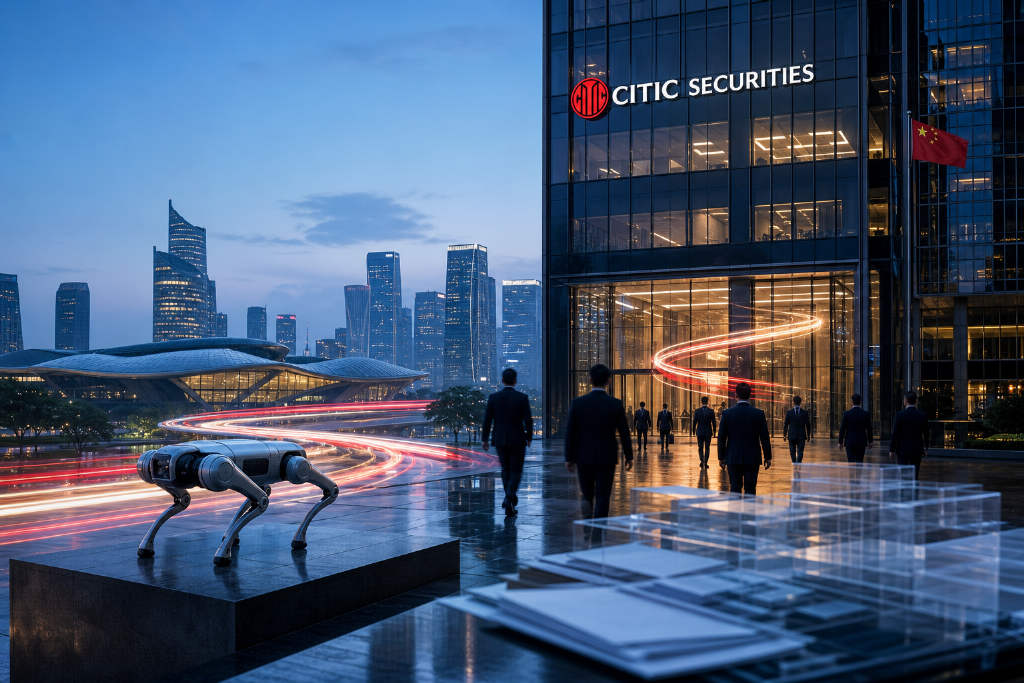
Unitree Technology is heading for an IPO, and a report carried by MarsBit and attributed to IT Juzi says brokerages were deeply involved long before the public offering opened. The article says the company is coming to market at a RMB 60.9 billion valuation and 219 times earnings, with fundraising of more than RMB 6 billion and oversubscription of 45%. Online subscriptions were described as extremely crowded, with a very low winning rate.
IT Juzi focused on who was positioned around the deal. Its report says at least 12 brokerages had already built exposure before listing, and 34 brokerages joined the offline subscription process during the offering.
At least 12 brokerages appeared in the pre-IPO shareholder structure
According to the report, Unitree had 46 shareholders before listing. After looking through those layers, IT Juzi said it found the footprint of at least 12 brokerages.
Most of them did not buy shares directly. Instead, they gained exposure through investment vehicles. One example in the article is Jingshi Growth, a fund under CITIC Securities. Before the IPO, Jingshi Growth held 4.15% of Unitree, making it the fifth-largest shareholder.
The report says the fund was not backed solely by CITIC’s own capital. Hualong Securities, Huaan Securities, and Hongta Securities each contributed money to the pool, which was then invested by CITIC’s fund platform. The article describes this as an LP, or limited partner, structure.
IT Juzi also listed other indirect routes. Soochow Securities held exposure through a Shenzhen Capital Group fund, Guotai Haitong through the Shanghai Sci-Tech Innovation Fund, and CICC through CICC Capital.
The article’s takeaway is that brokerage alternative-investment units often route capital into leading private-equity funds to obtain stakes in sought-after companies such as Unitree. It says that is not unusual by itself, but having 12 brokerages show up around one project is still rare.
CITIC Securities was described as benefiting from the deal in four ways
Among all the firms mentioned, CITIC Securities received the most detailed treatment. IT Juzi said the brokerage played four roles in the Unitree transaction.
First, it was an early investor. Through two pre-IPO investments made via Jingshi Growth and Zhongzheng Investment, CITIC is said to have put in a little more than RMB 33 million. Based on the offer price, the report says that stake is now worth close to RMB 500 million, implying a return of about 1,300%.
Second, it participated as the sponsor follow-on investor. The article says STAR Market rules require the sponsor to buy part of the deal. Through CITIC Investment, the firm bought more than 800,000 shares for RMB 122 million, with a 24-month lockup.
Third, it served as sponsor and underwriter. Unitree is raising more than RMB 6 billion in the IPO, and the report estimates sponsorship and underwriting fees at about RMB 145 million, which it describes as CITIC’s most direct service income from the deal.
Fourth, CITIC acts as the manager of the employee strategic placement asset-management plan. IT Juzi says Unitree’s senior executives and core employees joined the strategic placement, with the money managed through a CITIC asset-management product and locked up for 36 months. Founder Wang Xingxing personally contributed RMB 15 million.
The article then raises a question rather than making a conclusion: when the same institution is both a major institutional shareholder and the sponsor involved in pricing, how much independence remains?
Thirty-four brokerages joined the offline subscription process
Broker participation expanded again once subscriptions opened. The report says 34 brokerages and their asset-management subsidiaries took part in Unitree’s offline IPO subscription. The lineup included large firms such as CITIC, Huatai, and Guotai Haitong, mid-sized players such as Guoyuan, Zheshang, and Caitong, and the China units of foreign brokerages including JPMorgan and Goldman Sachs.
Together, those 34 firms were allocated more than 650,000 shares, worth about RMB 98 million, according to the article.
IT Juzi says some of those brokerages already had indirect primary-market exposure through LP structures, then added direct participation on the secondary side through asset-management products during the IPO subscription. In other words, some firms increased their position on top of what they already had.
High valuation puts brokerage exposure in sharper focus
The article says the scramble to buy despite a price-to-earnings ratio of 219 comes down to one judgment: these institutions believe there is still room for gains after listing. In that framing, offline IPO subscription is a calculated trade, not a symbolic allocation.
IT Juzi lays out three points for ordinary investors to watch.
- First, investing through indirect channels has become routine. Many small and mid-sized brokerages do not hold shares outright; they gain access through LP structures, reflecting a stable split of opportunities between brokerage capital and leading PE funds.
- Second, the brokerage system’s total exposure is larger than direct holdings alone suggest. The article says 12 brokerages were involved on the primary side and 34 participated in IPO subscriptions on the secondary side, with overlap between the two groups. Some firms held indirect positions before listing and also subscribed directly during the IPO.
- Third, at 219 times earnings, the same brokerage network is both one of the largest institutional shareholder blocs and one of the core groups involved in pricing the deal. The article says that when sponsor capital, employee strategic-placement capital, and underwriting income are all tied to the same high-valuation project, the structure is no longer only about aligned interests but also about shared risk.
Unitree expects first-half 2026 revenue of RMB 1.05 billion to RMB 1.13 billion
The report also cites Unitree’s earnings profile. It says the company’s adjusted net profit for 2025 was about RMB 590 million. At 219 times earnings, that supports a market capitalization above RMB 60 billion.
For operations, Unitree expects revenue in the first half of 2026 to range from RMB 1.05 billion to RMB 1.13 billion. IT Juzi says whether the company can sustain high growth through the full year will be a key test for the humanoid robotics sector as attention shifts from concept narratives to financial performance.
The piece closes on that point: the 12 brokerages positioned in the primary market, the 34 that joined IPO subscriptions in the secondary market, and CITIC Securities’ multiple roles mean the Unitree listing is not only an underwriting assignment. In the article’s framing, it is also a concentrated bet in which valuation, fees, and locked-up capital are bound together.
The report was originally published on the WeChat account IT Juzi (ID: itjuzi521) and credited to Judy.