
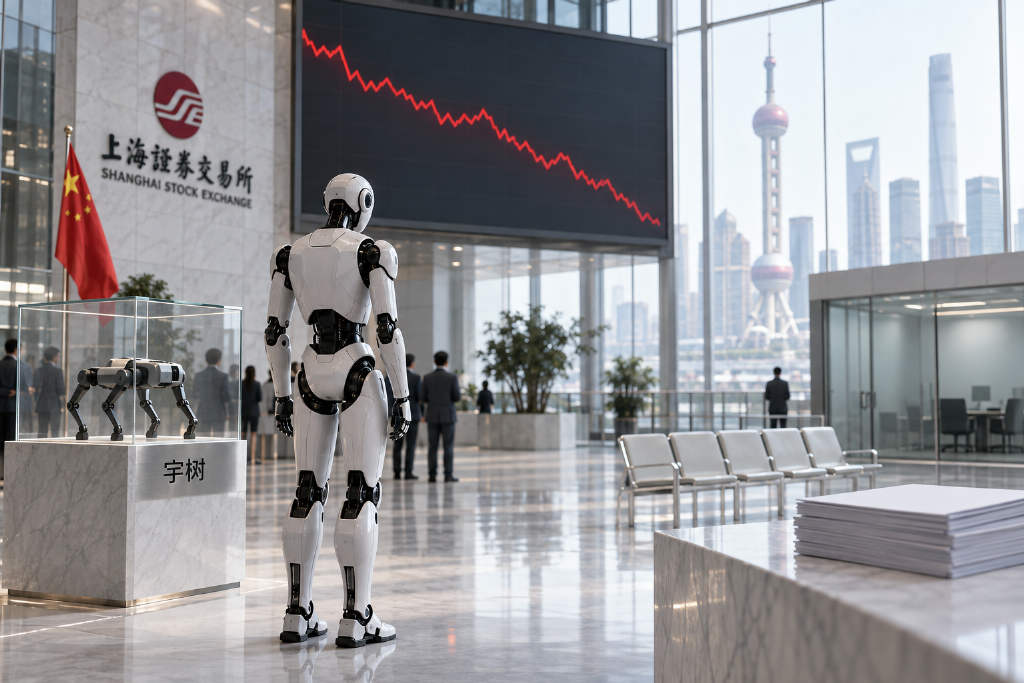
“After Unitree went public, we haven’t taken any embodied AI project to an investment committee meeting.” That is how one AI investor described the shift now spreading through the sector.
One month has passed since Unitree’s listing. After the frenzy on day one, the stock kept pulling back and has fallen by half from its peak. For embodied AI, the move has become a valuation mirror. Investor expectations have changed, and the financing mood has cooled.
An investor who backed an embodied AI unicorn valued at more than RMB 10 billion said there was no explicit internal order to stop investing, but the outcome of investment decisions shows activity has “basically stopped.”
The change has reached the IPO market as well. Outside the Hong Kong Stock Exchange, the queue of embodied AI companies has become hard to miss. Many are eager to get listed, but current conditions in Hong Kong have made the listing window feel far tighter. Companies are now facing two blunt questions: can they get a deal done, and if they do, will the stock break below issue price?
One month after Unitree’s debut
Over the past two years, primary-market valuations for embodied AI companies were built largely on technical vision, prototype capability, team background, and the scale of the sector narrative. That produced a group of unicorns with valuations running into the tens of billions of yuan. What investors did not have was a real domestic market benchmark for exit pricing.
That changed when Unitree reached the IPO market.
On Aug. 19, Unitree, founded seven years ago, officially listed on Shanghai’s STAR Market and became what the report called the A-share market’s first humanoid robot stock. Its issue price was RMB 150.80 per share. The stock jumped more than 500% at the open, and its market capitalization briefly exceeded RMB 440 billion. The path after that surprised many in the market. Unitree’s shares reversed quickly and lost half their value in just four days.
The market then began to reassess embodied AI. About half a month later, Mech-Mind listed in Hong Kong, becoming another robotics IPO after Unitree. Mech-Mind’s public offering was oversubscribed by more than 3,800 times, yet the stock still opened below its offer price.
Regulatory signals and pressure on the Hong Kong window
The industry is watching another variable even more closely: regulation.
In August this year, Li Chao, deputy director of the Policy Research Office of the National Development and Reform Commission, said the robotics industry must guard against blind follow-on investment and a rush of copycat activity. The Information then reported that regulators had issued informal “window guidance” to raise IPO approval thresholds for humanoid robot companies. Under that guidance, companies seeking a listing would need to show recurring revenue capability, a path of narrowing losses, or genuine technological innovation.
Hong Kong has also signaled possible rule changes. Hong Kong Chief Executive John Lee said the Hong Kong Stock Exchange will launch a consultation in the first half of next year on revisions to the specialist technology company listing regime under Chapter 18C, including a review of market-cap thresholds.
Yet a long line of embodied AI companies is already waiting outside that door. Zhiyuan Robotics, Galaxy General, Xinghaitu, Zhipingfang, Variable Robot, LimX Dynamics, and Cross Dimension Intelligence are among those in the queue. Most have valuations above RMB 10 billion, and some have crossed RMB 20 billion.
In the market’s view, A-share listing standards were already strict, and the route has become even narrower after Unitree. That made Hong Kong look like the more realistic exit path, especially because Chapter 18C has been relatively friendly to loss-making companies. Now, with a new round of rule revisions approaching, secondary-market pricing pulling back, and regulatory thresholds moving higher, the old idea of “list first, validate later” no longer looks like an easy default.
A dividing line for fundraising
The embodied AI boom had looked like a golden era. In the first half of this year alone, total financing in China’s embodied AI sector exceeded RMB 90 billion, five times the level seen in the same period of 2025.
In a normal cycle, companies move from angel rounds to Series A, growth-stage financing, and then private equity, with each round carrying its own valuation logic. In embodied AI, the speed of valuation expansion has been striking.
- Some early-stage projects had not even closed their first round before later rounds were already fully raised.
- Some companies opened three rounds at once, with different investors getting different valuation frameworks.
- In other cases, money had not yet been wired before the valuation had already risen fivefold.
- Stories of companies with revenue in the tens of millions of yuan being valued at $2 billion were common.
That changed after midyear.
After speaking with investors, the report says a broad view has emerged: Unitree’s listing marked a turning point for embodied AI. Investors are buying expectations, and valuations across the sector may need to be recalculated.
The most visible shift is this: investment firms are still looking at many projects, but they are not pushing them forward. Meetings continue. Formal approvals and deal closings have become much rarer.
One financial adviser put it more bluntly: “We stopped signing new embodied AI projects months ago.” The reason, in that adviser’s view, is simple. Institutions found that many of the milestones companies had promised early on were still not delivered, while each new financing round brought little more than updated rankings and awards.
When capital is abundant and consensus is strong, rankings and prizes can help open the door to the next round. Once sentiment cools, that kind of soft progress no longer supports lofty valuations.
Investors are refocusing on technology and cash generation
Xia Zhijin, managing partner at Vertex Ventures China, said earlier at the 2026 SuperLink conference hosted by PEdaily that there is not yet a huge technical gap between embodied AI companies valued at more than RMB 10 billion and startup teams. “The only thing that may count as a barrier is the financing barrier. Some people raised more money, or hope to build a long-term barrier that way, but that barrier may not hold,” he said.
Several investors also warned that follow-on fundraising is getting harder and the risk of down-round pressure is rising. Many companies still have cash from previous rounds sitting on their balance sheets. In their view, the real financing pressure may show up in a concentrated way after November this year.
That does not mean venture capital and private equity have shut the door on embodied AI.
Xu Xiao, founding partner and chairman of Orient Jiafu, said, “Our view is still to embrace it actively.” He argued that many foundational technologies in the sector have not yet converged, and waiting on the sidelines could mean missing a large opportunity. “The AI wave has only just begun. Pretending to be rational may be worse than being overly optimistic.”
Xia said the market is still in a stage where many approaches are being tried and no technical route has been settled. Lu Yuanxing, a partner at NIO Capital, also said it will take time to see whether the thousands of embodied robotics companies in the market can create real value, but the sector still has sustained investment value over the next five to 10 years.
Capital may move upstream
Based on the views of several investors, capital is likely to flow more heavily into upstream components and foundational technologies, including joints, dexterous hands, controllers, and world models. At the same time, the need to find real cash-generating use cases is becoming more urgent, and the room for trial and error is shrinking.
Xu offered a warning to portfolio companies: “No matter which path you take, in the end it has to be handed to users. I tell the companies we invest in not to talk about how great they are. Put the product in front of customers and test it there. In the end, customers pay the bill, not investors.”
Differentiation inside the sector now looks unavoidable.
Looking back at previous boom-and-bust cycles in venture capital, mid-tier players are often the first to feel the cold. One recent market story concerns an embodied AI company in Shenzhen valued at RMB 4 billion. It had planned to raise a new round at an RMB 8 billion valuation, but after a series of factors forced an adjustment, the company changed the structure of the deal. On paper the valuation was not cut, yet once secondary shares were bundled in, the effective valuation dropped to about RMB 6 billion.
“Don’t get hung up on valuation. Get the money in.”
Against that backdrop, investor advice to founders has become more practical.
Da Chen’s Xiao Bing said years ago that speed matters more than valuation in fundraising: “When you are raising money, speed is more important than valuation. Don’t get hung up on whether the valuation is 10% higher or 10% lower. Getting the money in quickly may matter more.” The report says that advice still fits the current moment. Founders need to be mentally prepared and manage financing timing carefully.
A managing director at a Shenzhen VC fund gave a similar warning: “The embodied AI sector has entered a buyer’s market. If you already have a clear financing intention, prioritize getting the deal done. Don’t overfocus on the headline valuation on paper. First secure a cash cushion large enough to support two to three years of R&D and operations.”
In the view of many investors, reality matters more than paper valuations. “None of us is as good as we think we are. Survival matters most.”
The article closes by citing Charles Darwin’s well-known line from On the Origin of Species: the species that survive are not the strongest or the most intelligent, but those most responsive to change.
For embodied AI companies still trying to raise money and reach the IPO market, staying at the table comes first. Only then do they have a chance to wait for the next window.
The original article was published by the WeChat account PEdaily (ID: pedaily2012) and written by Zhou Jiali.