
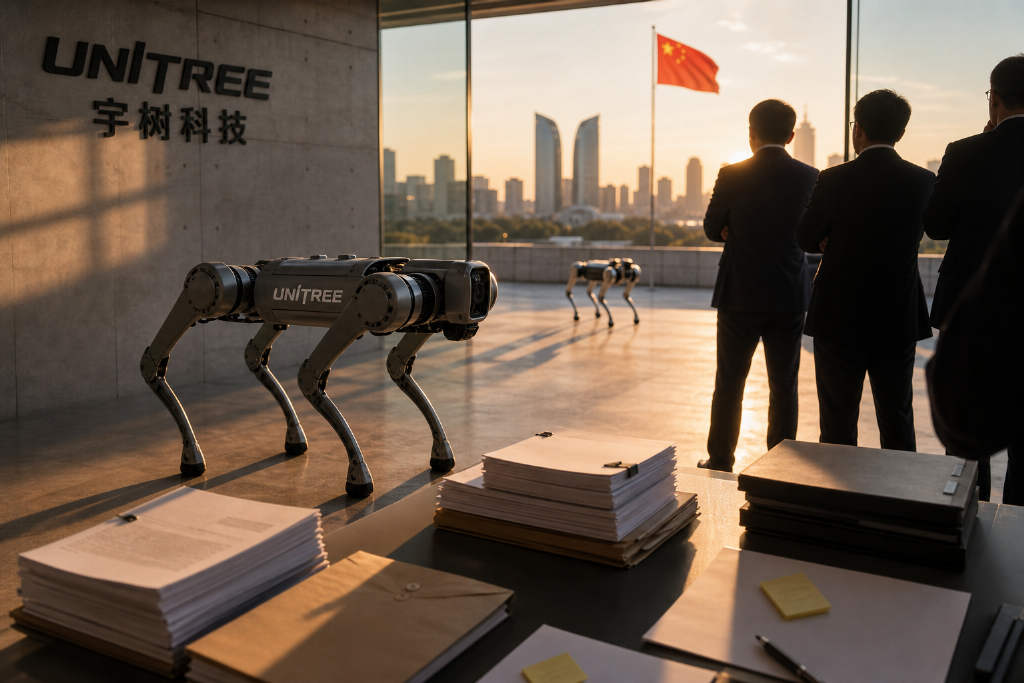
Unitree Robotics spent seven years moving from a question investors once struggled to answer — what exactly is a robot dog for? — to a new one: who can still get an allocation in the company.
A feature published by PANews, based on reporting by Zhang Yihao and Chen Zhiyan for elsewhere, reconstructs that funding story through old WeChat records, investment memos, photos and videos provided by some of Unitree’s investors. The article was framed as an online exhibition released around the company’s IPO moment.
In 2018, founder Wang Xingxing secured a RMB 2 million investment from Variables Capital, a fund under GeekPark. The report says that was Unitree’s first institutional round and the second investment in the company after Yin Fangming. At the time, Wang looked like an unlikely venture-backed founder: not a PhD from a top university, no overseas background, and no senior operating role at a major tech company. The product focus — quadruped robots — was also still a niche area with no widely agreed market narrative.
When funding nearly ran out, Wang at one point used his own money to pay salaries. The article says fundraising did not come easily before Unitree’s robot dog appeared on the Year of the Ox Spring Festival Gala in 2021 and before the company pushed the price of Go1 down to RMB 16,000. Before the 2024 Lunar New Year, Unitree closed a B2 round that brought in investors including Meituan, Jinshi Investment and Source Code Capital. That marked the shift from a non-consensus bet to what the article calls a consensus company in China’s primary market.
How Sequoia first found Unitree
In July 2019, Li Yannan, then an analyst at Sequoia China’s seed fund, heard about Unitree from a Zhejiang University alumnus. Unitree’s website listed only a QQ email address. Li used that email to trace Wang’s WeChat account and sent a friend request. Three days later, he made his first visit to the company.
Li still keeps footage from July 21, 2019, when Wang showed him AlienGo during that first visit. A month later, Li and Cao Xi, then a partner at Sequoia China’s seed fund, brought Unitree to the investment committee. Before the meeting, Wang proposed taking an A1 robot dog to Beijing for a live demo, saying it could fit inside a 20-inch suitcase.
The battery was over the transport limit, so the robot could not go by plane or high-speed rail. Wang instead took a sleeper train from Hangzhou to Beijing, a trip of more than 10 hours, and returned the same way after the demo. Before the committee meeting, the report says, Wang asked Li: 「方便带个狗子过去吗?」
Li later found that Wang always wanted to show the product whenever he had a chance. For several years, Wang proactively offered to bring robot dogs to Sequoia’s CEO summit and LP events. One year there was no booth space on site, so he waited outside the venue with the machine.
An 8 from Cao Xi
When Sequoia partners scored Unitree internally, Cao Xi gave the company an 8, the highest score among the group. The article notes that, according to a previous video podcast description by Sequoia Yuan, an 8 meant the firm definitely wanted to invest.
One line in an investment memo stood out: 「很喜欢这个人」.
Early investor descriptions of Wang
One VC’s internal assessment described Wang this way: 「严重偏科,13岁就自己学习代码和研究机械,大学开发出第一台机器人,应该算不是科班出身里的典型outlier。暂时没有发现特别的不足,和人交流上还是会有一些自己坚持的沟通方式,但也不一定是坏事,总体影响不大。」
The report also says the writers found Wang’s master’s thesis, along with investment materials from different institutions across several stages of Unitree’s development.
What Unitree looked like in 2020
Materials from Chuxin Capital’s March 2020 investment committee meeting recorded a small but profitable business. Unitree had 18 employees, about 70% of them in technical roles. Revenue for 2019 was RMB 11.8282 million, net margin was 26.5%, and R&D spending accounted for 41%.
The customer list was split into domestic and international accounts. On the domestic side, there were 30 customers, most of them university and research institute labs. Overseas, there were 12 customers, including Google, Nvidia, Apple and Android creator Andy Rubin.
At the time, the report says, comparable products from Boston Dynamics were still being rented out for nearly $10,000 a month, while Unitree’s Laikago was priced at RMB 20,000 to RMB 30,000. After comparing similar products, Chuxin Capital concluded that Unitree’s strengths were motion performance, the highest system integration, the lowest cost, and clear product positioning with a defined customer base.
A 12-question hiring test
The article also details Wang’s approach to recruiting in the early days. Every candidate had to complete a written 12-question test, including applicants for front desk roles. Beyond professional skills, some questions were unusual. Two examples cited in the story were: 「最近的几百年,人类显著的科技进步都诞生于西方,你认为是什么原因导致的?」 and 「你怎么看待和评价中医?」
The writers also said they found a visual spot-the-difference question that had been part of the test set.
Distinct stages in the funding story
The article breaks Unitree’s financing into several phases. In the company’s earliest stage, it first received a RMB 2 million seed investment from Yin Fangming, then brought in angel money from Variables Capital, Anchuang Technology and Binhe Investment, primarily to support quadruped prototype development and commercialization work.
After 2019, firms including Sequoia China, Vertex Ventures China, Shunwei Capital, Chuxin Capital and Matrix Partners China came in one after another, as Unitree moved from technical validation toward commercial expansion. After 2024, growth-stage investors saw both change and continuity in the company.
In mid-2024, Photosynthesis Ventures got a chance to invest at a RMB 3.5 billion valuation. The report says that figure appeared in an investment memo written in the notes app of partner Zhu Jia.
Source Code Capital left one especially concrete observation at the end of 2023. Unitree’s robot dog training ground was on the roof, and the machines had to climb the stairs from the office every day. After enough climbs and enough falls, the stair edges had been chipped away in places. Debris was cleaned up, but the stairs were not specially renovated. They were simply swept and used again.
Huang Yungang, managing partner at Source Code Capital, said: 「从这个细节里看到的,是一支仍将主要精力投入产品测试和研发迭代的团队。」 He added: 「兴兴是个极度克制的创业者,不盲目投入,即便后来宇树火了,有了更多资源后,在战略上也是尽可能的先把硬件和小脑做好。」
Jinqiu Fund, which tracked Unitree from 2020 to 2025, said what stood out was the company’s extreme focus. According to the article, what truly convinced the fund was that Unitree was effectively No. 1 in market share. 「80%的paper都是基于宇树本体发的,非常大的生态优势。」 Another technical view cited in the piece was that reinforcement learning-based motion control introduced a critical variable.
The report also says Wang discussed the meaning of the name Unitree and his habit of watching anime in his spare time during one closed-door session with Jinqiu Fund.
Photos and moments investors kept
In November 2021, Matrix Partners China managing partner Wang Huadong bought a Go1 himself while conducting due diligence on Unitree. He said: 「我可能是国内最早的几个买 Go1 的个人消费者。」 One of the photos in the story shows his children examining the robot after delivery.
In the second half of 2018, when Unitree formally began shipping Laikago, it had already sold hundreds of units overseas. The report says that later, when Vertex Ventures China helped connect the company with overseas clients, Wang introduced the specific parts of G1, described in the story as the 「铁甲拳王」.
Zhu Jia of Photosynthesis Ventures kept an R1 in the office. From pre-order to delivery, the wait took nearly half a year. When it arrived, the two shook hands.
On April 16, 2025, G1 stood with Snow King to welcome guests at Meituan Longzhu’s investor annual meeting. The article says Unitree and Mixue represented two signature projects for Longzhu in technology and consumer sectors, and investors found the pairing amusing enough to keep a photo of them together.
Cao Xi, founding partner of Monolith, placed two Unitree products at the entrances of the firm’s Shanghai and Beijing offices: a G1 dressed as a reception robot in Monolith workwear and a bow tie, and a robotic bull named 「牛犇犇」. The story says Wang gave 「牛犇犇」 to Cao as a commemorative gift after Unitree’s robot dog first appeared on the Spring Festival Gala in 2021.
The piece closes with one final link in the timeline. 「牛犇犇」 was modified from the A1 platform — the same model that had once been packed into a suitcase and carried by sleeper train to Beijing for that 2019 demo.
The cover image source is listed as Vittore Carpaccio, Letter Rack (verso), 1490–1495, J. Paul Getty Museum.