
Unitree Robotics is making a formal move into venture investing.
On Oct. 28, Unitree and Sequoia China announced the launch of the "Shanyu Venture Initiative," a program aimed at identifying and investing in early-stage startups working on embodied intelligence, robotics applications, key upstream and downstream technologies, and other frontier hard-tech fields. The two sides said the initiative is meant to act as an "entrepreneurial partner" for founders.
The announcement marks Unitree’s first systematic investment layout. It also brings together what the article describes as a deep partnership between engineers and investors. Seven years after Sequoia China first backed Wang Xingxing when he was still little known, the two are now investing together.
The new program focuses on early-stage founders
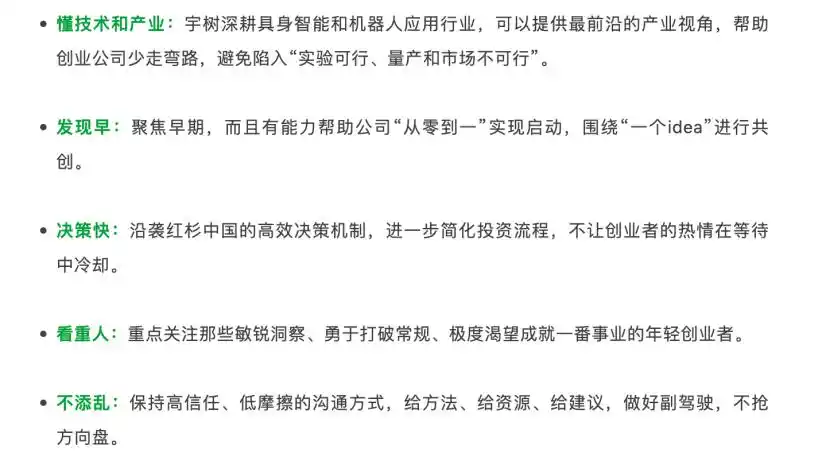
According to the article, the core strategy behind the Shanyu Venture Initiative has five parts: understanding technology and industry, discovering projects early, making decisions quickly, valuing people, and not creating unnecessary interference.
The program is focused on early-stage companies and places particular emphasis on young founders. Its stance is explicit: be a co-pilot, not the one grabbing the steering wheel.
Wang Xingxing said: "We use the dual perspective and collaborative approach of engineers and investors to discover more potentially high-quality entrepreneurs, help young teams take fewer detours, find product-market fit faster, and start the growth flywheel earlier — that is the original intention and foundation of the Shanyu Venture Initiative."
His interest in startup investing had already become visible last month. In mid-September, Unitree launched the "Yuchuang Plan," offering support to startup teams working on robotics industry application solutions, data and simulation platforms, robot bodies and core components, embodied intelligence algorithms, and global channels. The support package includes industrial capital, robot platforms, development tools, engineering mass production, and application scenarios.
Wang later said at the World Physical AI Conference that after a little more than one month, the plan had already collected more than 200 projects. Over the next five years, Unitree aims to incubate more than 200 high-quality ecosystem companies. In the article’s framing, that means Unitree is moving from selling robots to building an ecosystem.
Li Yannan, managing director at Sequoia China, described the partnership as a "double guarantee": Unitree contributes cutting-edge industry knowledge and engineering guidance, while Sequoia China provides full-chain capital support and professional post-investment services.
A relationship built over years
The trust behind the new partnership goes back seven years.
In 2019, a 29-year-old Wang Xingxing traveled to Beijing with a robot dog that, in his own words, could run and jump but whose broader use was still unclear. Because high-speed rail would not allow him to carry a high-energy battery, he spent more than 10 hours getting there by conventional train before presenting at Sequoia’s investment committee meeting. At the time, Unitree had just been stood up by an industrial investment fund, and its cash balance was close to running out.
Sequoia Seed approved the deal on the spot and issued an investment term sheet. Its first investment was RMB 15 million in Unitree’s Pre-A round. It later continued to back the company in the Pre-A+, B, and C rounds.
Before Unitree’s listing, Sequoia held about 7.11% of the company, making it the independent private equity fund with the largest stake.
Since Unitree listed on Shanghai’s STAR Market on Aug. 19 and became what the article calls the "first A-share humanoid robot stock," its share price has swung sharply and then climbed again in recent trading. On Oct. 28, the stock closed at RMB 695.9, giving the company a market capitalization of RMB 281.5 billion. That was more than 70% above its Oct. 16 low.
Even so, the two sides have not disclosed the size of the new program, how capital will be contributed, which investment entity will be used, or the specific decision-making mechanism. For now, the article says, it looks more like a cooperation framework and a recruitment portal, though the direction is already clear.
Embodied intelligence companies are increasingly becoming investors
Unitree is not alone.
The article points to AgiBot as an earlier example. Starting in 2024, AgiBot launched its "Venture A Plan," described as China’s first innovation and entrepreneurship acceleration program focused on the embodied intelligence supply chain. In April this year, AgiBot founder, chairman and CEO Deng Taihua said the company had invested in more than 20 businesses over the previous year and a half, and that the average annualized valuation growth of those portfolio companies had reached 17x. The article says that number of investments has now doubled, with direct investments spanning most of the supply chain.
One notable case came in November last year, when the early-stage fund "Lingzhi Xinchuang," jointly set up by Hillhouse and AgiBot, came into view. The fund is managed by Zhuhai Hillhouse and focuses on making early, small investments across the embodied intelligence supply chain. Hillhouse Venture Capital was also the lead investor in AgiBot’s seed round.
There are more examples.
In June this year, Xinghaitu and Cathay Capital announced the "Xingtu Plan," an industrial investment ecosystem program that aims to invest a total of RMB 1 billion over five years into 100 early-stage embodied intelligence projects. The plan covers components, data, algorithms, and application scenarios. Xinghaitu is contributing both capital and industrial resources, while Cathay Capital is providing investment, post-investment, and capital-market expertise.
Earlier, when humanoid intelligence company Current Robotics disclosed its financing for the first time, Xinghaitu appeared among the investors.
Zibianliang has also taken stakes in Juxie Intelligence and Moxian Technology, betting respectively on integrated joints/harmonic reducers and flexible tactile sensors, two hardware links tied to perception and execution. It also joined AgiBot, Mifeng Technology and others in backing Kaiwang Data as part of a push into the robotics data supply chain.
Galaxy General has invested in projects including Lanyue Power and Yixing Robot. It also co-incubated Boyin Hechuang with Boyuan Capital, focusing on dexterous robot development for industrial assembly and quality inspection scenarios. The article describes its overall pace as relatively cautious.
Zhifang and Zhuji Dynamics have also made outside investments.
DeepSeek has also appeared in the sector’s investment flow
The article says DeepSeek has recently surfaced through two investments: one involving former Tencent scientist Hu Han, and another involving embodied technology researcher Yu Tao. Both founders are building companies in embodied intelligence.
Quoting information obtained by PEdaily from people familiar with the matter, the article says DeepSeek’s completed and planned investments in embodied intelligence go beyond those two deals. After Yan Wentao joined, DS is expected to make more moves in the primary market.
A new phase for industrial capital
The article’s broader argument is that embodied intelligence is an unusually hard-tech field. For early-stage teams, the biggest shortage is often not money alone, but supply chains, mass-production experience, and access to real-world deployment scenarios. Those are exactly the capabilities complete-machine manufacturers have built through years of engineering work, often at significant cost.
In that framing, financial capital is better at solving the jump from 0 to 1, while industrial capital is better positioned to help companies move from 1 to 100.
The investment community, the article says, has largely accepted that investments by leading industry companies can create industrial synergies and speed up the development of portfolio companies in ways traditional venture capital firms cannot naturally match.
That matters even more now because financing for embodied intelligence in the primary market has gradually cooled in the second half of this year, while VC and PE firms have become more cautious and industrial giants have started to move further.
Over the past decade, the dominant narrative in China’s hard-tech market was that venture capital helped build companies like Unitree. Now, companies like Unitree are launching plans and setting up funds of their own, pulling entire supply chains into their ecosystems. Former portfolio companies are becoming capital providers, and companies once supported by investors are starting to support others.
The article compares this shift to the starting point of internet giants’ CVC activity two decades ago, except that this time the leading role belongs to a new generation of manufacturing companies.
This article was originally published by the WeChat account "PEdaily" (ID: pedaily2012) and written by Yang Jiyun.



