
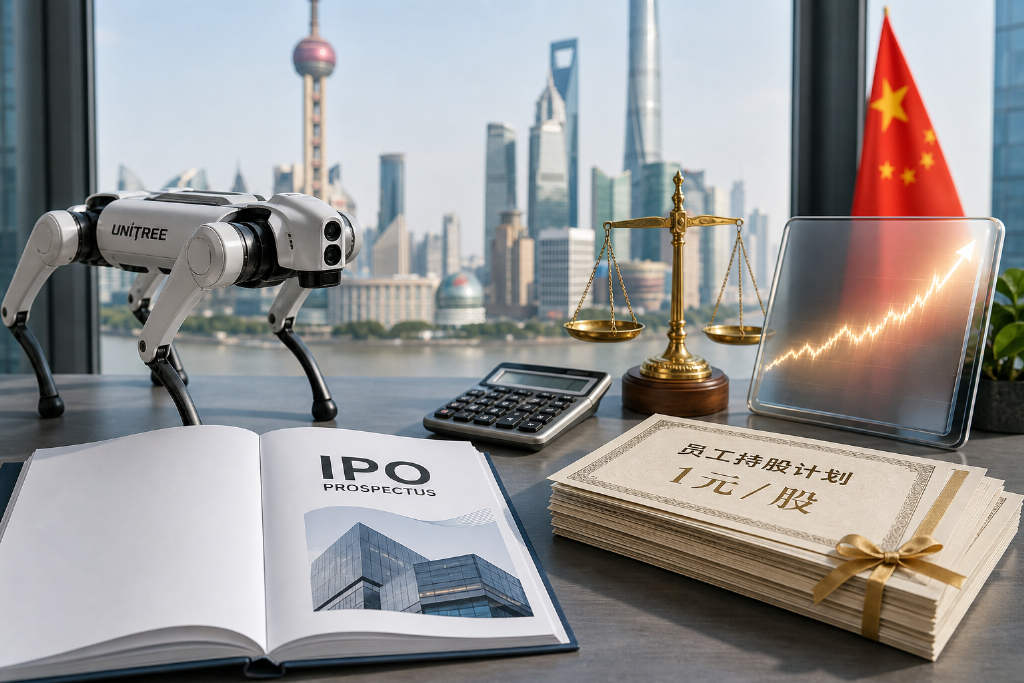
Unitree Technology made its debut on Shanghai’s STAR Market on Aug. 19, opening 629% higher at RMB 1,100. Its market capitalization briefly climbed to RMB 444.9 billion, and the source article said a retail investor who won one IPO allotment was sitting on roughly RMB 470,000 in floating profit.

Most of the first-day attention centered on the scale of wealth created by the listing. The original report said founder Wang Xingxing’s net worth reached RMB 133.5 billion. Shunwei Capital was described as holding floating gains of RMB 15.2 billion from its earlier investment, Meituan-linked entities as the largest outside shareholder with more than RMB 33.3 billion in floating gains, and Liang Wenfeng’s DeepSeek and High-Flyer as booking RMB 1.1 billion from IPO participation.
But the part of the story that sits closer to ordinary employees was found in the prospectus, through an entity called Shanghai Yuyi. Despite not carrying the Unitree name, Shanghai Yuyi is the company’s employee equity incentive platform and holds 10.94% of Unitree Technology. The article said the batch of options granted in 2017, when the company was unable to pay wages on time, was housed there. At the first-day market price cited by the report, the largest paper fortune among those option holders reached RMB 1.58 billion.
Shanghai Yuyi sits at the center of the employee incentive structure
The prospectus shows Shanghai Yuyi is a limited partnership. Employees do not directly own Unitree shares. Instead, they hold interests in the partnership and gain indirect exposure through that structure.
At the top of the partner list are three core employees born in the 1990s.
- Yang Zhiyu, head of mechanical structure, was born in 1991, studied mechanical engineering and automation at Zhejiang University, and joined in 2016 when the company was founded. The report said he indirectly holds about 1.7837 million shares. Based on the first-day peak price referenced in the article, his paper wealth reached about RMB 1.58 billion.
- Chen Li, head of the sales and service system, was born in 1990 and holds about 946,400 shares, giving him paper wealth of about RMB 840 million.
- Zhang Yangguang, head of algorithms and software, was born in 1993 and studied automation at Nankai University. The article said he led development of a function that directly generates motion programs from video, which was used in the robot yangko performance “Yang BOT” aired during CCTV’s 2025 Spring Festival Gala. He holds about 546,000 shares, worth about RMB 480 million on paper.
Shanghai Yuyi itself has only six direct partners: Wang Xingxing, Chen Li, Yang Zhiyu, one executive partner, and two other partnerships named Hangzhou Yixin and Hangzhou Yiyi. Most employees do not appear at that level.
The reason, according to the article, is that a limited partnership can have no more than 50 partners. To accommodate a broader staff incentive pool, Unitree added two upper-layer holding vehicles, Hangzhou Yixin and Hangzhou Yiyi, creating a three-tier structure of Shanghai Yuyi, Yixin and Yiyi, and then employees below them.
That is where the larger group of ordinary staff appears. More than 60 front-line R&D supervisors and core technical employees were allocated stakes ranging from 0.01% to 0.05%, the report said. Based on Unitree’s first-day closing market value of RMB 358 billion, their paper wealth ranged from about RMB 35 million to RMB 170 million.

The first option grants were signed when the company was short of cash in 2017
The story goes back to 2017, Unitree’s second year, when its financing had been used up and wages could not be paid.
The article cited Tian Jiangchuan of Chuxin Capital, who met Wang Xingxing in November that year, spoke with him at length, but did not invest. Tian later said his internal note from the time used four Chinese characters meaning “grassroots background.” Three years later, Chuxin Capital invested at a valuation four times higher, and Tian later attributed his earlier mistake to what he called 「elitist arrogance」.
During that early period without fresh capital, Wang stopped taking his own salary and paid employees out of pocket, according to the report. In September 2017, the company signed its first stock option agreements with 17 founding core employees including Yang Zhiyu, at an exercise price of RMB 1 per unit of registered capital. Over the following years, Unitree carried out multiple rounds of equity incentives and eventually consolidated them under Shanghai Yuyi.
Using the issue price of RMB 150.80, the article said those options were already up more than 150x. Using the opening price of RMB 1,100, the gain exceeded 1,000x. The report also cited Li Yannan of Sequoia China as saying Wang’s core management team is still the same group from the startup phase and that not one of them has left.
Another 171 employees joined through strategic placement plans
Unitree’s IPO included a broader employee participation mechanism beyond the early option pool.
The company set up two employee asset management plans, with a combined 171 executives and core employees subscribing RMB 272 million in total. Plan No. 1 involved 161 people and, according to the article, consisted mainly of front-line R&D engineers, each subscribing between RMB 1 million and RMB 4 million.
Plan No. 2 had only 10 participants and carries a 36-month lock-up period. Wang subscribed RMB 15 million, the largest amount among participants. Zhang Yangguang, Yang Zhiyu and another R&D leader, Wu Jinze, each invested RMB 9 million.
As of the end of 2025, Unitree had 516 employees. The article described that ratio this way: roughly one out of every three employees had put money behind the company through the listing.

More grants may come later, but monetizing them is far from immediate
The Shanghai Yuyi story does not end with the listing.
According to the article, the upper-layer partnership interests in Shanghai Yuyi held by Wang will all be used for employee equity incentives in the future, and Wang himself will not be among the recipients. During the two natural years following the company’s first 36 months as a listed company, at least 50% of those interests are to be granted.
The report highlighted another detail in the related incentive entities: 99.68% of Hangzhou Yixin is currently held by Wang and has not yet been distributed to others. In the article’s reading, that nearly empty vehicle leaves room for future grants.
Even so, the wealth shown on paper is not easy to realize. Shares held through the Shanghai Yuyi platform are locked up for 36 months, and later grants are tied to annual performance reviews. If performance requirements are not met, the corresponding incentive interests may not vest. Before the prospectus signing date, nine employees who had received grants had already left the company, and their incentive interests were canceled.
The RMB 272 million subscribed through the strategic placement plans is also subject to lock-up restrictions. Plan No. 1 is locked for 12 months, while Plan No. 2 is locked for 36 months. If the stock falls below the issue price during that period, those positions would show floating losses.
The original article added that no one can guarantee what price the market will be willing to pay for Unitree in six months, one year or three years after listing. For employees, questions around when to take profit, whether they can wait that long, and how they would eventually realize those gains remain unresolved.
Still, the timeline in the report is clear. In the autumn of 2017, when Unitree could not pay wages, some young employees chose to stay and tied themselves to the company at RMB 1 per share. By the time of the IPO, those holdings had risen more than 150x based on the issue price.