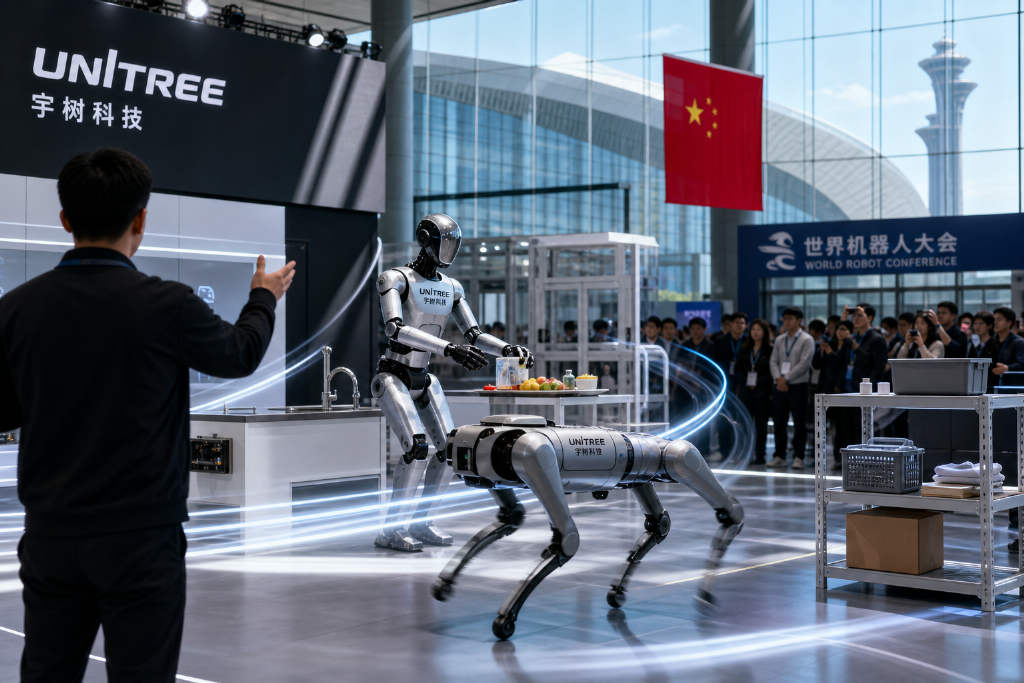
Unitree founder Wang Xingxing gives first public speech after listing, sees robot industry inflection point in 2 to 10 years

Unitree founder Wang Xingxing gives first public speech after listing, sees robot industry inflection point in 2 to 10 years

N
News Editor
2026-08-20 04:53:00
Unitree founder Wang Xingxing delivered his first public speech after the company’s listing at the 2026 World Robot Conference. He said the robot industry’s breakout point could come when robots can complete 80% of tasks in 80% of unfamiliar scenarios through voice commands, adding that the timing could be as soon as 2 to 3 years or as late as 5 to 10 years. Wang said the main bottleneck is the lack of alignment between AI model inputs and outputs and the real world, noting that small errors of just a few centimeters can sharply reduce success rates. He also described a new development direction at Unitree: letting large AI models write code, run simulations, test on real machines and grade the results on their own, creating a self-improving loop that could lift development efficiency at an exponential pace. He also looked back on Unitree’s 10-year history, including its Spring Festival Gala performance, the 49-robot formation at the Temple of Heaven, and a 12.65 m/s speed breakthrough.

Wang Xingxing makes his first public speech after Unitree’s listing

Unitree founder Wang Xingxing spoke publicly for the first time after the company went public, using the 2026 World Robot Conference to lay out his latest view on where the robot industry is headed. He said the sector’s inflection point will arrive when robots can complete 80% of tasks in 80% of unfamiliar scenarios through voice commands. In his view, that could happen in as little as 2 to 3 years, or take 5 to 10 years.

Wang said the biggest bottleneck today is the lack of precision in aligning AI model input and output with the physical world. Robots can carry out tasks in broad terms, but errors of just a few centimeters or even millimeters cannot be corrected, which drags down success rates. He contrasted that with language models, which he described as lossless, while noting that robots accumulate deviations every time they take in and send out information.

Unitree wants large models to run the development loop

To address that problem, Unitree is pushing a new direction: having large AI models write code, run simulations, test on real machines and score the results on their own. Wang said that would create a self-improving cycle, and that development efficiency would rise exponentially as foundational model capabilities improve.

A look back at Unitree’s 10-year milestones

Wang also revisited several milestones in Unitree’s 10-year history, including its Spring Festival Gala performance, the 49-robot formation at the Temple of Heaven, and a 12.65 m/s speed breakthrough.

This article was originally published by Bit.Fan. For more cryptocurrency news and market insights, visit www.bit.fan.
60

Disclaimer:

The market information, project data, and third-party content displayed on this platform are for industry information sharing only and do not constitute any form of investment advice or return commitment.

Cryptocurrency trading carries high risks. Users should fully assess their risk tolerance and make independent decisions. All profits, losses, and legal responsibilities are borne by the users themselves.