
Upbit is trying to claw back lost ground in South Korea’s stablecoin market with a fee holiday and a burst of new listings, but the early data points to a familiar problem: volume can be bought for a while, market share is harder to hold.

From July 26 to Aug. 9, Upbit waived its 0.05% trading fee for stablecoins listed in the won market. In the same week, it also added dollar stablecoins including RLUSD and USDG. The goal was straightforward — pull more stablecoin trading onto the platform.
The article, written by c4lvin and translated by Chopper for Foresight News, argues that this was Upbit’s first concentrated rollout of multiple stablecoin-related measures in a very short period, even though the exchange had listed stablecoins before.
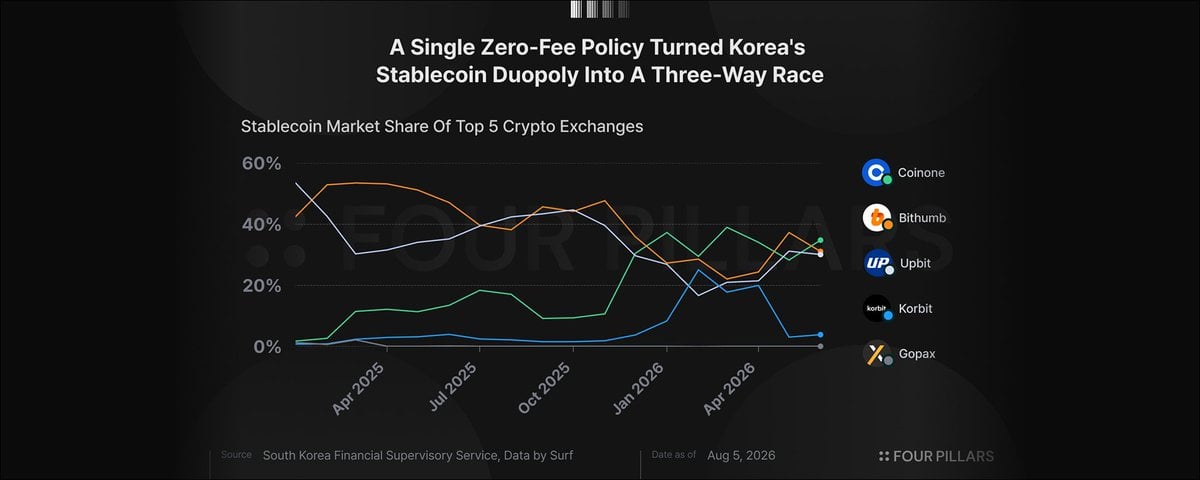
South Korea’s stablecoin market has been redrawn
In January 2025, South Korea’s stablecoin trading market was largely a two-player contest. Upbit held 53.5%, while Bithumb had 42.5%, giving the pair more than 95% combined.
Eighteen months later, that structure had changed. As of June 2026, Coinone ranked first with average daily stablecoin trading volume of KRW 84.58 billion and a 34.8% market share. Bithumb followed with KRW 75.57 billion and 31.1%, while Upbit posted KRW 73.02 billion and 30.1%.
The report traces the shift to Coinone’s decision to remove USDC trading fees across the board starting in October 2025. At the time, rival exchanges were still charging between 0.04% and 0.20%. Coinone’s market share rose to 11.5% in March 2025, then climbed to 30.5% in December, when it overtook Upbit’s 29.7% for the first time.
According to the article, the users most sensitive to fees fall into two broad groups: those moving funds offshore to trade derivatives on overseas exchanges, and those seeking gains from the dollar exchange rate. Stablecoins are functionally interchangeable across platforms, and many buyers withdraw them to outside wallets after purchase. That leaves fees and liquidity as the core points of competition. Even a 0.05 percentage-point gap can change the league table.
The reshuffle has been concentrated in stablecoins rather than the full crypto market. In June 2026, Upbit still held 60.0% of all crypto trading, Bithumb had 32.0%, and Coinone was at 6.2%. The article’s point is blunt: stablecoins have become Upbit’s clearest weak spot in a market where it otherwise remains dominant.
The market is shrinking, but stablecoins still matter
The pool itself is getting smaller. In July 2026, the five major South Korean exchanges recorded average daily stablecoin trading volume of $466.69 million, down 80.3% from $2.37 billion in January.
Dunamu, Upbit’s parent company, reported KRW 234.6 billion in revenue for the first quarter of 2026, down 55% year over year. Operating profit fell 78% to KRW 88 billion.
Against that backdrop, the report says sectors less exposed to the bull-bear cycle and backed by more persistent demand carry more strategic value than they would in a stronger market. Stablecoins fall into that group.
Stablecoins have become a key channel for outbound capital
The article says the clearest way to understand stablecoin demand in Korea is to track where the money goes after users buy.
In June 2026 alone, KRW 2.7625 trillion in stablecoins was withdrawn from the five major Korean exchanges to overseas exchanges. Stablecoin inflows from overseas back into Korea totaled KRW 2.2022 trillion, leaving net outflows of KRW 560.3 billion.

Since regulators began compiling that data in January 2025, net outflows have been recorded every month for 18 straight months. The cumulative total has reached about KRW 14.9 trillion.
The article compares that pattern with the stock market. In the second quarter of 2026, Korean investors were net sellers of overseas stocks by KRW 1.6185 trillion, while stablecoin net outflows reached KRW 1.6872 trillion. Overseas equity flows can reverse and come back home as market conditions change. Stablecoins, the report notes, have kept showing net outflows even during weaker market periods.
That supports the view that stablecoins now function as a transfer rail for capital moving to overseas exchanges and DeFi. The report adds that this role was not native to the Korean market. Won-based stablecoin pairs arrived late, and among the five major exchanges, Upbit was the last to launch a KRW market for USDT, doing so only in 2024.
Before that, users who wanted to move money to offshore venues had to buy volatile assets such as BTC or XRP and transfer those instead, taking on price risk in the process. Once won-based stablecoin pairs became available, stablecoins quickly took over that cross-border function.
The Financial Supervisory Service began separately tracking stablecoin cross-border transfer data in January 2025. The article treats that as a sign that regulators themselves already see stablecoins as a main tool for cross-border capital movement. It also notes that USDT’s global trading volume had exceeded Bitcoin’s as early as 2019, while Korea effectively compressed that adoption path into the period after 2024 because local won pairs came later.
Upbit’s promotion worked quickly, but almost all of the gain came from USDT
The immediate results were clear. In the 30 days before the promotion, Upbit’s average daily stablecoin trading volume stood at KRW 46.96 billion. After the campaign began, the figure rose 162.0% to KRW 123.06 billion. Looking only at weekdays, average daily volume increased 170%, from KRW 55.03 billion to KRW 148.69 billion.
The response showed up almost at once. On July 25, the day before the promotion started, trading volume was KRW 29.95 billion. On July 26, the launch day, volume reached KRW 72.19 billion despite falling on a Sunday. On July 27, the first weekday of the campaign, it climbed to KRW 162.27 billion, and on July 29 it hit a peak of KRW 203.29 billion.
Still, the article highlights three points that matter more than the headline jump.
Nearly all of the extra volume came from USDT
Average daily USDT trading volume rose from KRW 46.06 billion to KRW 120.71 billion. Its share of Upbit’s total stablecoin turnover stayed at 98.1%, almost unchanged before and after the promotion.
RLUSD, which was listed during the campaign, averaged KRW 710 million per day. USDG averaged KRW 340 million. Together they contributed only about 1% of the overall increase. RLUSD traded KRW 5.6 billion on its listing day, then quickly fell back to around KRW 100 million a day. USDG showed the same pattern, starting with KRW 2.24 billion on day one before shrinking fast.
Long-tail stablecoins including USD1, USDS and USDE, as well as gold-linked asset XAUT, were flat or lower even with zero trading fees. The conclusion in the report is direct: Upbit’s latest expansion strategy did not redirect USDT trading into a broader stablecoin basket.
The promotion was already losing momentum in week two
Average daily trading volume came in at KRW 148.65 billion during the first week, then dropped to KRW 84.68 billion in the second. On a weekday-only basis, volume fell 33%, from KRW 163.944 billion to KRW 110.58 billion. The pattern looks like a typical early surge followed by a quick cooldown.

Exchange-rate moves likely helped lift demand
The Korean won strengthened in July. On Upbit, the price of USDT fell from KRW 1,517 on June 26 to KRW 1,423 on Aug. 4. The late-July decline overlapped with the fee campaign. The report says exchange-rate volatility itself can create arbitrage and dip-buying demand, so not all of the volume increase should be credited to zero fees.
That leads to the article’s central judgment on the campaign. Once the promotion ends and fees return, Upbit may struggle to keep the share it temporarily captured. As long as Coinone’s permanent zero-fee model remains in place, Upbit faces a basic choice: match it with a lasting fee waiver for stablecoins, or preserve fee income and give up market share.
Why regulation may be the real reason behind the push
The report argues that Upbit likely understands the limits of the current approach. Fee waivers can create a short-term spike, and multiple fresh listings have not changed the concentration around USDT.
By the article’s estimate, Upbit gave up about KRW 1 billion in fee revenue over the past 15 days. That raises the question: why spend resources on a lower-margin business and voluntarily forgo fees?
The first clue is the policy backdrop. South Korea’s government has formally included legislation for the Digital Asset Basic Act in its 2026 economic growth strategy, with plans to push the bill in the second half of the year. The proposal is expected to include a licensing regime for won-backed stablecoin issuance, reserve asset requirements and users’ redemption rights.
The article also points to the U.S. GENIUS Act, which it says is expected to be fully implemented between late 2026 and early 2027. That, in its view, could trigger another round of global adoption for dollar stablecoins.
The second clue is a corporate one. In November 2025, Naver Financial approved a share-swap plan to make Dunamu a wholly owned subsidiary. The two sides said stablecoins and digital wallets would be a central part of a broader payments ecosystem they hope to build together.
From that angle, Upbit’s stablecoin trading volume, liquidity and user base are not just sources of transaction fee income. They could also become distribution infrastructure for future payments products. Expanding that base now would carry strategic value.
The third point is the tension inside the regulatory framework. Under the existing Act on Reporting and Use of Specific Financial Transaction Information and the Virtual Asset User Protection Act, virtual asset service providers are not allowed to trade assets issued by affiliated parties.
After Dunamu was folded into the Naver group, one possible interpretation is that if a Naver-led consortium later issues a won stablecoin, Upbit could be restricted from listing it. If the exchange cannot be certain it will host a domestic won stablecoin in the future, then the opportunity it can pursue right now is clearer: become the main distribution hub for dollar stablecoins in South Korea.
Seen through that lens, the fee waiver and rapid-fire listings look less like a simple promotion and more like a defensive move to secure position before the rules harden.