
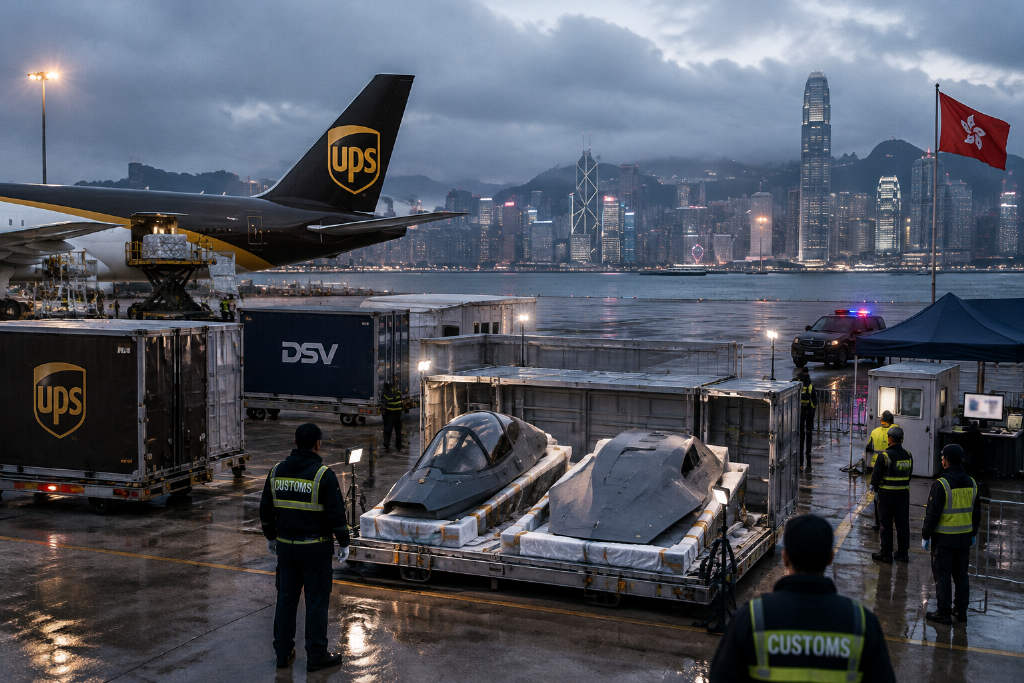
Two F-35 parts coated with radar-absorbent material were mistakenly sent through Hong Kong and later obtained by Chinese authorities after a UPS employee failed to notice an export-control warning from freight forwarder DSV A/S, according to Bloomberg reporter Anthony Capaccio, who cited a person briefed by the Pentagon.
The warning said the shipment could not transit certain countries in order to comply with the International Traffic in Arms Regulations, or ITAR.
The route changed after the shipment left Australia late
Capaccio reported that the cargo was originally supposed to leave Australia and travel to San Francisco through South Korea and Taiwan, both U.S. defense partners. But when it departed Australia in late May, it was already behind schedule. The shipment was then mistakenly rerouted through Hong Kong to speed up delivery.
The two components came from a Royal Australian Air Force F-35A. They were a canopy and a weapons-bay door, both covered with radar-absorbent material. The parts were being sent back to the United States for evaluation, repair, or disposal.
Hong Kong falls under the same U.S. export-control treatment as mainland China
Since 2020, the United States has no longer treated Hong Kong separately from mainland China for export-control purposes. That is why ITAR transit restrictions also apply to Hong Kong.
DSV, the Danish freight forwarder acting on behalf of F-35 developer Lockheed Martin, included the ITAR notice in its communication as required under U.S. rules. The person cited by Bloomberg said the warning may have been sent through a separate information platform, not the one used by the UPS staff handling the shipment.
The case surfaced publicly in September
Politico first reported in September that the parts had been routed to Hong Kong. On Sept. 22, Australian Deputy Prime Minister and Defense Minister Richard Marles confirmed the incident and said that, to his knowledge, the shipment did not contain sensitive equipment or sensitive parts.
On Sept. 23, Bloomberg reported for the first time that Chinese authorities had obtained the parts and had not returned them. Xi Jinping arrived in Washington that same day for a state visit. China’s Foreign Ministry had earlier said it was not aware of the matter.
The Pentagon distanced itself as Congress pressed for answers
Bloomberg said the Pentagon publicly distanced itself from the shipment and downplayed the value of the parts, calling them "unserviceable." U.S. Transportation Command said it "was not involved in the transportation or coordination" of the cargo.
In a statement, the Defense Department said: "We are actively working with U.S. authorities and industry partners to recover these parts, investigate the incident, and put protective measures in place to prevent this from happening again."
Questions quickly followed on Capitol Hill. Senate Intelligence Committee Vice Chair Mark Warner asked the Pentagon for a briefing. Committee Chair Senator Tom Cotton sent a letter on Sept. 29 calling for a review of the military supply chain, including chain-of-custody rules for contractors and commercial freight carriers, real-time cargo location tracking, approval and notification procedures for route changes, standards governing transit through foreign jurisdictions, and mechanisms to stop military items from reaching China.
Senator Kevin Cramer, the North Dakota Republican leading a military subcommittee review of the case, posed a more direct question: "Did China have a plan from the beginning to intercept this shipment?"
The person briefed on the matter also said compliance officials from the State Department’s Directorate of Defense Trade Controls, or DDTC, attended the briefing. The office, which enforces export-control rules, is investigating the transit incident.
"Unserviceable" does not mean worthless for intelligence purposes
The Pentagon’s description of the parts as "unserviceable" refers to whether they can be put back on an aircraft. Bloomberg drew a distinction between that and intelligence value. Maurer said the radar-absorbent material on the canopy and weapons-bay door is exactly the kind of thing China could study through reverse engineering. The parts may no longer be flightworthy, but they can still be examined.
Capaccio also noted that the F-35 is the world’s most advanced fighter jet and has long been an intelligence target for China.
A prior Honeywell settlement offers one point of comparison
Bloomberg referenced a 2021 case involving Honeywell, which reached a $13 million administrative settlement with the U.S. State Department over allegations that it had exported controlled technical data without authorization in violation of ITAR. The matter had been self-disclosed.
In this case, the DDTC investigation will likely end with a financial settlement and compliance improvements, the report said, though the political pressure is greater because the shipment involved F-35 parts.