
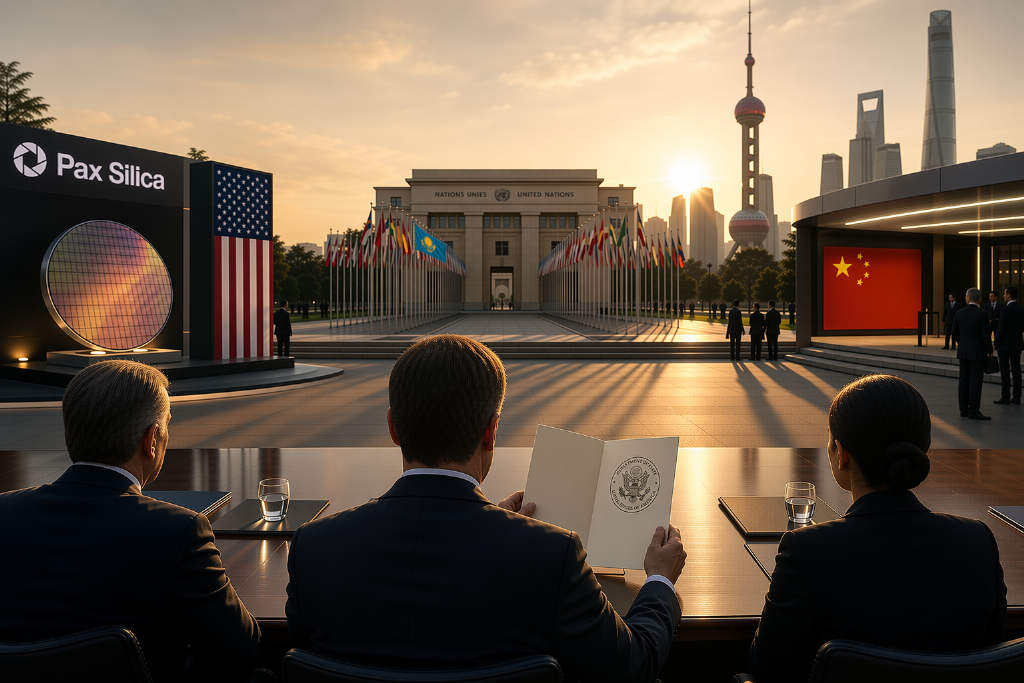
Washington is preparing to tell 35 countries that they may have to choose between a U.S.-backed AI bloc and a competing framework led by Beijing, according to a U.S. State Department draft letter reviewed by Reuters.
The draft is addressed to the 35 signatories of the AI Opportunity Statement signed in June. It warns that countries joining a rival AI framework backed by China could be shut out of the U.S.-led system. The text is blunt. It says, 「If you join everything, you join nothing. Signing the Pax Silica declaration is not merely paying a membership fee, but a commitment.」 It adds that the commitment 「cannot coexist with duplicative initiatives that expect commitments conflicting with ours」 and urges governments to 「choose carefully.」 Reuters said the draft never explicitly names China.
Draft not yet sent
Reuters reported that the letter has not been formally delivered to foreign governments. The draft carries no date, and it is not clear when Washington plans to send it or whether the wording will change before it goes out. The State Department said it would not comment on what it described as a leaked internal document. The Chinese embassy in Washington and Kazakhstan's embassy in Washington did not immediately respond.
An unnamed U.S. official quoted by Reuters made the message plain: countries cannot align with both camps. The official said, 「It is hard to imagine a country can credibly position itself as a trusted partner in one technology ecosystem while simultaneously signing onto an initiative designed by China to advance a competing AI vision.」
The framework in question is WAICO
While the draft avoids naming China, Reuters said the target is the World Artificial Intelligence Cooperation Organization, or WAICO. The intergovernmental body was established in Shanghai on July 16 by 29 countries. Chinese Foreign Minister Wang Yi signed on behalf of China, the organization is headquartered in Shanghai, and U.N. Secretary-General António Guterres attended the signing ceremony.
Reuters described WAICO as promoting open-weight models and pitching itself to countries in the Global South. China is also offering AI training and cooperation centers to developing countries, presenting the ability to run models domestically as part of that package.
Pax Silica ties AI to supply chains
The U.S. answer is Pax Silica. Reuters said the name echoes Pax Americana and was launched in December 2025 by Jacob Helberg, the State Department's under secretary overseeing economic affairs. The initiative covers critical minerals, energy inputs, advanced manufacturing, semiconductors and AI infrastructure. Its purpose is to bind allied supply chains more closely together and reduce reliance on what the report called adversaries.
After a Washington summit in June, Pax Silica added 10 new signatories, bringing the total to 24. Reuters said members can access co-investment opportunities tied to AI projects. It also said the State Department has used resources from 270 overseas missions in a pilot effort to help accelerate procurement of U.S.-made AI hardware for participating countries.
By contrast, countries that signed the AI Opportunity Statement had, according to the State Department's own website, only symbolically agreed to a shared purpose and shared vision. The draft letter would raise that symbolic endorsement into something far more exclusive.
Kazakhstan is the only overlap
Reuters compared the official lists and found that only one country appears in both camps: Kazakhstan.
WAICO's 29 founding members include Russia, Iran, Belarus, Cuba, Venezuela, Myanmar, Pakistan, Indonesia, Brazil, Malaysia and South Africa, according to the report. The 35 AI Opportunity Statement signatories are concentrated in Europe, East Asia, the Gulf and Latin America, with Japan, South Korea, Singapore, the Philippines, India, the Netherlands, Germany and the United Kingdom among them.
Reuters said Kazakhstan was also a country Washington had showcased at its June summit. The State Department had highlighted it as the first Central Asian country to join Pax Silica and pointed to its large reserves of critical minerals needed for advanced technologies. Less than a month later, the same country appeared in Shanghai at the WAICO signing ceremony.
Taiwan is outside the 35-country letter list
For Taiwan, Reuters noted a separate track. Taiwan is not among the 35 intended recipients of the letter, and it is not listed among the 24 Pax Silica signatories.
Instead, Reuters said the American Institute in Taiwan and Taiwan's representative office in Washington, TECRO, signed a Joint Statement on the Pax Silica Declaration and U.S.-Taiwan Economic Security Cooperation on Jan. 27. In the outcome document from the June summit, the State Department specifically said Taiwan had endorsed the principles of the Pax Silica declaration through that joint statement. Taiwan also sent representatives to the Washington summit in June.
The draft letter, as described by Reuters, shows the U.S. trying to stop the 35 June signatories from straddling two AI cooperation systems at the same time.