
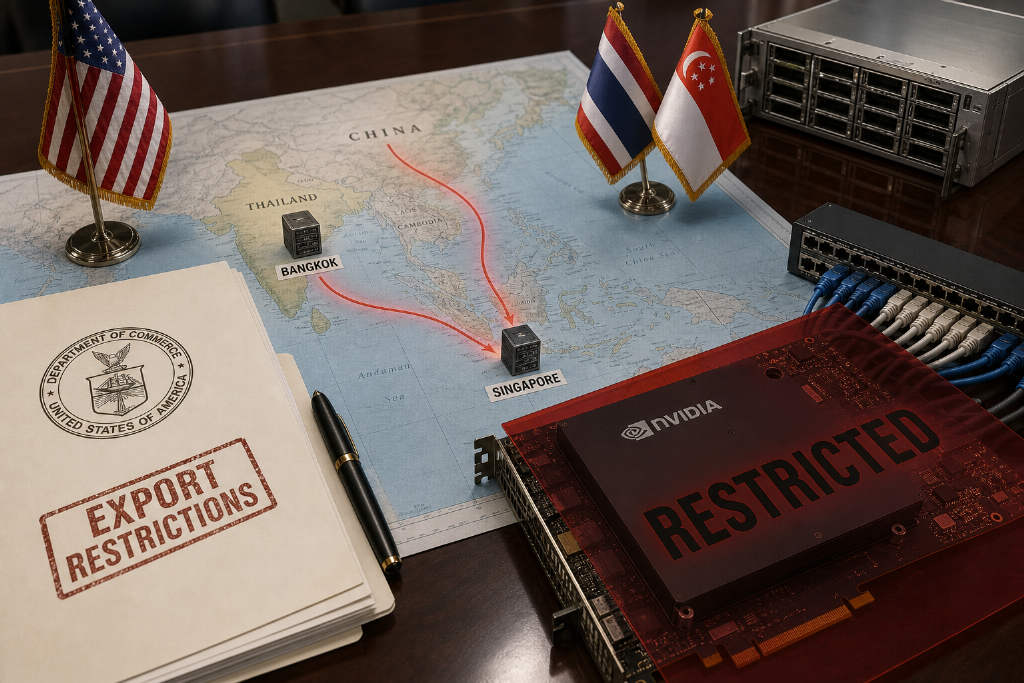
The Trump administration is drafting new AI export control rules to stop China from accessing U.S. chip compute by renting cloud servers in third countries such as Thailand and Singapore, according to The Information. The U.S. Commerce Department could send a draft rule to industry groups for comment as early as September.
Current rules focus on physical exports, not rented remote access
Existing export controls are largely based on rules issued in 2022. They cover advanced AI chips as well as advanced semiconductor manufacturing equipment, including EUV lithography tools. Those rules were built around a straightforward case: chips leaving the United States in physical form and being sold across borders into China.
That leaves a gray area when the chips stay inside data centers in third countries such as Thailand or Singapore and Chinese users rent cloud access to run models on them remotely.
The AI Diffusion Rule introduced at the end of the Biden administration was meant to narrow that gap through a tiered licensing system. But it was overturned in early 2025, and the Commerce Department said it would not enforce it during the transition period. In March this year, the department floated another tiered licensing framework, then withdrew it a little more than a week later after pushback from the U.S. AI industry.
Kimi K3 dispute helped trigger the latest push
The report says a key trigger for the latest rulemaking effort was Moonshot AI’s Kimi K3 model. In July, Michael Kratsios, director of the White House Office of Science and Technology Policy, wrote on X that Moonshot had used servers in Thailand equipped with Nvidia chips to distill U.S. models to train Kimi K3. He specifically named Anthropic’s Fable.
Kratsios also alleged that Moonshot built an internal platform for large-scale distillation across multiple U.S. models at the same time and could switch quickly between different methods.
Legal authority may become the central problem
Writing a rule and enforcing it are separate matters. A lawyer at Baker McKenzie told The Information that it is "widely believed" the Commerce Department does not have clear statutory authority to directly regulate remote access. The department has traditionally regulated the shipment of physical goods, not the person logging into a server from the other side of a screen. Once a formal rule is issued, the report says, a legal challenge is all but certain.
In practice, that means the White House could approve a new restriction while the Commerce Department still lacks a direct legal tool to reach a server sitting in a Bangkok or Singapore data center and available for remote login.
KYC checks are another option
The report says the department is not without alternatives. One possible route is KYC checks, requiring cloud providers to verify a customer’s identity and intended use before login, shifting the control point from goods crossing a border to access at the account level.
The Foundry Due Diligence Rule introduced near the end of the Biden administration was designed to use that mechanism to close the loophole, but the Trump administration has also said it will not enforce that rule.