
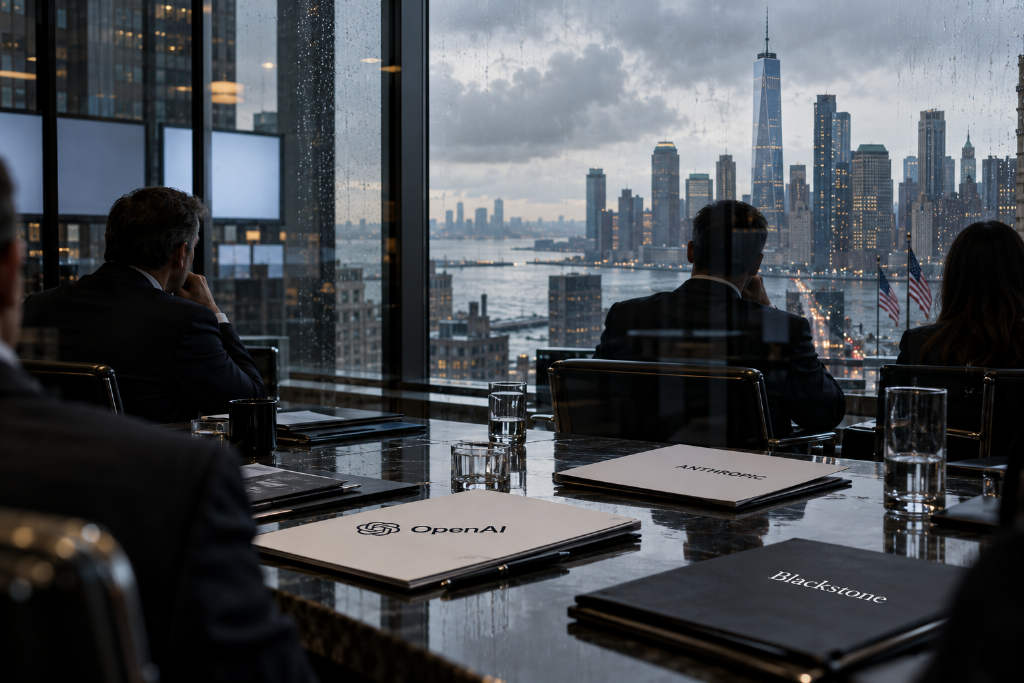
Cheap money is getting harder to find for the U.S. artificial intelligence business after years when AI companies pulled in hundreds of billions of dollars with barely a fight from Wall Street.
This week, two of the hottest names in the sector hit resistance in capital markets. Blackstone told investors Anthropic is now more likely to land a rating in the BB range or above after its IPO, instead of the investment-grade rating it had expected before. OpenAI, for its part, cut its latest fundraising target to about $20 billion from $30 billion.
Both point to the same change: the money is still there, but it is not cheap anymore. And it is not easy.
Dan Ivascyn, chief investment officer at Pacific Investment Management Co. (Pimco), said: "The hurdle for proving to lenders that these investments can turn into enough revenue is getting higher... and the weakest links will get hit first." He said the bar for proving to lenders that these investments can generate enough revenue is rising, and the weakest links will be hit first.
Capital is still flowing, but investors now hold the leverage
Since ChatGPT showed up, AI companies have tapped almost every big funding source out there: venture capital, public equities, bank loans, bonds and private credit.
Bank of America says AI-related issuance across U.S. corporate debt markets came to $394 billion in 2025 and had reached $655 billion by mid-October this year. Analysts think that number could get close to $1 trillion next year.
The appetite for capital keeps climbing, but investors are getting pickier. Their worries come down to three things:
- rising resistance to data centers in several regions, which could slow big projects;
- doubts about whether AI profits at hyperscalers and startups such as Anthropic and OpenAI will show up as fast as promised;
- the sheer amount of stock and bond issuance, which has left investors heavily exposed to the AI trade.
You can see the harder terms all over the market. Bonds sold by large technology companies such as SpaceX and Meta are trading at deep discounts. AI cloud companies including CoreWeave, Nebius and Nscale, which depend on debt to build computing capacity, have in effect been pushed out of the bond market in recent weeks. Even Broadcom has had to give banks sweeter terms to lock in financing.
Anthropic faces a lower rating outlook and narrower funding channels
Anthropic is the latest case. The company plans to raise as much as $100 billion in an IPO in mid-November and said in its prospectus that it expects to invest more than $800 billion in compute infrastructure by 2045.
According to the Financial Times, Blackstone recently told investors that guidance from major rating agencies points to Anthropic being more likely to receive a rating in the BB range or above after listing. Blackstone had earlier expected the company to win an investment-grade rating before year-end.
Under S&P and Fitch frameworks, BBB- and above counts as investment grade, while BB+ and below is speculative grade, often called junk. A rating in that band would shrink Anthropic’s borrowing options and push up its funding costs, because many insurers and pension funds are limited in how much junk-rated debt they can hold.
Broadcom’s $63 billion chip leasing deal with Anthropic also got done in a tense backdrop. The Wall Street Journal reported that Broadcom chief executive Hock Tan joined the negotiations late in the process to calm banks. More than $42 billion of senior loans in the deal depended on Broadcom’s high A-category rating for support.
Anthropic also flagged financing constraints among power suppliers as a risk factor in its prospectus. So even if the company can raise money on its own, projects could still get disrupted if suppliers cannot.
OpenAI cuts its target as some investors wait on the sidelines
OpenAI is under similar pressure. The Financial Times reported that the company cut its fundraising target to about $20 billion and reduced its valuation to $1.25 trillion from $1.4 trillion.
The Wall Street Journal, citing people familiar with the matter, said OpenAI has raised less than half of its original $30 billion target so far. Some investors cut their orders. Others want to wait until after Anthropic’s listing before deciding.
The strongest companies with better credit can still raise cash, but the market’s patience is wearing thin.
This week, weak earnings from technology companies sparked selling in AI-linked stocks and bonds. Alphabet lost about $500 billion in market value on Thursday, the biggest drop in its history. Intel sank 29% on Friday. The Nasdaq Composite fell 2.9% on Friday in one of the biggest selloffs since the AI boom started in U.S. equities.
If that volatility sticks around, financing conditions will probably get harsher.
Neocloud companies are being hit first
The first pressure is landing where you would expect: on the weakest credits.
One of the busiest groups in AI debt markets is the so-called neocloud sector. These companies own or lease data centers, install AI servers, and sell computing capacity to big technology firms, trading companies and AI startups.
A lot of neocloud operators started out as cryptocurrency mining businesses. Their history running AI infrastructure is short. And their borrowing costs were already high before the latest market shakeout, which makes them especially exposed to higher rates.
The turn came in September. The Federal Reserve raised rates for the first time in three years. Oracle, pointing to power supply and permitting problems, told the developer of a large data center in New Mexico that it would delay the start of full rent payments. After that, lenders started rethinking construction risk across projects.
CoreWeave bonds sold earlier this year came with a 9.75% coupon. Their yield in the secondary market has now moved above 15%. Falling bond prices and rising yields mean the company’s borrowing costs have jumped in a very short time. Bankers have warned in recent weeks that the high-yield market is basically shut for new neocloud issuance, and yields above 15% just do not work for borrowers.
Nebius has sold about $2.7 billion in stock to investors including Nvidia since 2024 and has also issued billions of dollars in convertible debt, yet it still has not filled its funding needs. It looked at issuing its first high-yield bond, then scrapped the idea and switched to customer prepayments instead.
Chief executive Arkady Volozh said in Berlin last week that some funding channels, including asset-backed securities and bond markets, may be temporarily closed, but tools like customer prepayments are probably enough to let the company build at least 1 gigawatt of capacity. Chief operating officer Ophir Nave said the asset-backed financing market remains open.
Equity financing has gotten tougher too. People familiar with the matter said Lambda tried to raise $4 billion in its final pre-IPO round, but after investors including Coatue decided not to join, it cut its target valuation to $13 billion from $14.5 billion.
UK-based neocloud company Nscale had been weighing a November listing and is now leaning toward pushing it back to December. It is also talking with investors including Nvidia to secure funding support for Anthropic’s $45 billion data center in West Virginia. After market conditions changed, investors demanded tougher terms, which slowed the company’s prospectus update. Some bankers have told Nscale its IPO is unlikely to hit the earlier $30 billion to $35 billion valuation target.
Even top-rated giants are running into investor limits
Meta, Amazon, Alphabet and Microsoft sit at the other end of the credit spectrum. They carry top ratings and still have borrowing room on their balance sheets. The problem is not credit quality. It is size.
These companies have already issued heavily in the investment-grade bond market this year, and they have said more borrowing is on the way. The investment firms, insurers and pension funds supplying the money are beginning to run into position limits and concentration concerns around a single sector.
Ivascyn put it this way: "The real question is, how full can investors get on one name and one theme?" The practical question, he said, is how full investors can get on one name and one theme.
On Friday, bonds of several hyperscalers fell to near record lows in price, with yields clearly above those of typical investment-grade corporate debt. So despite their top ratings, their borrowing costs have risen above those of ordinary investment-grade issuers.
Everyone is trying to get there first. Meta plans to raise as much as $97.5 billion through a series of new share offerings, partly because it wants to move before rivals do. In regulatory filings, the company said fundraising by other giants is a challenge to the market’s ability to absorb new supply.
Ben Connard, chief investment officer at Carnegie Investment Counsel, said: "Everyone wants to raise money for construction before liquidity dries up. In the end, there may not be enough money to support this whole buildout. Financing may become the final bottleneck that slows everything down." He said everyone wants to fund construction before liquidity dries up, but there may not be enough money to support the entire buildout, making financing the final bottleneck that slows everything down.
Why funding conditions matter more now
AI buildout is leaning more heavily on outside capital. Reuters’ analysis of LSEG consensus forecast data shows capital spending at Microsoft, Alphabet, Amazon, Meta and Oracle is expected to top free cash flow by 2027. For every additional $1 of operating cash flow, those companies are projected to add about $1.57 in capital expenditure. Put simply, internally generated cash no longer covers the expansion bill.
The biggest companies also do not have much room to pause. A research report from Cornell Capital Group described the setup as a prisoner’s dilemma: if one company pulls back while competitors keep spending, it risks being left behind.
Investor Citrini, speaking on the Monetary Matters podcast, said this shift has changed the nature of the risk. During the first three years of the AI trade, sentiment-driven declines had a floor because most spending came from hyperscalers’ operating cash flow.
Now the extra spending is coming mostly from equity and debt financing. If market sentiment sours, that extra capital can vanish, because the spending is no longer set only by a company’s own cash generation. It is set by the market.
He described the mechanism as reflexivity: confidence supports financing, financing supports investment, and once confidence weakens, tighter funding feeds back into investment and growth expectations. He also said AI revenue is currently growing at about 25% to 30% a year, while capital expenditure is rising at roughly 60% to 70%, and the gap keeps widening after each round of guidance.



