

Large U.S. banks are preparing a coordinated response to the rapid growth of stablecoin payments. After years of mostly watching from the sidelines, banks are now trying to build shared infrastructure of their own as stablecoins evolve from a niche crypto instrument into a payments network moving tens of trillions of dollars a year.

JPMorgan Chase, Bank of America, HSBC Holdings, Citigroup and Wells Fargo have recently unveiled a plan to create an interoperable tokenized bank deposit network. The idea is to digitize money held inside the commercial banking system and move it through blockchain-based payment rails, a model banks hope can slow the encroachment of digital dollars on their core payments business.
The report was written by Anna Irrera for Bloomberg and translated by Saoirse for Foresight News.
The Clearing House will run the initiative
The project will be operated by The Clearing House, or TCH, and is described as the first large-scale coordinated effort by the U.S. banking industry to answer the rise of stablecoins. Stablecoins are typically pegged to the U.S. dollar and can process payments and settlement around the clock, with use cases expanding well beyond their early role in crypto trading.
Tokenized bank deposits are digital representations of money already held within the commercial banking system. They can move through blockchain channels while retaining features tied to bank money, including interest-bearing deposits and deposit insurance protection. Banks see that as a way to combine parts of the stablecoin user experience with the structure of regulated banking.
The competitive threat is becoming harder for banks to ignore. More payment companies and financial institutions are turning to stablecoins for cheaper and faster money movement. Artemis Analytics said stablecoin transaction volume jumped 72% last year to roughly $33 trillion. Bloomberg Intelligence estimates stablecoin payment flows could exceed $50 trillion by 2030.
Zelle is the model banks are trying to repeat
The banking industry’s clearest reference point is Zelle. More than a decade ago, major banks joined forces to build a shared person-to-person payments network to counter fast-growing consumer apps such as Venmo. That project took years to prepare, but Zelle now processes more than $1 trillion in annual payment volume and stands as one of the industry’s most successful examples of defending itself against outside challengers.
Whether banks can repeat that outcome is far from certain. The market is moving quickly, and dozens of institutions that normally compete with one another would need to align on technical standards, governance and commercial incentives. Financial industry consortiums often stall because participants move at different speeds and do not always want the same thing.
“These are the same banks that have spent the past decade announcing various blockchain projects,” Alessandro Hatami, managing partner at fintech consultancy Pacemakers.io and former head of digital payments at Lloyds Bank, said in the report. “Banks compete with one another, and building shared infrastructure is difficult in itself.”
Policy shifts have accelerated Wall Street’s tokenization push
According to the report, regulation became more accommodating during the Trump administration, giving Wall Street room to press ahead with tokenization strategies. U.S. policymakers see dollar-linked tokens as tools that can reinforce the dollar’s global position while also supporting demand for U.S. Treasuries.

The U.S. passed the GENIUS Act last year, creating a full regulatory framework for stablecoins. That has shifted the policy debate toward market rules and a separate question that matters greatly to banks: whether stablecoin issuers should be allowed to offer yield or rewards. If that door opens, bank deposits could face sharper outflows.
“The threat is now visible and measurable,” Nicole Sandler, chief ecosystem officer at tokenized clearing startup Ubyx, said in the report. “Banks are increasingly seeing customers choose stablecoins for fund transfers. That is very different from the distant, abstract risk they used to talk about.”
Interoperability is the main goal
Banks have been testing blockchain-based payment systems for years, both individually and through joint efforts. JPMorgan, Citi and Bank of New York Mellon are among the institutions that have already launched their own blockchain payment platforms to support around-the-clock transfers for clients.
Those in-house systems offer some of the same traits as stablecoins, while preserving benefits attached to commercial bank money. Their reach, though, is usually limited to customers within the same bank. Stablecoins do not face that constraint and can be sent globally regardless of where a user banks.
One of The Clearing House’s main objectives is to make different digital money systems interoperable, which would greatly expand the network’s reach and transaction capacity.
“Interoperability, scalability and simplicity for clients are critical,” Debopama Sen, head of payments for Citi Services, said in the report. “Many of our large clients operate globally and bank with more than one institution.”
The Clearing House plans to connect financial institutions that collectively manage trillions of dollars in deposits and serve tens of millions of customers. The report says the resulting network would be larger in scale and broader in coverage than the stablecoin market today.
Christopher Ward, head of enterprise payments at Truist Financial, said the logic is similar to the one used when the U.S. built real-time payment systems: agree on common rules and drive broad adoption across the market.
The Clearing House has long operated industry networks and has experience balancing the interests of community banks, regional lenders, multinational banks and foreign institutions operating in the U.S. The project is scheduled to launch next year.
“Building shared industry infrastructure is in our DNA,” Elena Casal, chief client officer at The Clearing House, said in the report. “We already have mature governance and compliance processes, and that can help the project move faster.”
Casal said demand is concentrated in wholesale payments, especially corporate treasury management and liquidity movement. The network could also provide digital cash for the clearing and settlement of tokenized securities, supporting the development of tokenized capital markets. The Clearing House is selecting technology providers and is leaving room for the network to expand so it can support stablecoin settlement in the future if needed.
A crowded field with several parallel projects
The Clearing House may have a strong starting point, but bank-led digital money is already a crowded field. Many similar efforts began a decade ago, and several banks are participating in multiple projects at once. That can leave the sector fragmented rather than aligned.
Last week, SWIFT said more than 17 banks were preparing to pilot cross-border tokenized payments on its new distributed ledger system. Separately, Goldman Sachs, Deutsche Bank, Bank of America and Banco Santander formed a consortium late last year to develop a stablecoin-like digital currency.
Manish Kohli, HSBC’s head of global payments solutions, said platforms built by upgrading existing systems have better odds than projects created from scratch. Referring to The Clearing House plan, he said it benefits from existing infrastructure, a stable member base and a clear domestic use case in the U.S., which lowers execution risk. HSBC is also involved in other initiatives, including the SWIFT pilot, the U.K. Tokenized Deposit Initiative and Hong Kong’s Ensemble project.
Banks have scale and compliance, but move slowly
Banks come into this race with huge balance sheets and deep regulatory credentials. Their long-standing weakness is speed. The report points to Zelle again: development took years, and without pressure from rivals such as Venmo, it might not have gained traction in the same way. Even when the technology was ready, member banks still argued over the product name.
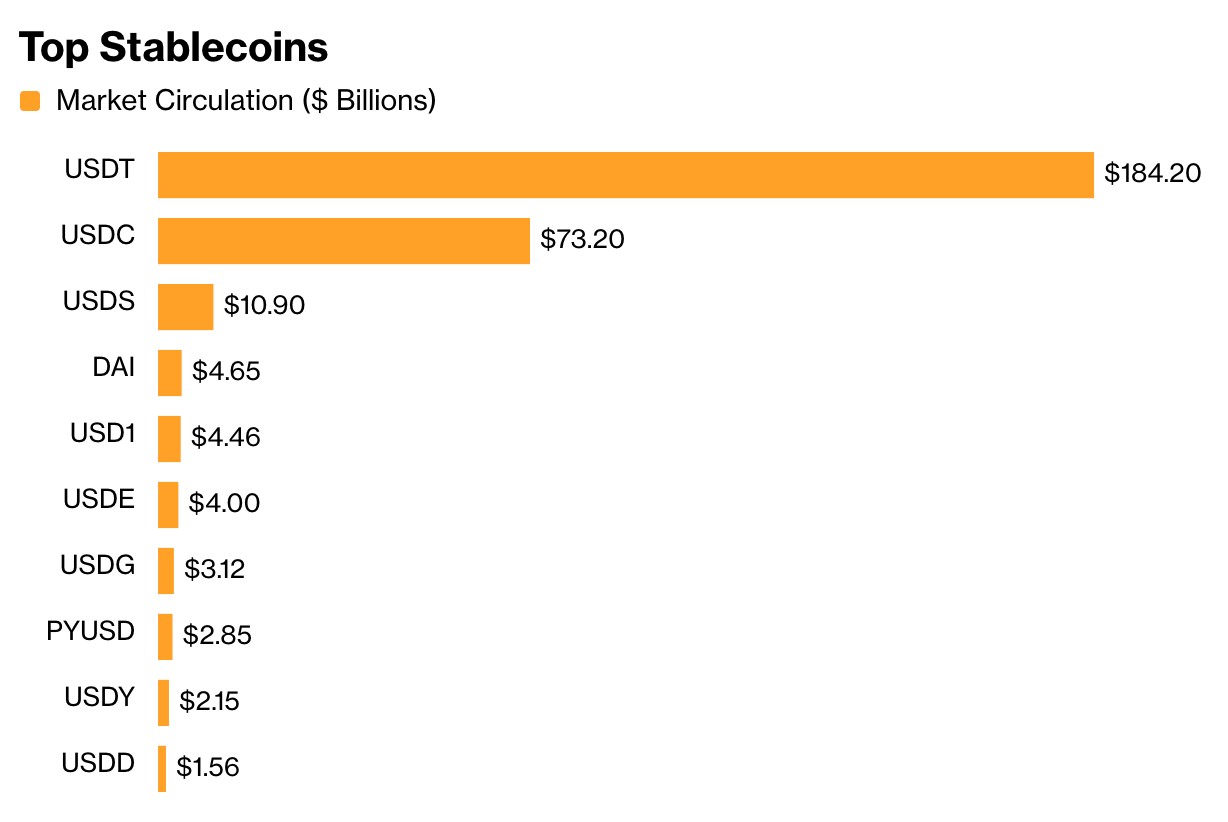
Legacy payment companies have also found the shift difficult. PayPal launched its stablecoin PYUSD in August 2023, but adoption remains limited, with circulation at just $2.9 billion. That is small next to the leading issuers: Tether’s USDT has a circulating supply of about $184 billion, while Circle’s USDC stands at $73 billion.
By that measure, major stablecoin issuers do not have immediate reason to panic. Banks, for their part, may not need to rush for a first-mover edge either. The report notes that many of the largest and most profitable corporate clients in bank payments do not yet have an urgent need for programmable dollars.
“Banks may appear slow, but once they decide to move, they can mobilize enormous resources,” Marieke Flament, co-founder of digital currency consultancy Currency of Power, said in the report. “Crypto moves very quickly, and whether banks can keep pace remains a major challenge.”
Reporters Paige Smith, Olga Kharif and Yizhu Wang contributed to the reporting.