
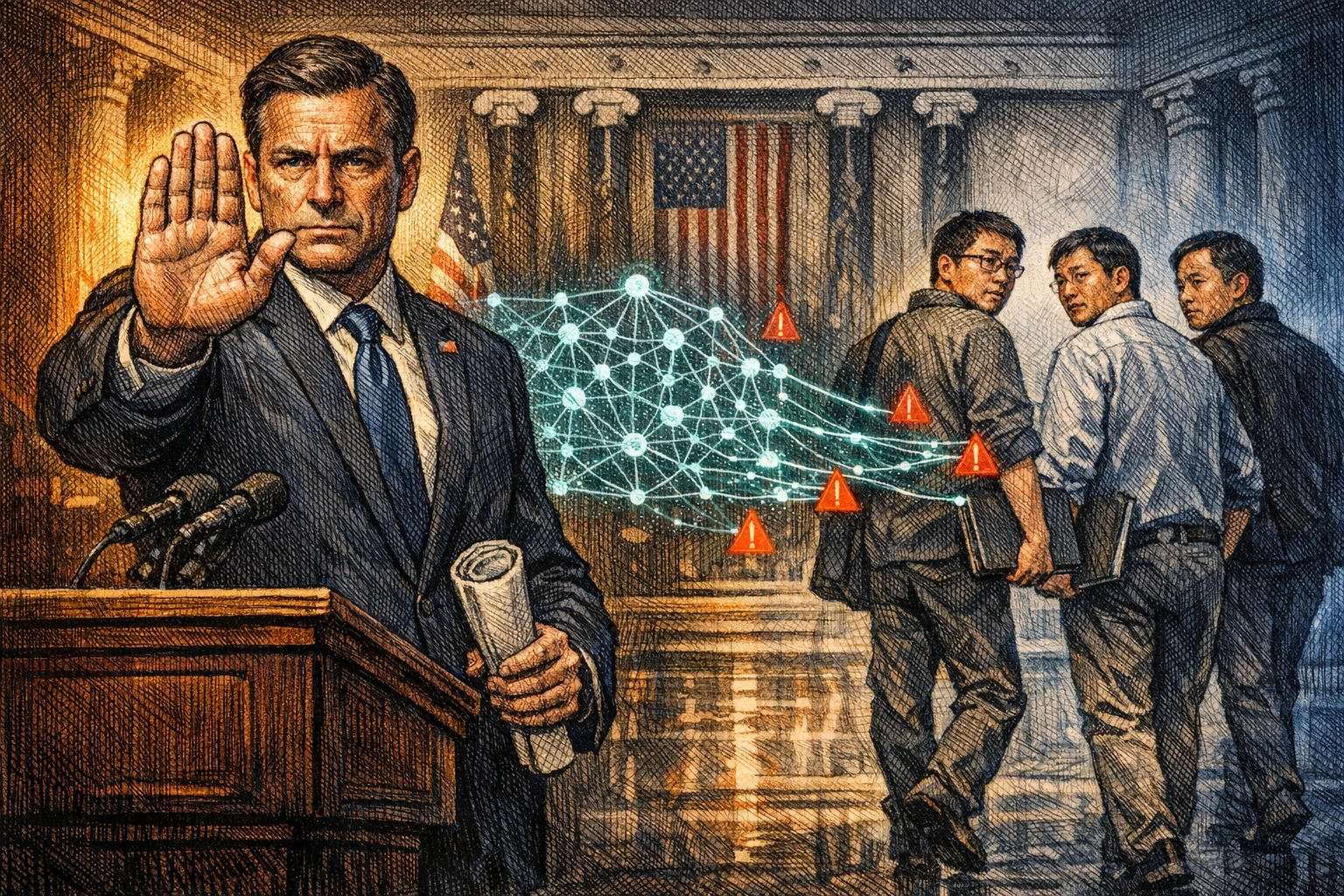
U.S. House Republican Bill Huizenga introduced the Deterring American AI Model Theft Act, targeting companies in China and Russia that use query-and-copy techniques to steal American AI models. The bill names DeepSeek, Moonshot AI, and MiniMax, with Alibaba and ByteDance also in scope.
Dual Sanctions Path: Entity List and IEEPA
The mechanism first identifies offending entities, then applies sanctions via the Commerce Department's Entity List or the International Emergency Economic Powers Act (IEEPA), which grants the president broad authority. "Model extraction is the latest front in Chinese IP theft," the sponsor said. Co-sponsored by Rep. John Moolenaar, head of the House Select Committee on China, the bill is slated for markup in the Foreign Affairs Committee next week alongside over a dozen other China-focused export control measures.
Committee Report Reveals Distillation Infrastructure, Names Tsinghua and Peking U
A parallel report from the Select Committee finds Chinese firms prioritize lightweight, compute-efficient models, a natural fit for distillation. It identifies two open-source tools and three intermediaries that allowed Alibaba, Tencent, Baidu, and Tsinghua and Peking universities to bypass restrictions and access closed-source models. The system is described as a "sophisticated access infrastructure" designed to obscure origins and distribute queries across thousands of fraudulent accounts.
OpenAI testified earlier that DeepSeek illegally used ChatGPT responses to build replica models, continuing even after countermeasures. Google and Anthropic also presented evidence. The report proposes three legislative recommendations: refer cases to the Justice Department for prosecution, assess whether DeepSeek, Moonshot AI, and MiniMax should be added to the Entity List, and establish a government-led information-sharing center among AI firms to systematically detect distillation threats.