

FinTax said the same ASIC mining rig can follow very different cost-recovery schedules in financial statements and on a U.S. federal tax return. In accounting, the cost may be depreciated over two or three years, or longer. For tax purposes, qualifying basis may be deducted in full in the first year.
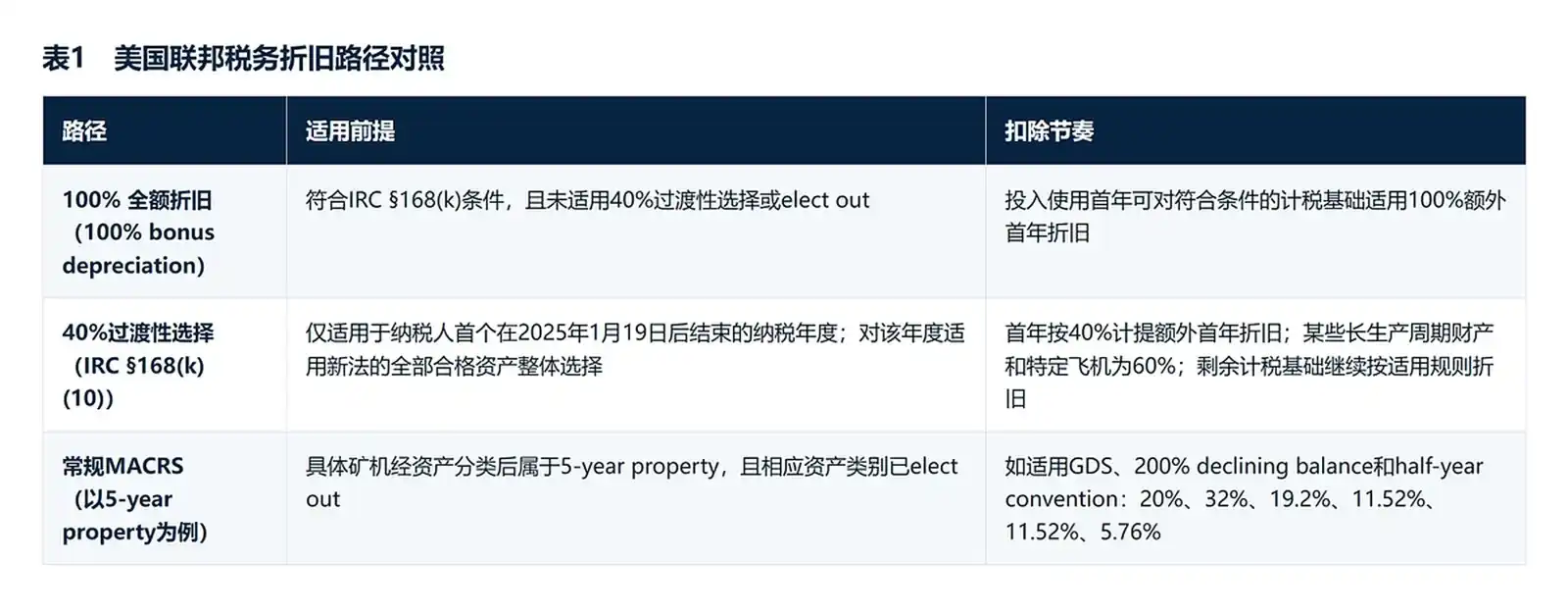
According to the article, H.R.1 became Public Law 119-21 on July 4, 2025. Section 70301 amended IRC §168(k) and permanently restored the 100% additional first-year depreciation deduction, commonly called bonus depreciation. IRS Notice 2026-11 later said the rule generally applies to qualified property acquired and placed in service after Jan. 19, 2025.
FinTax added an important caveat: 100% bonus depreciation does not mean every mining machine can be fully deducted in the year it is purchased. The actual tax treatment still turns on asset classification, the date of acquisition, and the date the equipment is placed in service.
Useful life for mining rigs is an accounting estimate, not a fixed rule
For self-mining ASIC machines that meet the recognition requirements of IAS 16, listed mining companies typically capitalize them as mining equipment within property, plant and equipment, or PPE, and then depreciate them over their expected useful lives.
IAS 16 requires depreciable amount to be allocated systematically over an asset’s useful life. In setting that life, a company has to consider expected usage, physical wear and tear, technical or commercial obsolescence, and legal or similar limits. FinTax noted that useful life is based on the period the asset is expected to provide utility to the business, so it can be shorter than the machine’s broader economic life. Depreciation methods must be reviewed at least at each financial year-end, and a major change in the expected pattern of economic benefit consumption is treated as a change in accounting estimate.
That matters more for mining rigs than for many other machines. A unit may still run, but that does not mean it still makes economic sense to operate it. As newer ASIC generations improve hashrate and energy efficiency, older rigs need lower power prices to preserve marginal profitability. At the same time, rising network hashrate and higher mining difficulty can reduce the expected output attached to a given unit of computing power.
FinTax said a mining rig’s practical useful life depends more on how long it can keep producing economically valuable hashrate at a viable cost. A machine generation may be able to run for five years from a technical standpoint. If a company expects that, after three years, the rig’s efficiency will no longer support economic operation at that company’s power cost, then a three-year accounting life may better reflect actual use. The opposite can also be true if electricity costs are lower, maintenance conditions are stronger, or the model remains competitive for longer.
Public company disclosures point in the same direction. Bitdeer Technologies Group said in its 2025 Form 20-F that, beginning in July 2025, the estimated useful life for the vast majority of its mining machines was revised to two to three years, from two to five years previously. Argo Blockchain plc said in its 2025 Form 20-F that mining machines are generally depreciated on a straight-line basis over an estimated useful life of 36 to 48 months.
In FinTax’s view, there is no single depreciation period that fits every mining machine. Companies need to judge the period over which an asset will continue generating economic benefits by looking at the rig model and generation, energy efficiency, changes in hashrate and mining difficulty, equipment replacement plans, and expected residual value. Because product cycles in mining hardware are moving quickly, those estimates can shift as well, which means companies need supportable, reviewable evidence and regular reassessment of useful life, residual value, and depreciation method.
How the U.S. 100% first-year deduction works
The article said the main U.S. federal tax change came from Public Law 119-21. The policy applies to a broad range of qualified depreciable property, not just crypto mining rigs. IRS guidance lists qualified property that is depreciable under MACRS and has a recovery period of no more than 20 years, which can include qualifying new assets and some used assets.
For mining companies, whether a rig qualifies for 100% bonus depreciation starts with several threshold questions: the tax classification of the asset, when it was acquired, when it was placed in service, which taxpayer is using it, and any other applicable requirements. FinTax noted that merely signing a purchase order or completing payment is not enough. The IRS generally requires that the asset be in a condition or state of readiness for its specifically assigned use.
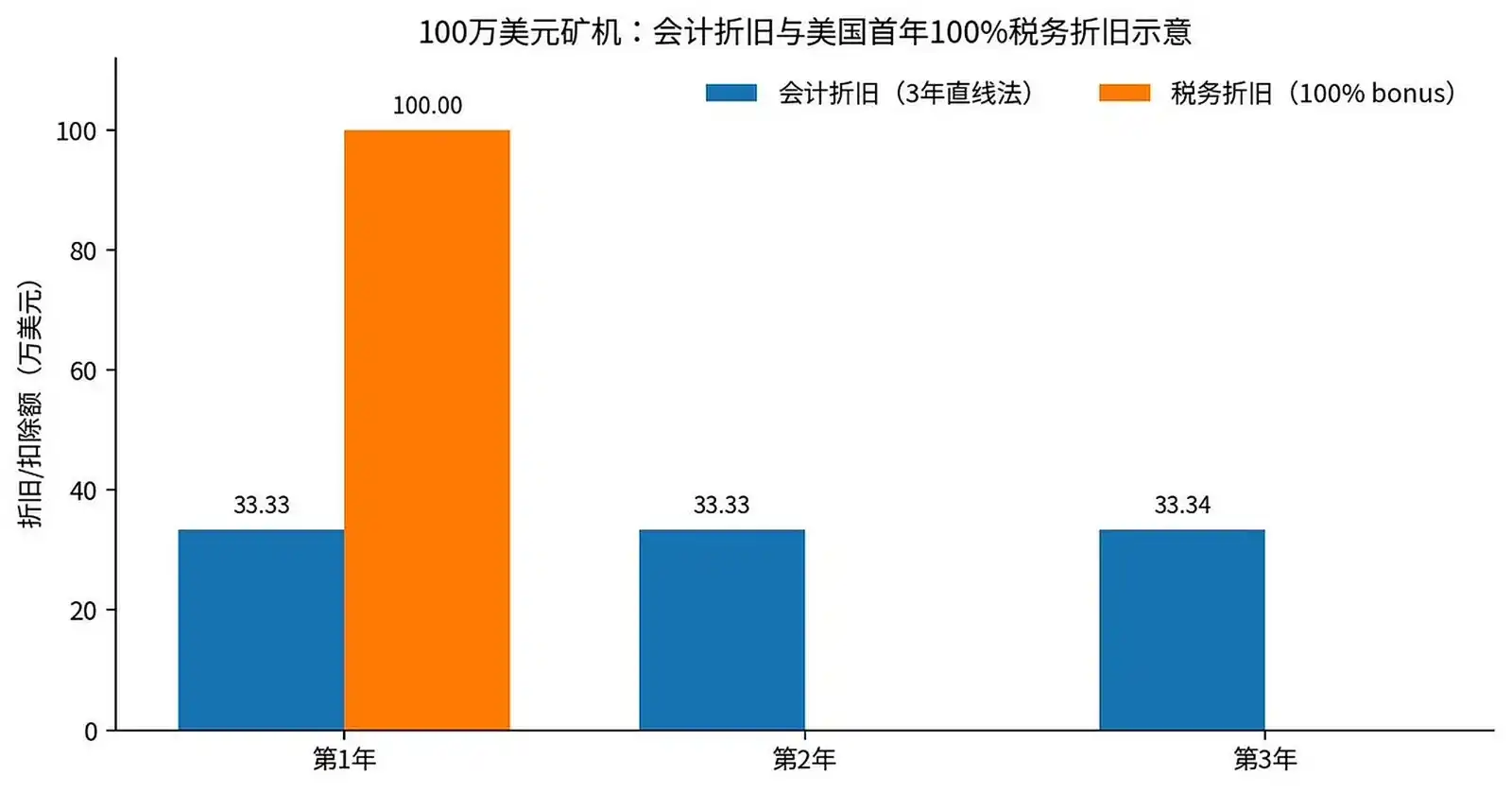
If a mining machine qualifies, the timing benefit can be material. FinTax used a $1 million example. If a company buys $1 million of mining rigs and depreciates them on a straight-line basis over three years for accounting purposes, it would record about $330,000 of depreciation expense each year. If the same asset qualifies for 100% bonus depreciation under U.S. federal tax law, the company can deduct the full $1 million of qualified tax basis in year one. For companies with strong current profits, that front-loaded deduction can reduce taxable income and current cash taxes.
In loss years, slower depreciation may be more useful
FinTax said IRC §168(k)(7) allows a taxpayer to elect out of first-year bonus depreciation for a class of property. That election applies to the relevant class of qualified assets placed in service during the tax year. It is not a pick-and-choose decision for one individual machine.
The new law also offers a transitional election. Under IRC §168(k)(10), for the first tax year beginning on or after Jan. 19, 2025, a taxpayer may elect 40% additional first-year depreciation for qualified property under the new law. Certain longer-production-period property and specified aircraft are subject to 60%.
If a company elects out of 100% bonus depreciation for a class of assets, cost is recovered under ordinary MACRS rules. Whether a mining rig falls into five-year property requires identification of its specific asset classification. FinTax said that if a rig is analyzed as five-year property and uses the common GDS method, double-declining balance, and the half-year convention, the standard Publication 946 table gives rates of 20%, 32%, 19.2%, 11.52%, 11.52%, and 5.76%, so cost recovery stretches across six tax years.
The decision to claim 100% first-year bonus depreciation depends on how deduction timing affects total tax burden and cash flow. For companies with high current profits, accelerating the deduction often lowers taxable income and cash taxes sooner. If a company is already in a tax loss position, however, additional depreciation may only increase its net operating loss, or NOL, without an equivalent drop in current cash tax.
FinTax also said that, for a typical C corporation, NOLs generated after 2017 are generally subject to an 80% taxable income limitation when used in future years. If an ownership change occurs, the use of pre-change NOLs may face additional restrictions. Because of that, a decision on 100% bonus depreciation should be modeled together with expected future earnings, NOL usability, the time value of money, class elections, and other tax-law limits.
How the book-tax difference shows up on the balance sheet
When the book value of an asset is higher than its tax basis, a taxable temporary difference arises, and that usually leads to recognition of a deferred tax liability, the article said.
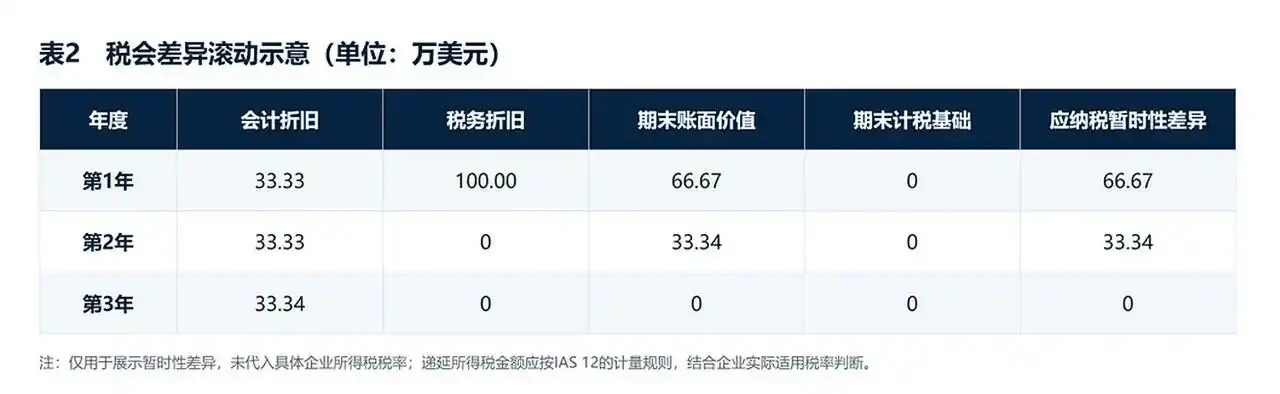
FinTax used another example involving mining rigs that cost $1 million and have zero residual value, with straight-line accounting depreciation over three years. At the end of year one, accounting depreciation would be about $333,300 and book value would still be $666,700. If the rigs qualified for U.S. 100% bonus depreciation and the full $1 million tax basis had already been deducted in the placed-in-service year, tax basis would be reduced to zero.
That leaves a taxable temporary difference of $666,700 between the book value and the zero tax basis, which would support recognition of a deferred tax liability. FinTax said the amount of that deferred tax liability should be measured by applying the enacted, or substantively enacted, income tax rate expected to apply when the temporary difference reverses, based on the rate in force at the reporting date.
In years two and three, accounting depreciation would continue, but there would be no corresponding tax depreciation because the full tax cost had already been deducted in year one. As book value declines over time, the taxable temporary difference and the related deferred tax liability would gradually reverse as well.
FinTax stressed that a 100% first-year tax deduction does not shorten the accounting life of a mining rig to one year. Financial statements still reflect the expected pattern of economic benefit consumption, while the tax return follows the cost-recovery schedule permitted under tax law. In practice, purchase cost, placed-in-service date, accounting life, tax asset class, and the amount already deducted all need to line up for the same unit of equipment.

Other jurisdictions can produce the opposite result
FinTax said the U.S. 100% bonus depreciation rule gives mining companies a faster cost-recovery path and leaves room to choose whether to accelerate deductions. In Ethiopia and Kazakhstan, by contrast, mining rigs are generally written off under local asset classifications and statutory depreciation rules, with less flexibility in tax treatment.
Ethiopia’s Federal Income Tax Regulation, Council of Ministers Regulation No. 410/2017, uses categorized depreciation rules. Computers, software, and data storage equipment can use 20% straight-line depreciation or 25% declining-balance depreciation. FinTax gave a simplified example: if a company depreciates a $1 million machine over three years on a straight-line basis for financial reporting, and local tax classification ultimately supports computer equipment with straight-line treatment, then year-one book depreciation would be about $333,300 while tax depreciation would be about $200,000. In that case, tax deductions are slower than accounting depreciation, and year-end tax basis of about $800,000 would exceed book value of about $666,700, creating a deductible temporary difference. FinTax said that result stands in sharp contrast to the U.S. pattern.
In Kazakhstan, the new Tax Code, No. 214-VIII, was signed on July 18, 2025, and takes effect on Jan. 1, 2026. Based on a tax summary updated in July 2026, tax depreciation mainly uses the declining-balance method, and fixed assets are generally split into four groups. Ordinary machinery and equipment can be depreciated at up to 25%, while computers and information-processing equipment can be depreciated at up to 40%. If mining rigs are placed in different asset groups, the pace of tax cost recovery changes with that classification.
What companies need to keep in their records
FinTax concluded that mining-rig depreciation has to be analyzed separately for accounting and tax. On the accounting side, companies should determine a reasonable useful life by looking at machine generation, efficiency, and expected operating cycle. On the tax side, using U.S. federal law as an example, they need to determine whether the equipment qualifies under IRC §168(k), and then decide whether 100% bonus depreciation, the 40% transitional option, or an election out is the right treatment.
For rigs deployed in other jurisdictions, the same analysis has to be repeated under local asset classifications and depreciation rules. FinTax said the practical priority is to make sure the accounting treatment and tax treatment can be matched back to the same equipment. That means fixed-asset records should retain information such as model, acquisition cost, placed-in-service date, estimated useful life, and tax asset class, so that deferred tax calculations and related processes rely on a consistent data set.
The article added that mining hardware turns over quickly, and useful lives, operating arrangements, and applicable tax rules can all change over time. Companies therefore need regular reviews and timely updates to accounting estimates and tax judgments.