
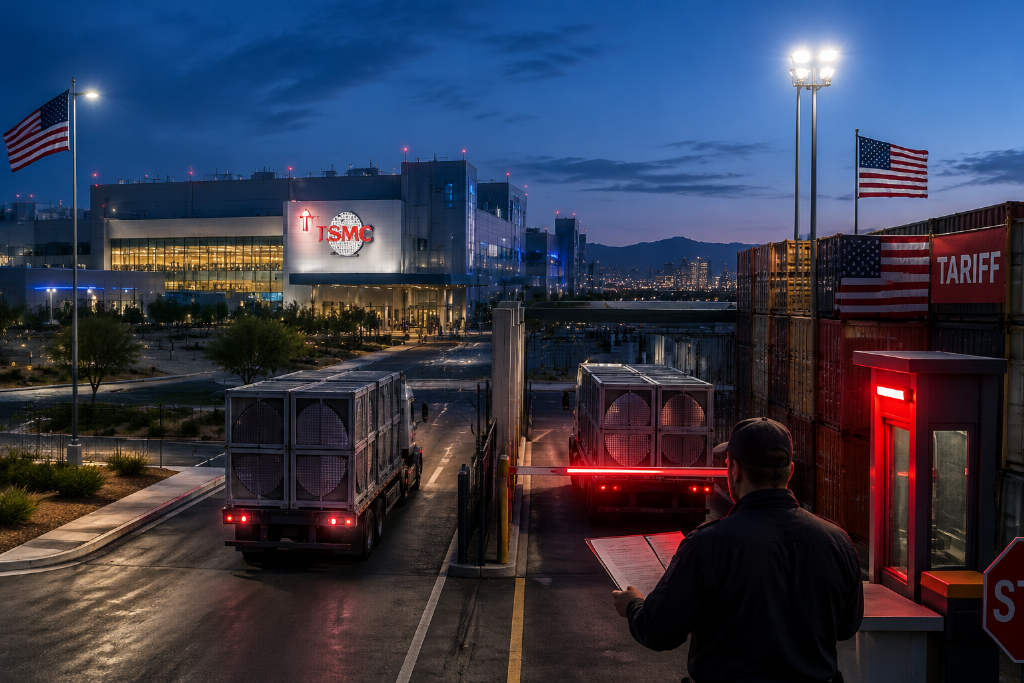
The US Commerce Department is considering a new round of semiconductor tariffs that would exempt chipmakers building factories in the United States, while companies that stay out of US manufacturing would have to pay to enter the market.
That message came from Commerce Secretary Howard Lutnick in a Sept. 2 interview with CNBC. Lutnick described the proposed semiconductor tariff structure as a "precise" and "careful" policy tool. He said, "Build here, you don’t pay. Don’t build here, then get ready to pay to enter the world’s largest market."
Duty-free chip quotas would scale with US investment
Under the framework Lutnick said he prefers, the amount of chips a company could import without tariffs would be proportional to the investment it commits to US production capacity. A larger commitment would mean a larger duty-free allowance.
He did not disclose the actual tariff rate, which chips would be covered, or when the policy would take effect. Those details, according to the report, have not been formally announced.
Section 232 chip tariffs are already in force
The proposal would build on an existing tariff regime rather than start from scratch. The report says the US already has semiconductor tariffs in place under Section 232, the legal basis that allows Washington to impose additional duties on imports on national security grounds.
According to the article, those tariffs took effect on Jan. 15, 2026, imposing a 25% ad valorem duty on certain advanced semiconductors and derivative products. The report says the measure targets high-end computing chips such as NVIDIA H200 and AMD MI325X.
Importers can apply for relief if they can prove that the chips were made in the United States or underwent substantial transformation there.
Lutnick said the model follows the earlier pharmaceutical playbook
Lutnick said the logic behind the semiconductor plan was modeled on an earlier approach used for pharmaceuticals during the Trump administration.
The report says that in September 2025, Trump announced a 100% tariff on all branded and patented drugs, while companies building factories in the United States could qualify for an exemption. Projects that had already started construction were also counted.
In April 2026, that policy was adjusted to a step-up structure. Companies committing to US facilities were first charged 20%, with the rate rising to 100% four years later. Drugmakers that had negotiated prices with the US Department of Health could also be exempted.
The article says the purpose of that mechanism was not simply tax collection, but to push capital back into the United States through a combination of high tariffs and conditional exemptions. It argues that the same logic is now being applied to chips.
Tariff coverage may stretch beyond semiconductors
The report says the planned tariff expansion may not stop at chips themselves. The scope could also include technology products made with those chips, including laptops, data center servers, and gaming hardware.
That creates tension between two White House goals identified in the article: bringing semiconductor manufacturing back to the United States while also preserving the pace of AI infrastructure expansion.
NVIDIA and AMD design chips in the United States, but their production depends heavily on overseas foundries. The report says they could also be hit, and that tougher tariffs would raise cost pressure on both companies.
TSMC has expanded its US commitments
Taiwan Semiconductor Manufacturing Co. is presented in the report as the company that has moved most aggressively. The article says TSMC began with an initial $12 billion commitment in 2020, then expanded that figure to $40 billion, $65 billion, and $165 billion, before adding another $100 billion in July this year. That brought the total to $265 billion, more than 20 times the original level over a period of more than five years.
Its planned Arizona footprint is described as eventually including 10 fabs, 2 advanced packaging plants, and 1 research and development center. The report also says TSMC raised its 2026 capital expenditure target to a range of $60 billion to $64 billion.
The article also references a US-Taiwan trade agreement that cut Taiwan’s tariff rate on exports to the US from 20% to 15%, matching Japan and South Korea. In exchange, Taiwan committed at least $500 billion, split evenly between direct investment and credit guarantees, with the money mainly directed to semiconductors, artificial intelligence, and energy.
During the period when Taiwanese manufacturers are building in the US, they can import semiconductors duty-free at volumes equal to 2.5 times newly added capacity, according to the report. After completion, they can still import duty-free at volumes equal to 1.5 times capacity. The article says this matches Lutnick’s formula that more investment brings larger tariff-free allowances.