
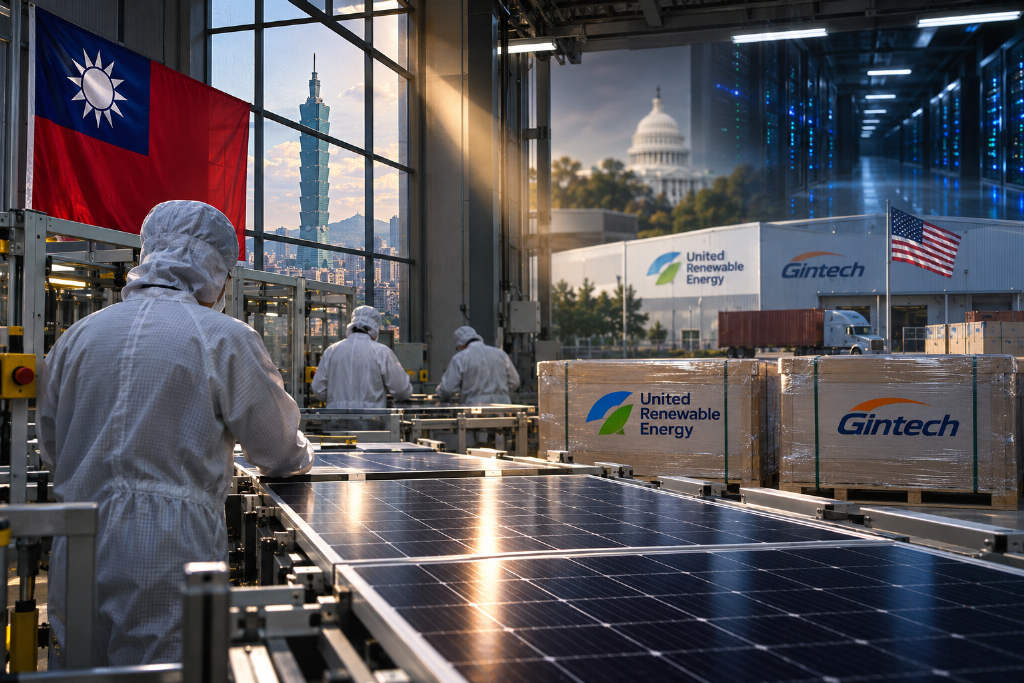
Taiwan solar stocks moved against the broader market after Democrats won control of both chambers of the U.S. Congress in the midterm elections, raising expectations that Washington could become more supportive of green energy policy again. Taiwan shares fell sharply on Nov. 5, but solar names including Giga Solar (3691), United Renewable Energy (3576), Gwo Hwa Energy (2406) and TSEC (6443) stood out. Giga Solar and United Renewable Energy have both already built positions in U.S. module manufacturing.
Election result lifts expectations for renewable support
According to Commercial Times, Democrats scored an overwhelming victory in the Nov. 3 U.S. midterm elections and took control of both the Senate and the House. Because the party has long backed renewable energy, low-carbon infrastructure and grid upgrades, the market is now pricing in a possible recovery in policy support for green energy. U.S. renewable-related stocks also rose after the election, the report said.
Institutional investors cited in the report said policy under Trump after returning to the White House has leaned toward expanding fossil fuel production, while also planning to scale back some green subsidies under the Inflation Reduction Act, or IRA. That has weighed on the global green energy sector. After reviewing policy positions from several newly elected Democratic governors, those investors said the election outcome sends a positive policy signal for the global renewable industry.
Giga Solar and URE are already building U.S. capacity
Giga Solar acquired solar module production equipment in the U.S. in 2025 and began production at the end of that year. Its first-phase 500MW capacity is already fully loaded. A second-phase expansion of 1GW entered mass production in October this year and can produce TOPCon and PERC solar cell modules. The report added that solar module pricing in the U.S. is better than in Taiwan and China.
United Renewable Energy announced in July this year that it would form a joint venture with Sino-American Silicon Products (5483) to build a module plant in the U.S. with annual capacity of 1GW. Production is expected to begin next year. The company wants overseas markets to become its main source of revenue, with the U.S. at the center. It is using local manufacturing to reduce direct competitive pressure from China’s solar supply chain, while targeting rooftop projects, ground-mounted solar plants and demand tied to AI data centers.
TSEC stays cautious on U.S. manufacturing, while Cangher says U.S. is its fastest-growing market
Not every Taiwan green energy company is taking the same approach. TSEC said the U.S. is an actively evaluated sales market, but that does not mean it must build a plant there. For now, production remains centered in Taiwan. The company said any large investment in overseas production lines still has to be weighed against equipment spending and technology conversion risks. Overseas revenue currently accounts for about 10% of TSEC’s total, mainly from Japan.
Solar screen supplier Cangher (6538) said demand for screens is rising as U.S. customers continue to expand local cell capacity. The U.S. has become the company’s fastest-growing market.
Two variables remain: Trump’s term and AI power demand
Investors also warned that expectations for a quick return of subsidies may be premature. They pointed to two main variables.
- First, AI data centers are driving a rapid increase in global electricity demand, and renewables alone may struggle to provide stable supply.
- Second, Trump still has two years left in office, which limits how much room Democrats have to push energy policy.
On that basis, investors said U.S. energy development may end up following a mixed path that combines renewables and nuclear power.
Some industry participants also said Democratic control of Congress does not mean solar subsidies will change immediately. They said the next step depends on how legislation advances and on the stance of the executive branch. For Taiwan, any U.S. policy shift may have limited direct impact on domestic energy policy. Still, if the global trend turns back toward green energy, and with Taiwan facing rising power demand and supply pressure in the short term, local energy policy could also see adjustments.



