
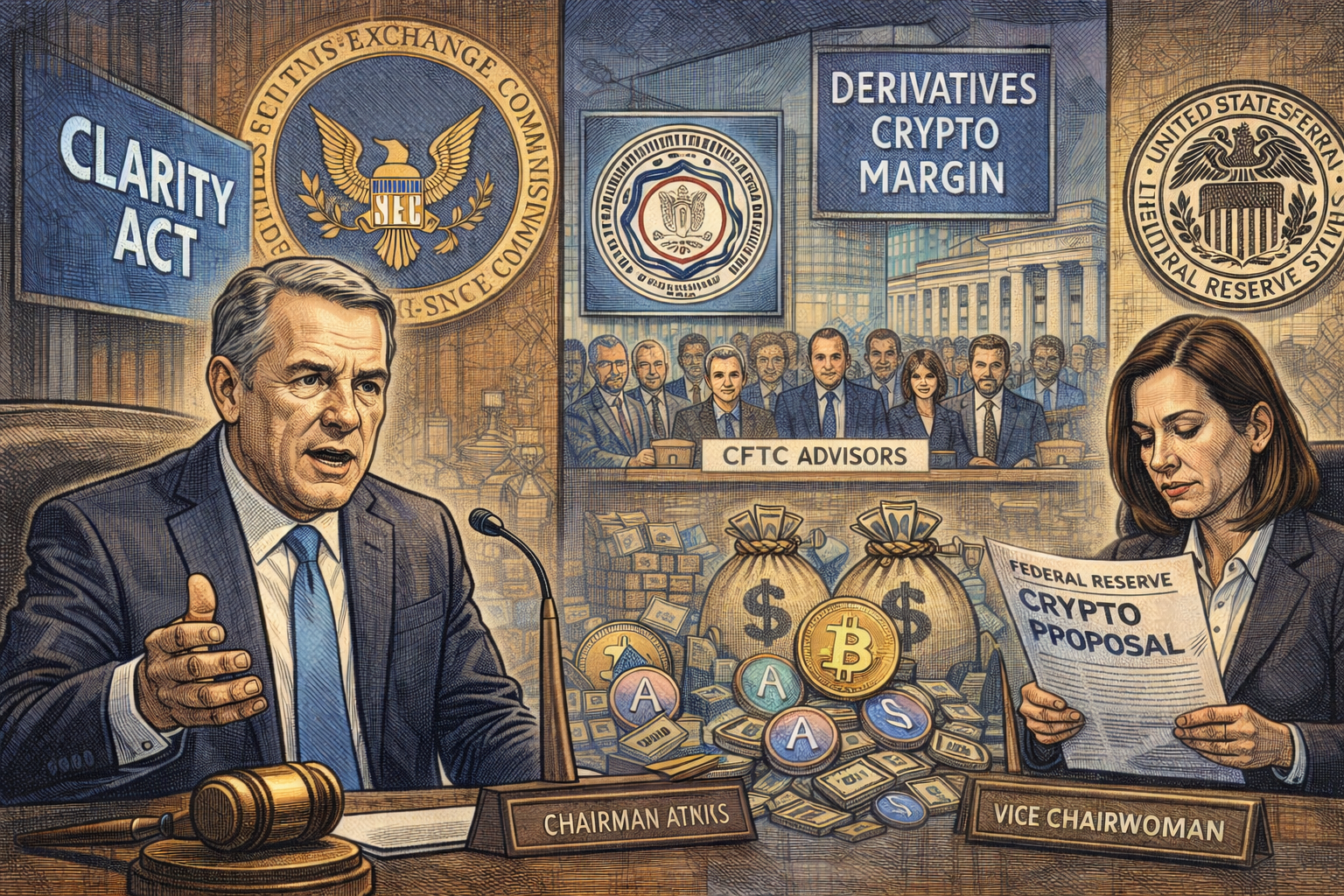
US regulators made three coordinated moves on crypto within 48 hours. SEC Chair Paul Atkins used a Senate hearing to press for the CLARITY Act, CFTC Chair Michael Selig released the names of a 35-member innovation advisory group, and the Federal Reserve published a research paper proposing that cryptocurrencies be treated as a separate asset class for derivatives initial margin weighting.
The tools were different: legislation, advisory structure, and technical risk modeling. The direction was the same. Crypto assets are being brought into the existing US financial regulatory framework with unusual speed.
Atkins argues rulemaking is not enough without Congress
Atkins told the Senate Banking Committee that regulators need a “firm foundation in law” to prevent future reversals. His point was clear: agency rulemaking can be undone by a later administration, while statute is much harder to roll back.
The CLARITY Act is designed to address one of the industry’s longest-running disputes, the line between tokens overseen by the SEC and those falling under the CFTC. If enacted, it would create a legal boundary between the two agencies’ crypto jurisdictions and set guardrails for DeFi and stablecoins.
The Senate remains the main obstacle. During the hearing, Virginia Senator Mark Warner, a Democratic negotiator, said he supports moving the bill forward but wants safeguards to ensure decentralized finance does not become a channel for money laundering. The report said the bill needs support from at least seven Democrats, and that number could rise if Republicans do not stay united.
CFTC brings crypto executives and market infrastructure firms to one table
On the same day, Selig announced a new innovation advisory committee with 35 members. The list includes Coinbase CEO Brian Armstrong, Ripple CEO Brad Garlinghouse, Solana Labs co-founder Anatoly Yakovenko, Chainlink co-founder Sergey Nazarov, and Uniswap Labs founder Hayden Adams.
It also includes representatives from Gemini, Crypto.com, Kraken, and Robinhood. In prediction markets, Polymarket’s Shayne Coplan and Kalshi’s Tarek Mansour were named. Venture capital is represented by a16z crypto’s Chris Dixon and Paradigm’s Alana Palmedo.
The group goes beyond native crypto firms. Representatives from Cboe, CME, DTCC, Nasdaq, and the Options Clearing Corporation are also on the roster. That mix suggests the CFTC wants digital asset firms and traditional market institutions involved in the same rulemaking conversation rather than treating crypto as a separate silo.
Federal Reserve paper proposes a distinct risk bucket for crypto derivatives
The Fed’s move was more technical, but it may carry the broadest policy implications. The paper argues that floating crypto assets such as Bitcoin and Ethereum, along with pegged stablecoins such as USDT and USDC, behave differently from interest rates, equities, foreign exchange, and commodities. Because of that, they do not fit neatly into the standardized initial margin model, or SIMM.
The research team proposed handling crypto as its own risk category with dedicated weights. It also suggested using a benchmark index split evenly between floating crypto assets and stablecoins to model market volatility and calibrate margin weights.
The paper does not establish final policy. Still, it shows the Fed’s technical staff is preparing for a world in which crypto derivatives are supervised on a routine basis. The question being addressed is no longer whether crypto belongs inside the financial system, but how its risk should be measured once it is there.
Prediction markets emerge as a new jurisdiction fight
Atkins also said prediction markets are a “huge issue” that he and Selig are both watching. The rapid growth of platforms such as Polymarket and Kalshi has revived an old classification dispute: are these contracts futures, securities, or gambling products.
At the federal level, the CFTC currently holds primary authority. Some state governments, though, argue that contracts tied to sports betting or political forecasting may violate local gambling laws. The platforms argue that event contracts fall under the Commodity Exchange Act and should be regulated exclusively by the CFTC. Selig said he wants “reasonable rules and protections” for prediction markets so the business is not pushed offshore.
Taken together, the SEC, CFTC, and Federal Reserve actions show a US crypto framework starting to take shape. What remains uncertain is timing: whether this burst of regulatory activity can become durable law, formal rules, and operational standards before the political window narrows.