
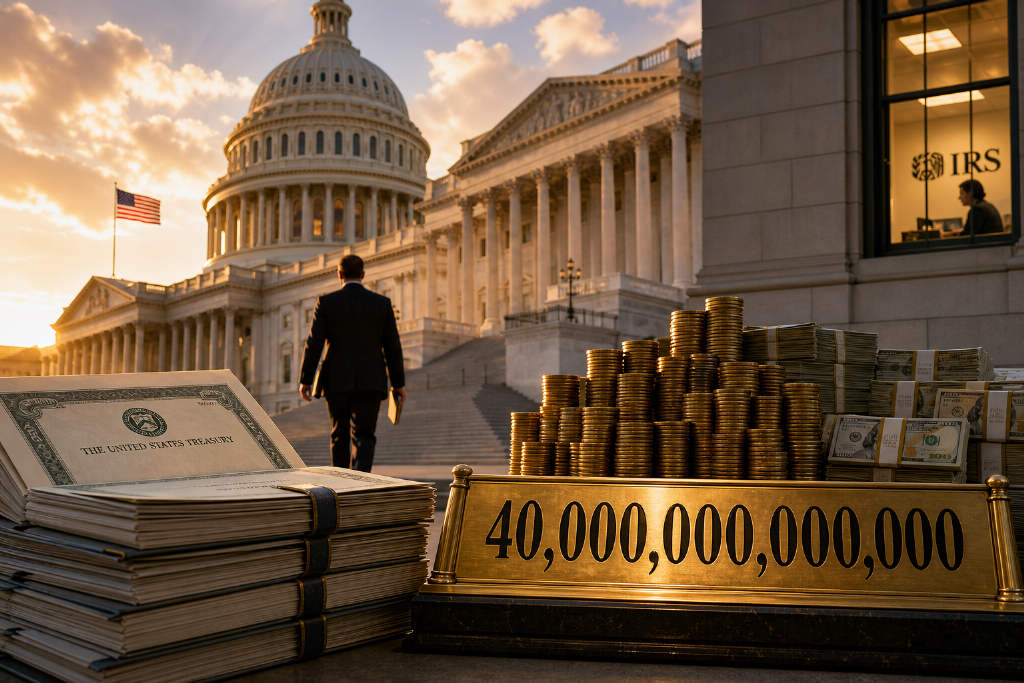
US federal debt has officially risen above $40 trillion, passing the milestone only about 150 days after crossing $39 trillion. The report said that pace was nearly two months faster than market expectations. In March this year, federal debt had just reached $39 trillion. Less than half a year later, it added another $1 trillion. From the point when debt first crossed $30 trillion in early 2022, the move to $40 trillion took only about four and a half years.
The average interest rate paid on US government debt is now around 3.75%, putting the annual interest burden close to $1.5 trillion. Over the first 10 months of fiscal 2026, federal interest payments alone have already exceeded Medicare spending, making them the second-largest single line item after Social Security, according to the report. The article also said those interest costs are now larger than the entire defense budget.
Krugman says the number is a warning, not the endgame
Paul Krugman, the 2008 Nobel Prize-winning economist, took a measured view in a column published on the 20th. He argued that reading the $40 trillion mark as evidence of an imminent default storm misses the core issue. In his view, the United States is not in the same position as Greece and other southern European economies during the 2010 sovereign debt crisis.
Krugman said Greece’s crisis was tied to the fact that, as a member of the eurozone, it did not control its own currency issuance. The United States is in a different position because federal debt is denominated in dollars. In theory, the Federal Reserve can always create more money to deal with maturing obligations. That means running out of cash is not the central risk the United States faces. Even with debt at a far larger scale, he said, the country is unlikely to be forced into the kind of default path associated with Greece.
Why debt is rising so quickly
On the question of why the debt has accelerated in such a short period, the report cited US Treasury Secretary Bessent, who spoke last week in an interview with Newsmax. He first pointed to court rulings that found parts of the Trump administration’s tariff measures unlawful. Refunds tied to those rulings have exceeded $160 billion, directly reducing funds that had been expected to help narrow the deficit.
Military spending linked to the Iran war has also climbed. At the same time, higher energy prices have weighed on broader economic growth, which in turn has reduced tax revenue. Another factor, according to the report, is the large tax-cut package passed by Republicans in 2025. That law allows companies to immediately deduct the full cost of plant construction and equipment investment, and it may reduce government revenue by more than $100 billion this year alone.
Krugman pushed the argument further back, describing the problem as structural rather than sudden. He wrote that the weakening of fiscal discipline did not begin out of nowhere. Before the Trump administration pushed through a series of tax cuts that he described as clearly tilted toward the wealthy, the Bush administration had already set the pattern by steering the tax code in favor of high-income groups. In Krugman’s telling, if that policy path had not been extended over time, the current deficit gap would not have widened to today’s scale.
From Obama-era debt fights to a progressive tax fix
Krugman also looked back to the Obama years as a point of comparison. He said repeated warnings that a debt crisis was imminent helped limit the size of post-financial-crisis stimulus, which slowed the recovery and left the economy on weaker footing until near the end of Obama’s presidency.
He highlighted what he sees as a contradiction. Voices that strongly called for deficit reduction said little during Trump 1.0, when major tax cuts led to a clear loss in tax revenue, but quickly returned to warn about a debt blowup when the Biden administration expanded fiscal support to counter pandemic-driven unemployment.
Krugman said that if Democrats regain both the White House and Congress in 2029, similar deficit arguments will likely return and should not be allowed to become a reason to block progressive reforms. At the same time, he said that does not mean Democrats should ignore the deficit in the way he believes Trump did.
His prescription is a stronger Internal Revenue Service, tighter enforcement against loopholes used by multinational companies to avoid taxes, and higher taxes on high-income households. If the US tax system regains its progressivity, Krugman argued, it could both slow the country’s drift toward oligarchy and put the federal deficit back on a more manageable track.