
Chinese PCB stocks extended losses on Oct. 12 after renewed attention on a U.S. defense procurement restriction scheduled to take effect on Jan. 1, 2027. Jinan Guoji hit its daily down limit for a second straight trading day, Hongchang Electronics also fell to limit down, and Huazheng New Material dropped more than 9% intraday.

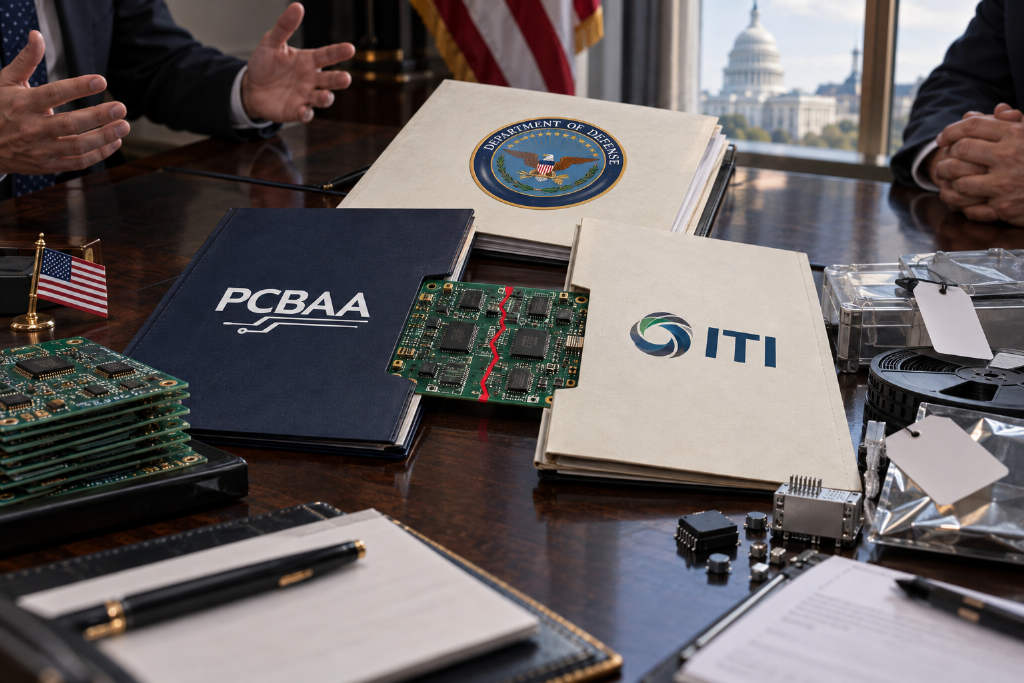
The concern was tied to a U.S. rule that would restrict Pentagon procurement of certain printed circuit boards from China. But the timeline shows the issue is not new. The Printed Circuit Board Association of America, or PCBAA, had already published a statement on Sept. 11 calling for Chinese PCBs to be excluded, while debate inside the United States has continued over whether the restriction should be enforced on the current schedule just three months from now.
The Information Technology Industry Council, or ITI, which represents technology companies, submitted formal comments to the Department of Defense and asked for a 36-month transition period after the final rule is issued for relevant commercial products. PCBAA took the opposite position, urging the Pentagon to exclude Chinese PCBs as planned and not delay or soften the measure. In a research note dated Oct. 12, Citi said the global aerospace and defense PCB market is only about $1.4 billion. Given the size of mainland China’s PCB industry, Citi estimated that the demand directly affected by the U.S. defense restriction would amount to less than 1% of China’s total PCB demand.
That leaves three distinct positions in the market: one side wants a slower rollout, another wants the ban enforced quickly, and a third argues that the direct impact would be limited even if the rule takes effect. The split comes down to incentives. U.S. board makers see possible new orders. Downstream manufacturers see new costs. China’s weight in the supply chain is visible in that gap. Alternative suppliers may exist, but matching the same price, output and delivery schedule is another matter.
What the restriction covers
The measure has been in the works for five years. The National Defense Authorization Act for fiscal 2021 first introduced the PCB procurement ban, and the fiscal 2022 version pushed the implementation date back to Jan. 1, 2027.
On Jan. 1, 2021, the U.S. Senate voted 81-13 to override then-President Donald Trump’s veto of the fiscal 2021 National Defense Authorization Act, allowing the bill to become law.
The restriction is aimed mainly at Department of Defense procurement and covers certain PCBs from China, Russia, Iran and North Korea, including bare boards and assembled boards used in mission-critical systems, weapons and command-and-control systems. It does not amount to a blanket ban on Chinese PCBs in ordinary smartphones, automobiles or commercial AI servers. The law also includes commercial product exceptions and waiver mechanisms, while the exact scope of enforcement still depends on the final rule.
For U.S. companies, the issue is not just where defense orders are sourced. It also means they may need separate production lines for defense work and dedicated supply-chain traceability. If procurement requirements tighten immediately in 2027, companies may have to find new suppliers while absorbing added certification, traceability and production costs. That is the core reason ITI wants a delay.
PCBAA sees the same rule from the other side. For domestic U.S. board makers, the restriction could redirect defense orders that might otherwise go overseas. If implementation is pushed back again, customers have less reason to switch to U.S. suppliers, and new factories have a weaker basis for long-term order planning.
Washington’s broader direction is clear: it wants to strengthen the competitiveness of domestic board makers. The United States still has leading chip design companies and major technology brands, but much of the manufacturing base that supports large-scale electronics production has moved offshore. The result is dependence in one of the most basic parts of the supply chain.
Sun Xi, director of the Case Center at Capital University of Economics and Business, described this shift in an article titled “The Great Alliance Against the Current — On the Banner and Background of Science: The New Golden Age” as a move to rebuild an “industrial commons.” In that framing, the state no longer leaves critical manufacturing capacity entirely to global specialization. It redefines strategic demand and organizes domestic supply through defense orders, fiscal subsidies and tax incentives. The PCB procurement restriction is not presented as a direct product of “Science: The New Golden Age,” but the two share the same policy turn: the United States is turning what had been a less openly stated form of developmentalism and protectionism into explicit industrial rules.
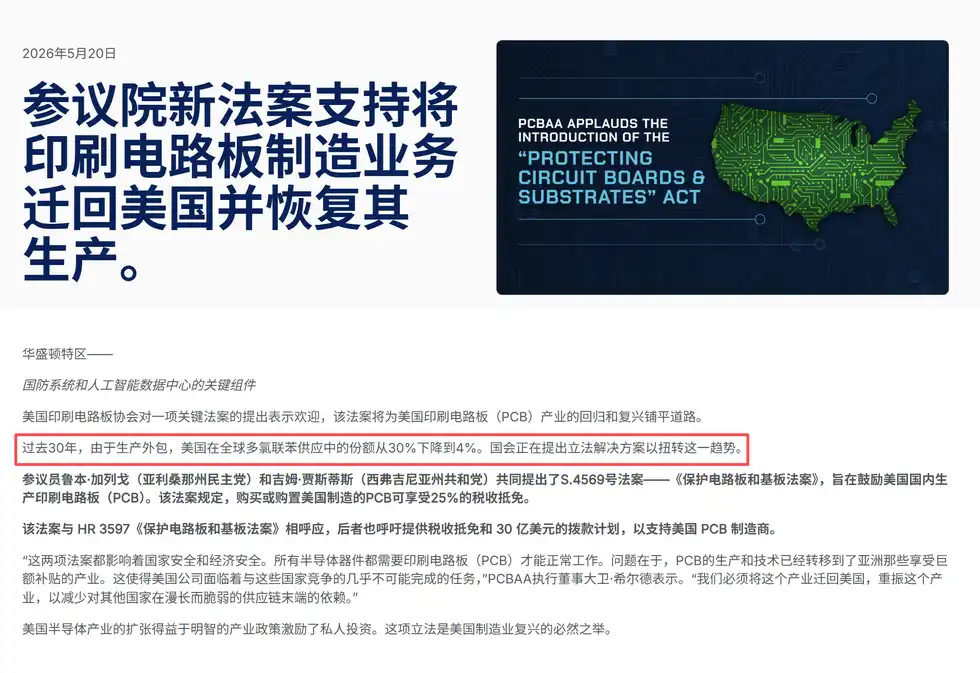
According to data released by PCBAA in May, the U.S. share of global PCB supply has fallen from about 30% to 4% over the past 30 years. In 2000, the United States had more than 2,000 PCB companies. Today, fewer than 145 manufacturing operators remain.
Over the past 30 years, the U.S. share of global PCB supply has dropped from about 30% to 4%.
AI has widened the gap. As chip performance rises, board requirements rise with it. High-speed signal transmission needs lower-loss materials, finer circuitry and more complex interconnect structures between layers. PCBs are no longer just basic components linking electronic parts. They now directly affect signal quality and system performance in AI servers.
Prismark estimates the global PCB market will reach about $85.8 billion in 2025, up 16.7% year over year. TTM, a leading U.S. PCB maker, said its data center and networking revenue in the second quarter rose 91% from a year earlier and accounted for 40% of total company revenue.
The fastest-growing AI hardware segment is creating new demand for high-end PCBs. The U.S. problem is that demand has returned faster than a complete domestic manufacturing system.
In May, a bill backed by PCBAA proposed a 25% tax credit for purchases of U.S.-made PCBs and package substrates. The House version also included a $3 billion support program.
That fits the same industrial policy logic as the 2027 procurement restriction: use defense procurement to create a market for domestic board makers, then use tax credits and subsidies to pull more commercial orders into U.S. factories.
The goal is not only to restore military PCB supply. It is to make advanced electronics manufacturing part of the domestic industrial base again.
Using Sun Xi’s interpretation of the new science report, defense procurement here serves to “pre-guarantee market demand” for specific capabilities. The PCB case also shows the limit of that approach. The state can provide initial orders, but it cannot absorb all commercial costs for companies. A law can set a ban date. Industrial capacity still has to move through equipment ramp-up, yield verification, supplier qualification and order allocation. The argument between board makers and technology companies is what that policy sounds like once it reaches the cost sheet.
Factories take years, and capacity is still expanding in China
Excluding Chinese suppliers does not automatically bring orders back to the United States. The harder problem is the gap left by industrial hollowing-out: capacity, supporting suppliers and commercial competitiveness.
In June, a U.S. PCB manufacturing project officially opened. The project involved $130 million in investment, including $30 million from the U.S. defense sector, and is focused on military programs such as radar and missile defense, producing ultra-high-density interconnect boards.
TTM announced its investment plan as early as 2023. Based on progress disclosed by the company in August, the new plant only began gradual ramp-up in the third quarter of this year and is expected to reach full production in 2028. That is a span of more than four years from announcement to full output. And this is a leading U.S. PCB company that already has technology, manufacturing experience and defense customers. Building the same capability is harder for companies without that base.
Beyond factory buildings, the United States also faces gaps in materials, equipment and certification systems. In congressional testimony last year, PCBAA’s executive director said that as PCB manufacturing moved offshore, related materials and equipment supply moved with it. Several categories of specialized equipment now have to be sourced from Europe or Asia, and at that time the United States had only one remaining source of copper foil production.
Even after a plant is built, new suppliers still have to meet defense procurement requirements. In a proposed rule notice issued in July, the Department of Defense estimated that IPC-1791 certification usually takes 8 to 16 months, while two other supply-chain security and traceability standards require 3 to 11 months.
Capacity utilization may be even more important. PCBAA previously estimated that the defense sector accounts for about 40% of domestic U.S. PCB demand. Military programs can support high-specification, low-volume production, but they are not enough on their own to give all new capacity the benefits of scale.
Once a high-end PCB line starts operating, it still has to carry depreciation, materials, labor and maintenance costs. Without a large enough commercial order base, subsidies and military procurement alone are unlikely to create a cost structure that can compete with Asian supply chains.
That is why PCBAA wants the restriction implemented quickly, to lock part of the order flow into the domestic market. Downstream technology companies are worried that procurement rules may change faster than replacement capacity can be built.
In comments submitted in August, ITI said commercial manufacturers typically do not build separate production lines just for government customers. If an entire commercial line has to meet extra defense standards, certification, traceability and review costs spread into commercial business. If a separate defense-only supply chain is built instead, investment and operating costs rise.
ITI also opposed changing the exception for compliant commercial products into a case-by-case waiver process, saying that would force existing commercial products to go through fresh review and waiting periods before entering the defense procurement system.
Even with new rules and subsidies, domestic companies have not pulled back from overseas expansion. On its August earnings call, TTM said one expansion area in China was still an empty factory building in March, had drilling equipment installed by May, and later received additional investment approval from the company’s board.
The same U.S. company is using government support to strengthen domestic defense manufacturing while also using China’s existing industrial system to meet rising market demand. That mismatch captures the constraint facing U.S. manufacturing. Policy can define restricted suppliers. It cannot stop companies from moving toward industrial clusters with lower costs, more complete support systems and higher delivery efficiency.
China’s edge now reaches high-end manufacturing
Prismark says that among the world’s top 100 PCB companies in 2025, 43 are headquartered in China, and Chinese companies account for about 36% of global PCB output value. The manufacturing capability the United States wants to rebuild is the result of years of accumulation in China’s PCB industry.
A more important shift is that China’s PCB sector is moving from scale alone to a combination of scale and technology. Chinese companies are no longer relying only on mass production of standard boards. They are also raising value-added content in high-end segments such as AI servers, high-speed switches and advanced packaging.
沪电股份 reported first-half revenue of 13.689 billion yuan, up 61.17% year over year. Net profit attributable to shareholders reached 2.923 billion yuan, up 73.72%, and gross margin in its PCB business was 40.52%. Profit grew faster than revenue, reflecting stronger demand for high-end products and an upgraded business mix.
Also targeting the AI computing market, 胜宏科技 has achieved large-scale production of 6th-order 24-layer HDI boards, while 8th-order 28-layer HDI boards are ready for volume production. Its 2026 interim report said the company has also broken through core manufacturing processes for 10th-order 30-layer and 14th-order 36-layer HDI boards, and has reached volume production for some PCB products used in custom AI ASIC chips.
These high-end PCBs rely on finer circuitry and repeated layer-build interconnects to achieve dense connections in limited space. The challenge is not only making samples. It is controlling yield, maintaining consistency and meeting customers’ continuing product iterations. Once they are widely adopted in customer products, they are difficult to replace.
Progress in high-end PCBs is also extending upstream into materials. In August, Shengyi Technology, a leading global copper-clad laminate maker, said its ultra-low-loss materials had passed certification by multiple domestic and overseas end customers, with some products already entering batch supply. These materials are mainly used in AI servers and high-speed switches to reduce signal loss in high-speed transmission. In the first half, Shengyi Technology’s revenue rose 50.05% year over year and net profit attributable to shareholders increased 130.42%. A higher share of high-end products was one of the key drivers.
Closer to the chip packaging segment, Shennan Circuits is expanding its package substrate business. Revenue from package substrates in the first half reached 3.667 billion yuan, up 110.76%, and its high-end FC-BGA substrates have entered large-scale production at multiple customers.
Material suppliers develop lower-loss base materials. Board makers turn those materials into stable, deliverable processes. Large-volume orders from end customers then provide the cash flow for more equipment spending and research and development. China’s confidence in this sector does not rest only on company count or output share. It also comes from an industrial system built jointly by material suppliers, board makers, end customers and engineering validation. It is not a supplier list that can be recreated quickly by a single restriction order. It is an organizational capability formed through long-term orders, collaborative development and repeated mass-production cycles.
One core reason the U.S. PCB industry has struggled to recover is that after commercial electronics production moved offshore, American military board makers lost the chance to upgrade processes by drawing directly on commercial mass-production experience. That is exactly where China now has an advantage. Its large communications, consumer electronics and computing markets give manufacturers repeated opportunities for product development, validation and scale production. Rising AI demand is pushing that accumulation into even more advanced applications.
In the old division of labor, the United States held chip design, end-product brands and high-value orders, while China and the rest of Asia provided large-scale manufacturing support. AI is changing that structure. Leading Chinese board makers are not only able to manufacture high-end products. They are also moving into more profitable parts of the global electronics industry through materials, process capability and mass-production execution.
For Chinese board makers, U.S. supply-chain restrictions may raise the cost of overseas factory construction and compliance, and may redirect some orders. But what the United States cannot easily replicate is not one specific Chinese factory. It is the industrial system formed by material supply, process accumulation, customer qualification and large-scale production.
The United States can use law to decide who receives defense orders. It cannot use law to decide who is better able to manufacture. Now that Chinese PCB companies are moving from scale competition to high-end manufacturing, what the United States is trying to win back is no longer only lost capacity from the past. It is also a new round of competitive advantage that Chinese companies are still building.
This article was sourced from the WeChat public account “Kegong Liliang” and written by Wang Runlian.



