
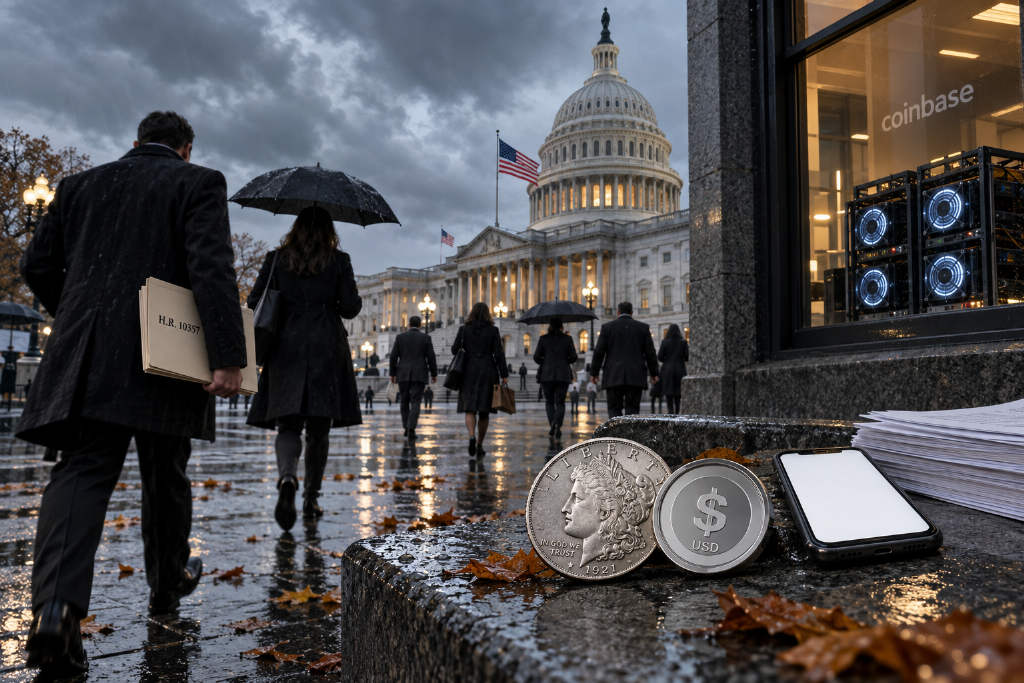
The US House Ways and Means Committee approved H.R. 10357, the Digital Asset Tax Certainty Act, by a 38-5 vote on Sept. 16, one day after the CLARITY Act failed to clear a procedural vote in the Senate. While the CLARITY Act is centered on SEC and CFTC jurisdiction and broader digital asset market structure, H.R. 10357 is aimed at a narrower question: how digital assets should be taxed in the United States.
The bill was introduced on Sept. 14 by House Ways and Means Committee Chairman Jason Smith, a Republican from Missouri. It has eight co-sponsors: Jodey Arrington, Aaron Bean, Mike Carey, Steven Horsford, Mike Kelly, David Kustoff, Max Miller and Rudy Yakym. The measure now awaits consideration by the full House. Even if it passes there, it would still need Senate approval and the president’s signature before taking effect.
Who backed the bill and where it came from
Mike Kelly, a Republican from Pennsylvania, serves as chairman of the Ways and Means Subcommittee on Tax. H.R. 10357 incorporates a digital asset charitable donation provision he had previously pushed, allowing eligible digital asset donations to use a simplified tax process closer to the one applied to publicly traded securities.
Steven Horsford, a Democrat from Nevada, is the only Democratic co-sponsor. According to Foresight News, he had been involved in the issue well before this vote. In May 2026, Horsford and Republican Representative Max Miller were among the lawmakers who introduced H.R. 8899, the Digital Asset PARITY Act. That earlier bill covered stablecoins, digital asset lending, wash sale rules, mark-to-market taxation, mining and staking rewards, charitable donations and investment trusts. Some of those policy directions later appeared in H.R. 10357, though the new bill does not adopt the full PARITY Act framework.
$10 threshold for certain fees
Under current Internal Revenue Service treatment, digital assets are generally treated as property. Using them to pay fees can also count as a taxable disposition, which means taxpayers may need to calculate basis and gain or loss.
H.R. 10357 would allow taxpayers to exclude gains or losses when digital assets are used to pay blockchain network fees of $10 or less, as well as qualifying brokerage fees, transaction fees, liquidity fees and similar charges.
The bill does not create a blanket tax exemption for all crypto payments under $10. The threshold applies to network and transaction-related fees, not to the purchase price of goods or services. Professional traders, brokers, digital asset dealers, service providers that process transactions in bulk for others, and certain entities that handled more than 5,000 digital asset transfers in the prior year generally would not qualify for the ordinary-user relief.
This provision is drafted to apply to dispositions occurring after Dec. 31, 2027.
Elective simplified accounting for widely traded digital assets
The bill would let taxpayers elect a simplified accounting method for eligible widely traded digital assets. The election is voluntary. It is not automatic for all investors, and it is not simply a tax cut. Instead, it would allow annual aggregate accounting by asset type in place of tracking basis lot by lot and recognizing gain or loss on each separate transaction. Eligible US dollar stablecoins would be excluded from this system.
Once a taxpayer makes the election, annual gain or loss for the same type of digital asset would be calculated under a single formula. In practical terms, the calculation compares one side made up of proceeds from dispositions during the year plus the fair market value of assets still held at year-end, against another side made up of the cost of assets acquired during the year, the prior year-end asset value and other statutory adjustment items. If the first amount is higher, the difference is annual gain; if lower, it is annual loss. Individual sales, exchanges and other dispositions during the year generally would no longer be recognized separately for that asset type.
The tradeoff is clear. The method reduces the work involved in identifying basis on a transaction-by-transaction basis, but all gain or loss calculated under it would be treated as short-term capital gain or loss. Once effective, the election generally could not be revoked during the first five taxable years. These rules are drafted to apply to taxable years beginning after Dec. 31, 2027.
Special rules for qualifying US dollar stablecoins
H.R. 10357 would determine the tax basis and transaction value of qualifying US dollar stablecoins by reference to the issuer’s promised US dollar redemption value.
If statutory conditions are met and the purchase, sale or exchange value of the stablecoin stays close to redemption value, taxpayers generally would not need to recognize gain or loss from very small price differences around $1. The bill uses thresholds including 99.5% and 100.5%, with different tests applying at different stages of a transaction.
That treatment would not apply to every token pegged to the dollar. To qualify, a stablecoin generally must be issued either by a permitted payment stablecoin issuer under the GENIUS Act or by a qualified foreign issuer lawfully registered in the United States. The Treasury Department would also need to publish a list of qualifying stablecoins periodically to the extent feasible.
Dealers, brokers, certain high-frequency traders, taxpayers using a functional currency other than the US dollar, and related-party transactions would face additional limits. These rules are drafted to apply to taxable years beginning after Dec. 31, 2026.
Traditional tax rules extended to digital assets
The bill would apply parts of the tax framework already used for securities and commodities to qualifying digital assets. The main items include:
- Eligible digital asset lending could receive nonrecognition treatment, provided the lending agreement meets conditions such as returning property of the same kind.
- Digital asset dealers and qualifying professional traders could elect mark-to-market taxation.
- Foreign investors trading digital assets through US brokers or agents could receive safe harbor treatment similar to the one used in securities and commodities trading.
- Donations of qualifying US dollar stablecoins or widely traded digital assets could be exempt from some qualified appraisal requirements.
- For other digital assets that do not fall into those two categories and are not tokenized digital assets, taxpayers would not be able to claim a charitable deduction by donating the asset directly. They could, however, sell the asset or exchange it into a qualifying US dollar stablecoin and donate the proceeds within the required period. If the conditions are met, the disposition gain would not be included in taxable capital gain.
The bill also states that these tax provisions cannot be used on their own to infer that a digital asset must be a security, commodity, debt instrument or equity under securities law or other laws.
Wash sale and constructive sale rules
At the same time that H.R. 10357 gives digital assets access to some traditional tax treatment, it would also bring anti-abuse rules into the market. Foresight News said the purpose is to close tax gaps specific to digital assets, including strategies that create artificial losses through quick sales and repurchases or lock in gains through derivatives without triggering recognition.
One major change is the wash sale rule. The bill would bring traded digital assets other than qualifying US dollar stablecoins into Section 1091 of the Internal Revenue Code. If an investor sells a digital asset at a loss and acquires a substantially identical asset within 30 days before or after the sale, the loss generally could not be deducted immediately and instead would be added to the basis of the replacement asset. The article gives the example of an investor selling bitcoin at a loss and buying back the same bitcoin right away; under the proposal, that loss could no longer be used immediately to offset other capital gains the way current rules allow.
Contracts and options tied to the asset would also be covered. Tokenized or wrapped assets that are economically equivalent to stocks, securities or other digital assets could also be treated as substantially identical.
The bill would also extend constructive sale treatment to digital assets. If an investor has not actually sold an appreciated digital asset but has largely locked in the gain through a short position, a forward contract or another offsetting position, tax law could treat the arrangement as if the asset had been sold and require recognition of the gain built up to that point.
In addition, the bill would adjust tax treatment for digital assets in foreign corporations, US possessions and hedging position combinations.
Mining and staking income classified as ordinary income
The proposal would place income from mining, staking and similar blockchain validation activity into a single category called income from digital asset validation support activities, and it would classify that income as ordinary income.
Source rules would generally follow the taxpayer’s residence status. For US residents, the income would usually be treated as US-source income. For nonresidents, it would usually be treated as foreign-source income. If the validation activity is carried out through a fixed place of business inside or outside the United States, the source determination would depend on the facts of that business location.
For investment trusts, the bill says a trust would not automatically lose its tax status merely because it stakes digital assets it holds, receives staking rewards or takes necessary liquidity management steps. But an entity that actively operates a blockchain validation business could not rely on that protection.
The article notes that while the bill clarifies the character of mining and staking income, it does not resolve the timing of recognition.
Broker reporting and a voluntary disclosure program
H.R. 10357 would revise digital asset broker reporting obligations so they line up with the stablecoin rules and the elective simplified accounting method.
Qualifying US dollar stablecoins acquired near redemption value would no longer need to be handled under ordinary transaction-by-transaction digital asset reporting. If a taxpayer elects simplified accounting for a category of widely traded digital assets, brokers could report transactions, net gain or loss, and beginning- and end-of-year fair market value on an aggregated asset-category basis.
The bill would also require the Treasury Department to establish a digital asset voluntary disclosure program within 12 months after enactment. Eligible taxpayers would have 24 months after the program is set up to file applications and amended returns, and to pay tax, interest and the specified digital asset violation penalties.
After completing the required remedial steps, taxpayers could receive partial relief from civil penalties. In qualifying cases, information disclosed voluntarily also could not be used to open certain criminal investigations or prosecutions tied to the violations already disclosed.
The Treasury Department would also be directed to study whether zero-knowledge proofs, smart contracts and other blockchain tools could improve information reporting, withholding, tax compliance and data protection.
Gambling loss provision added to the bill
The final part of H.R. 10357 adds language from the FULL HOUSE Act, which is not directly related to digital assets. It would restore the prior rule allowing taxpayers to deduct all gambling losses up to the amount of gambling winnings.
Under current law, beginning in 2026, the deductible amount is limited to 90% of actual gambling losses and cannot exceed gambling winnings. The article gives an example of a taxpayer who wins $100,000 and loses $100,000 during the year. Even though the economic result is zero, that taxpayer could still end up with $10,000 of taxable income because only $90,000 of losses would be deductible. H.R. 10357 would reverse that change.
What the bill is trying to address
As presented in the article, H.R. 10357 is aimed at a set of practical tax questions: which small fees do not need lot-by-lot calculations, how stablecoins should be accounted for, whether digital assets should receive some of the same tax treatment as traditional financial instruments, and what anti-abuse and reporting obligations should apply to investors and platforms.
Foresight News wrote that the value of the bill is not simply that it would make crypto pay less tax. The point, in its framing, is to build a more symmetrical system: reduce compliance costs that have little practical value, give digital assets access to some tax treatment already available to traditional financial assets, and bring over the anti-abuse rules used in those markets as well.
For now, the bill remains far from enactment. It has only cleared the House Ways and Means Committee, and the text could still change during consideration in the House or the Senate.
