


Author: Prof G Research Team
Translated by: TechFlow
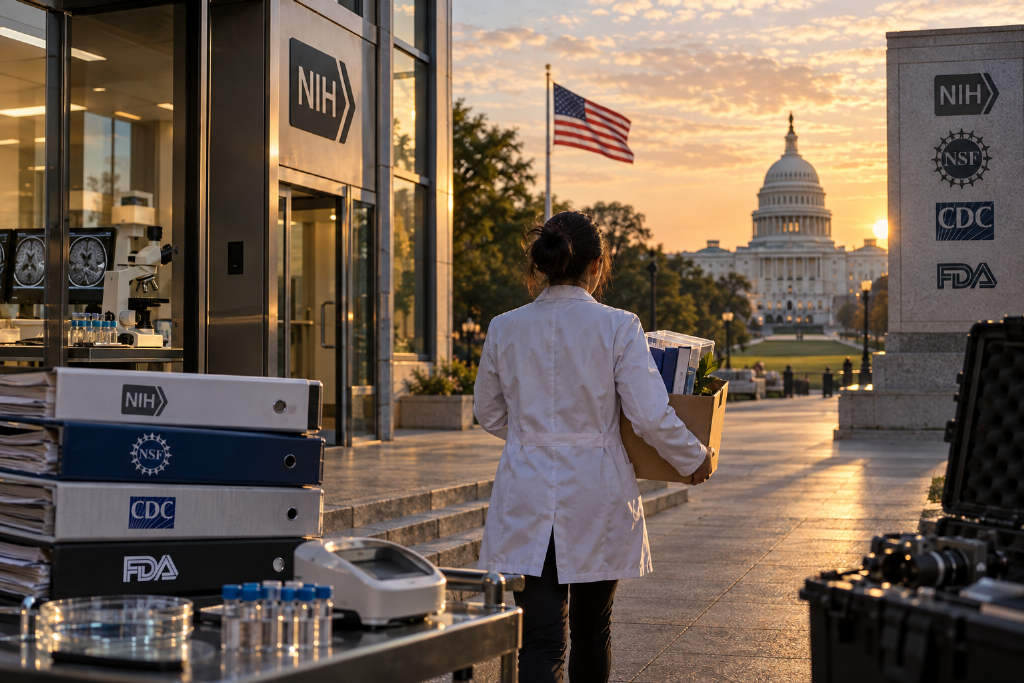
A commentary carried by MarsBit argues that the US is weakening the kind of federally backed science that has historically produced breakthrough drugs, defense technologies, and foundational discoveries. Its central question is simple: among the projects that are not being funded today, which ones might have changed everyday life 20 years from now?
The piece opens with the author’s visit to Washington, D.C., for the Golden Goose Award ceremony last month. The award recognizes federally funded research that looked obscure at first but later led to major advances in medicine, technology, and biology. One of the early winners, Dr. John Eng, helped lay the groundwork for GLP-1 drugs through his study of Gila monster venom. One of this year’s winners developed an FDA-approved liver tumor treatment from research involving a $5 bag of pig organs, then went on to found a company now valued at $4 billion. According to the article, she spent 20 years on the work, and for most of that time the federal government was her only source of funding.
That, the article says, is exactly the category of science the federal government is now abandoning. Since President Donald Trump returned to the White House, nearly $200 billion in federal funding has been cut, delayed, or otherwise disrupted across 17 policy areas and 21 federal agencies. The article says the impact goes well beyond what the administration describes as “woke” science or wasteful spending. It says the cuts have reached long-term studies of Alzheimer’s risk factors, randomized trials on opioid addiction treatment, and technologies designed to counter misinformation. At the same time, funds have been redirected toward this administration’s priorities, including artificial intelligence and quantum computing, as well as what the article describes as low-science pet projects.
A research system under pressure
The article argues that anyone who cares about curing disease, winning wars, or maintaining US dominance should care about the state of American science. It says every new drug approved by the Food and Drug Administration between 2010 and 2016 can be traced back to research funded by the National Institutes of Health, or NIH. It also links stealth technology, night vision, GPS, and precision-guided weapons to government-backed basic research. Nearly one-third of US patents, described in the piece as a foundation of American innovation, also depend on federally funded research.
Against that backdrop, the article says the country’s most successful and prestigious research system is being dismantled in a clumsy way. It says the National Science Foundation, or NSF, has issued 45% fewer research grants this year than its five-year average, the lowest level in 40 years. NIH grantmaking is down 13% from its five-year average. The Trump administration has also terminated more than 400 Centers for Disease Control and Prevention, or CDC, grants worth nearly $6 billion in total.
The administration’s stated rationale is to improve efficiency by eliminating what it calls wasteful spending tied to “DEI” programs. The article disputes that framing. It says grant processes and critical research have been canceled or delayed to satisfy the president’s preferences, and in many cases funding was later restored after officials realized the work was in fact essential.
Political screening and delayed research
The article says policy changes under the current administration have created more paperwork and longer waits for scientists. Every federal grant application now faces a new layer of political review. According to the piece, NIH staff were told to use a “computational text tool” to pre-screen applications. Staff members described it as a large language model trained to flag terms the administration does not like.
It cites reporting by Nature journalist Max Kozlov on a list of 235 flagged terms, including “racism,” “fossil fuels,” and “sexual minority,” with the latter used as a fragment intended to capture variations of “sexual minority groups.” Noam Ross, co-founder of Grant Witness, a public database that tracks federal spending cuts, said in the article: “It’s a euphemistic way of saying, ‘We have a lot of words and topics that are prohibited.’”
Some grants, the article says, were cut simply because they mentioned minority populations. It points to $15 million in Alzheimer’s research funding at Emory University and the University of Pittsburgh that was reduced in part because researchers were trying to understand why Black Americans are twice as likely as white Americans to develop Alzheimer’s disease or dementia. More broadly, it says the Trump administration has canceled nearly $800 million in NIH grants because those studies focused on or mentioned minority groups.
Renewals now take months rather than weeks, the article says, because political appointees comb through research documents for banned language. Staffing has also been cut sharply at US science agencies, adding to the delays. Among more than 11,000 grants disrupted at NIH, CDC, NSF, and the Substance Abuse and Mental Health Services Administration, or SAMHSA, the article says 65% were later restored either by courts or by reviewers themselves.
Still, the piece argues that delays have real-world consequences, including losses that cannot be undone even if funding eventually returns.
A pediatric brain cancer trial disrupted
One example centers on John Paul Macari, whose life, the article says, depended on federal funding. In March 2025, the 8-year-old boy was diagnosed with DIPG, an aggressive, inoperable brain tumor. The article says the disease has a five-year survival rate of just 2%, but his parents were hopeful because he could enroll in a clinical trial for a new mRNA therapy.
Five months after his diagnosis, however, Elon Musk’s DOGE cut funding for the NIH-funded Children’s Brain Tumor Network, which was supporting the trial. As a result, John Paul could not enroll. The network’s work is now being shifted into a broader hospital system, according to the article, but he was unable to take part in the next trial. He died on October 4.
The article says one category of research has not faced the same level of disruption: projects favored by political appointees. Ross says those scientific efforts are “usually not thought through very well scientifically.”
As an example, the piece points to an NIH call for proposals on metal toxicity published last month. That subject may sound harmless, Ross says, but he argues it serves as a convenient way to study aluminum in vaccines, a long-running fixation among anti-vaccine groups. The article adds that aluminum in vaccines has already been evaluated and deemed low-risk. It also notes that the window between the announcement and the proposal deadline was unusually short, suggesting the agency may have been soliciting proposals from a specific audience.
Money moves to AI and other priority areas
The article argues that government should not only fund the most exciting frontier work. It should also support research that private investors, driven by near-term financial returns, will not touch. That is often where scientific breakthroughs begin.
Instead, it says, the Trump administration has been reallocating research funds toward AI, quantum computing, biotechnology, and advanced materials for semiconductors and robotics, even though those fields are already attracting trillions of dollars in private-sector investment.
In 2025, health research lost $1 billion, while machine learning and AI gained $468 million and networking and information technology gained $368 million, according to the article. This year, the White House announced it would redirect $200 billion in science funding toward AI initiatives. At the same time, new NSF awards are down by more than 20% year over year.
The article quotes Sudip Parikh, chief executive of the American Association for the Advancement of Science, or AAAS, which publishes the Science family of journals. Parikh testified before Congress last year on the budget proposed by the Trump administration. “This is not a five-year problem. This is a 10-year, 20-year, 30-year problem,” he said, referring to the effect budget cuts could have on US science and the broader scientific enterprise.
At the 15th Golden Goose Award ceremony last September, Parikh also told the audience: “Our nation’s scientific and economic leadership starts in part by allowing researchers the freedom to pursue promising ideas, even when nobody knows exactly where those ideas may lead.”
The author adds that a livestream discussion with Dr. Parikh and Dr. Shruti Naik, a professor of immunology and dermatology at the Icahn School of Medicine at Mount Sinai, is scheduled for November 13 to examine what these long-term problems look like in laboratories and in the halls of Congress, and what breakthroughs may already be slipping away.
From a $5 bag of pig organs to a $4 billion company
Before the ceremony, the author spoke with several winners, including Dr. Zhen Xu. The article says Xu left Nanjing, China, in 2001 to attend graduate school at the University of Michigan. A year later, while experimenting with pig hearts to look for treatments for congenital heart disease, she lowered the frequency of ultrasound pulses after colleagues complained about the noise. What happened next was unexpected: the pulses punched holes in tissue.
At the time, the article says, Xu did not know she had discovered histotripsy, a tumor-destroying technique that does not require incisions, radiation, or toxicity. For years, few believed it could work in human patients. Scientists were skeptical, and investors saw it as too risky. Federal agencies were her only backers. Grants from NIH and later the Department of Defense paid for specialized equipment and for research showing what other conditions histotripsy might treat.
“Federal funding was absolutely critical, especially in the early stages, when you are laying the foundation that could lead to applications,” Xu said.
Twenty years later, histotripsy won FDA approval for liver tumors. Xu co-founded HistoSonics to commercialize the technology. The company is now valued at $4 billion, with backers including Jeff Bezos, Peter Thiel, and Reed Jobs. Time named it one of the 10 most influential health and life sciences companies of 2026.
“It all started with a $5 bag of pig organs,” Xu said. “Federal funding made the impossible possible.”
From coffee stains to sand piles
Another winner, Dr. Sidney Nagel, has spent his career asking questions that sound almost childlike in their simplicity. Why does the edge of a coffee stain dry darker than the center? His work eventually explained how evaporation drives particles toward the edge of a drying droplet, helping improve diagnostic tests used in medical settings.
Nagel also studied how materials such as glass, sand, and other particles stack and move in order to understand order within disorder. The article says those findings improved industrial processing and pharmaceutical manufacturing. The connection may sound indirect, but his curiosity about piles of sand helped drugmakers distribute powder inside capsules.
From splitting droplets to stars
The article closes with the author asking Nagel how he would defend his work to a skeptical taxpayer. His answer had two parts.
First, he said his biggest expense is people, because a major part of his work is training the next generation of scientists. Nagel said he sees that as teaching young researchers “to look at the world with an open mind, to see the things that are there in plain sight but might be overlooked.”
Second, he said there is inherent value in understanding the world humans live in.
He used splashing water as an example. Nagel studies what determines the shape and motion of a droplet when it breaks apart. He told the author this is a basic problem in mathematics and computer science. The singularity that appears when a droplet splits, he said, also appears in star formation, in the division of bacterial colonies, and all the way down to nuclear fission.
“The best part is, all I’m doing is studying something on a desktop,” he said.
The article ends with a direct argument: the task in front of the US is simple. Give great minds the freedom to explore, and the returns will appear over the coming decades.