
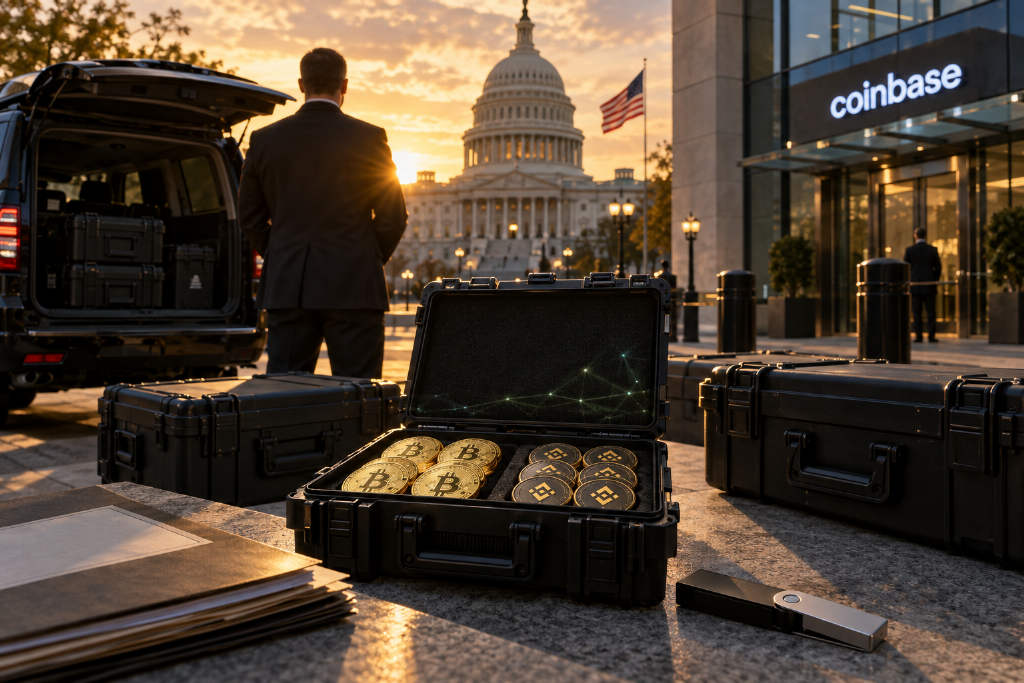
Wallets controlled by the U.S. government moved more than $100 million in Bitcoin and BNB on Tuesday, according to blockchain analytics firm Arkham.
Some of the funds ended up at Coinbase Prime. Traders often read that kind of move as a possible prelude to a sale, but the reason for the transfer — and whether any sale is actually planned — has not been confirmed.
833.6 BTC moved through intermediary addresses
The Bitcoin portion totaled 833.6 BTC, worth about $71.6 million. The coins passed through two unlabeled addresses before reaching deposit addresses that Arkham identifies as Coinbase Prime, the Coinbase service used by large institutions for crypto trading and custody.
Arkham linked roughly 568.7 BTC in that batch to forfeited assets tied to Sergei Potapenko and Ivan Turõgin. In this context, forfeiture means a court has approved the government’s retention of assets linked to a crime. The two Estonian men operated HashFlare, a crypto mining business that sold mining contracts without the computing power to support them.
Prosecutors said HashFlare generated more than $577 million in sales between 2015 and 2019. In August 2025, a federal court sentenced both men to the 16 months they had already served. The U.S. Department of Justice said the forfeited assets would be available to compensate victims.
Another 264.9 BTC came from the Bitfinex hack case
The remaining 264.9 BTC came from the Bitfinex hack. In 2016, hacker Ilya Lichtenstein stole 119,754 BTC from the exchange. In January 2025, the Justice Department argued that 94,643 BTC should be returned to Bitfinex. The government kept moving coins from that wallet throughout the day until it was fully drained.
40,285 BNB traced to Alameda Research seizure
The rest of the $103 million transfer consisted of BNB, Binance’s exchange token. The government moved 40,285 BNB worth $31.63 million to an unlabeled address, which later sent the full amount to another unlabeled address.
Arkham traced those BNB tokens to assets seized from Alameda Research, the trading firm tied to the collapsed FTX exchange.
A transfer is not the same as a sale
The movement does not by itself prove that a sale is coming. Coinbase Prime also serves as a custodian for the U.S. government, so a deposit there can mean storage rather than liquidation. Decrypt noted a similar $288 million transfer in July. For now, only the government knows which category this latest move falls into, and it has not said.
The U.S. government has sold large amounts of seized Bitcoin before, although not recently. In December 2024, it sent 19,800 BTC from the Silk Road seizure to Coinbase, then worth about $1.92 billion. Bitcoin fell more than 2% over the following 24 hours. Silk Road was an online black market that the government shut down.
Bitcoin trades on supply and demand, and a large government sale can weigh on the market. That is why traders keep a close watch on these wallets.
Strategic Bitcoin Reserve limits some disposal options
At the moment, government crypto sales are partly constrained by policy. A March 2025 executive order created a Strategic Bitcoin Reserve made up of forfeited Bitcoin that "shall not be sold." Bitcoin enters that reserve only after forfeiture is final, which means coins tied to open criminal cases sit outside it.
BNB does not fall under that Bitcoin reserve. It belongs to a separate Digital Asset Stockpile. Treasury may release those assets only for purposes such as repaying crime victims, law enforcement operations, or legal requirements. Treasury Secretary Scott Bessent has said forfeited Bitcoin forms the foundation of the reserve.
U.S. remains the largest government BTC holder in Arkham’s ranking
Tuesday’s transfer represents only a small share of the government’s overall holdings. In research published in September, Arkham estimated that the U.S. government held about 325,000 BTC worth roughly $27 billion, equal to around 1.6% of Bitcoin’s supply. That makes Washington the largest government holder in Arkham’s ranking, ahead of the U.K. with 61,245 BTC and El Salvador with 7,200 BTC.
Arkham said almost all of the U.K.’s holdings came from a fraud case that affected more than 120,000 Chinese pensioners. El Salvador’s Bitcoin, by contrast, came from direct purchases and mining.