
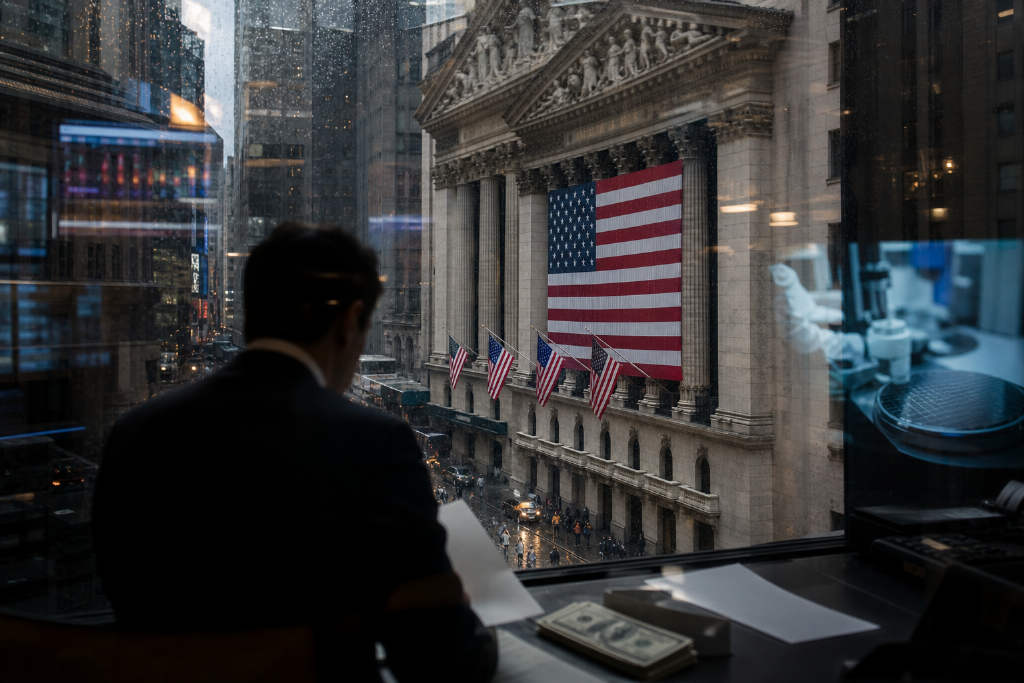
Wall Street closed higher on Thursday after another round of softer U.S. inflation data, though the rally remained concentrated in technology and semiconductors. The S&P 500 gained 0.65% to set a fresh record closing high, the Nasdaq rose 0.81%, and the Dow added 0.13%.
Producer prices cool and September hold odds rise
U.S. July PPI slowed to 4.7% year over year from 5.5% in June, while the monthly reading was flat. Both figures came in better than expected. Coming after an earlier soft CPI print, the data quickly pushed money markets to raise the probability of the Federal Reserve leaving rates unchanged in September to around 65%. Pricing for one full rate hike later this year also fell sharply.
The 10-year Treasury yield dropped about 5 basis points to 4.65%, and risk appetite improved. But the policy message was far from settled. Cleveland Fed President Hammack said on Thursday that “we must raise rates now,” arguing that the recent slowdown in CPI and PPI was not enough to confirm a turn in the trend. She also pointed to rising risks tied to an overheated economy, private credit and financial bubbles in AI.
Former Dallas Fed President and Goldman Sachs vice chairman Kaplan took a different line, calling for flexibility. He said inflationary and deflationary cross-currents were colliding and that, without the risk of oil being pushed higher again by conflict, “we wouldn’t even be discussing rate hikes.” Bank of America remained the most hawkish voice, reiterating a call for three rate hikes this year, with the first in September.
The front end trades inflation, the long end trades fiscal supply
While the inflation data helped the front end, the long end of the Treasury market reflected a different concern. The U.S. 30-year Treasury auction stopped at 5.216%, the highest level since 2001. A day earlier, the 10-year issue cleared at 4.683%, the highest since 2007.
Demand for long bonds did not collapse, but the composition worsened. The indirect bid in the 30-year auction fell to 66.8% from 77.7% in July, while primary dealers were forced to absorb a larger share. That pointed to softer demand from overseas and end investors, and to fiscal issuance demanding a higher term premium.
Allspring global fixed income portfolio manager Stanczyk warned that if investors continue to demand greater compensation for inflation and fiscal risks, long-end yields could break back above 5%. Barclays said the market was becoming more reliant on price-sensitive buyers and would need higher yields to clear supply. Fitch kept the U.S. at AA+ but warned that the 2026 fiscal deficit would widen because of tax cuts and tariff rebates. Interest expense in the current fiscal year has already reached $1.17 trillion, up 15% from a year earlier.
Against that backdrop, the 30-year fixed mortgage rate climbed to 6.69%, the highest since July 2025.
Oil falls and drone tariffs are announced
Crude turned lower, with WTI down about 2.5% and briefly slipping below $80 intraday. The International Energy Agency and OPEC both cut demand expectations. Tensions involving Iran remained elevated but did not escalate further, and a Houthi drone attack on Saudi Arabia’s Jizan refinery only caused a brief rebound.
CIBC energy trader Rebecca Babin said the market looked more like buyers had paused their chase than a true shift to bearish positioning. Bank of America also cautioned that, unless geopolitical conditions improve, a rapid pullback in oil prices would be hard to sustain. If inventories are exhausted, volatility could increase sharply. Diesel crack spreads were close to $100 a barrel, showing that refined products remained under heavy strain.
On trade policy, Donald Trump signed a proclamation imposing ad valorem tariffs of 10% to 100% on imported drones and drone parts for national security reasons. Products with takeoff weight above 25 kilograms, or those carrying highly sensitive specifications such as thermal imaging and key components, face a 100% tariff. Smaller configurations face 25%. Imports from the European Union, Japan and South Korea face 15%, while the U.K. rate is 10%. The main tariff schedule takes effect in 21 days.
SanDisk drives storage stocks higher
The strongest equity theme of the session came from memory and storage. At its 2026 investor day, SanDisk laid out long-range targets that included enterprise data-center flash TAM reaching 1.2ZB by 2030, mid- to high-double-digit revenue growth from fiscal 2028 through fiscal 2030, non-GAAP gross margin of about 80%, and adjusted free cash flow margin of about 50%.
The company also said 100% of cash remaining after business investment would be returned to shareholders, and that long-term contracts with eight major customers already covered about two-thirds of shipment volume for fiscal 2028. Investors responded by re-rating NAND from a cyclical commodity to part of the infrastructure layer for AI inference.
SanDisk rose as much as 18% intraday before closing up 13.67%. Western Digital gained 7.31%, SK Hynix rose 7.29%, Seagate added 4.91%, Micron gained 4.23%, and the Roundhill storage ETF advanced 3.89%. Meta also announced that it had joined the open standard alliance for high-bandwidth flash, reinforcing the view that an ecosystem is taking shape.
Workday jumps on acquisition talks
AI application software also moved sharply on event-driven trading. Workday surged as much as 30% intraday and finished up 17.78% after Reuters reported that private equity giant Silver Lake had spent months in talks over a possible acquisition of the enterprise software company.
Workday had previously been treated as a casualty of the “AI disrupts SaaS” trade and was down 18% for the year before the move. Co-founder Aneel Bhusri pushed back directly, saying that “no amount of Vibe Coding will produce an HR system.” The move spread across software: Cloudflare rose 6.22%, Palantir gained 4.66%, Adobe climbed 4.54%, Salesforce added 4.16%, and the iShares expanded tech-software ETF rose more than 3%.
Optical names and some AI hardware reverse lower
The flip side of the session was a sharp pullback in optical networking, which had rallied hard a day earlier. Coherent fell 7.99%, AAOI lost 5.79%, Lumentum dropped 5.58%, and Corning declined 5.32%.
Cisco fell 8.40% even though its fourth-quarter revenue reached a record $17.3 billion and EPS came in at $1.22, both above expectations. Investors focused on margin concerns instead of the headline beat. The company said quarterly AI infrastructure orders reached $4 billion, but even upbeat revenue guidance did not satisfy elevated expectations. Cerebras dropped as much as 18% intraday after quarterly revenue missed forecasts.
Applied Materials lost 2.48% and fell more than 5% after hours. The company reported third-quarter revenue of $9.12 billion, up 25% year over year, and adjusted EPS of $3.50, ahead of expectations. Its fourth-quarter guidance also topped estimates. The CFO highlighted strength in DRAM, leading-edge foundry and advanced packaging.
Model launches and IPO attention stay in focus
On the model side, Google introduced the stronger and cheaper Gemini 3.7 Flash, aimed at coding and more complex tasks. Even so, the market remains focused on delays surrounding the flagship Gemini 3.5 Pro.
OpenAI stayed at the center of IPO speculation. Its annualized revenue has now exceeded $40 billion, roughly double the level seen at the end of 2025. But the company’s chief revenue officer left less than a year after joining, becoming the second key executive departure this week and adding governance and execution risk to any future listing process. Rival Anthropic is said to have annualized revenue above $47 billion and could move first with an IPO this fall. Funding conditions for AI companies have opened up, but investors are also looking more closely at revenue quality, loss levels, compute costs and management stability.
Other movers and what comes next
SpaceX slipped 3.33%. A filing showed that, as of June 30, Elon Musk held about 48.4% passive ownership in SpaceX. The Public Sector Pension Investment Board of Canada disclosed a holding of 100,000 SpaceX shares, while the Ontario Teachers’ Pension Plan held about 50.70 million shares valued at roughly $8.7 billion.
Reddit rose 3.04% and gained more than 12% after hours after S&P Dow Jones Indices said the company would be added to the S&P 500 before the market opens on August 18. Since listing in March 2024, Reddit has posted more than 60% revenue growth for eight straight quarters and signed AI data licensing agreements worth hundreds of millions of dollars with OpenAI and Google. Even so, the stock had still been down about 31% for the year before the after-hours move as investors waited for more AI data deals to materialize.
Chinese ADRs were broadly weaker. The Nasdaq Golden Dragon China Index fell 1.84%, JD.com dropped 7.31% after earnings, PDD lost 5.46%, and Alibaba fell 2.44%. GDS Holdings bucked the trend with a 6.20% gain, while Tencent Music rose 2.36%. Among the “Magnificent Seven,” Tesla climbed 3.8%, Meta rose 2.78%, Apple added 1.00%, Microsoft gained 0.90%, Nvidia rose 0.54%, Google added about 0.46%, and Amazon slipped 0.80%.
Markets are now watching three near-term events. First is the U.S. July retail sales report due at 20:30 on August 14. A stronger-than-expected reading could revive the “consumer still firm, inflation still sticky” trade, pushing Treasury yields higher and putting pressure on growth valuations. A weak reading could strengthen the case for a Fed pause, while also increasing concern that the economy is deteriorating, which would favor bonds and defensive stocks over cyclicals and consumer names.
Second is the preliminary University of Michigan consumer sentiment reading and inflation expectations at 22:00 on August 14. Traders are focused on both one-year and longer-term inflation expectations. A further decline would support the pricing for no Fed move in September. A rebound, especially with oil and tariff risks still in the background, could put hawkish rate-hike messaging such as Hammack’s back into market pricing.
Third is Reddit’s formal entry into the S&P 500 before the open on August 18. Passive index buying could offer short-term technical support, after which the market will test whether the company can keep expanding AI data licensing revenue.