

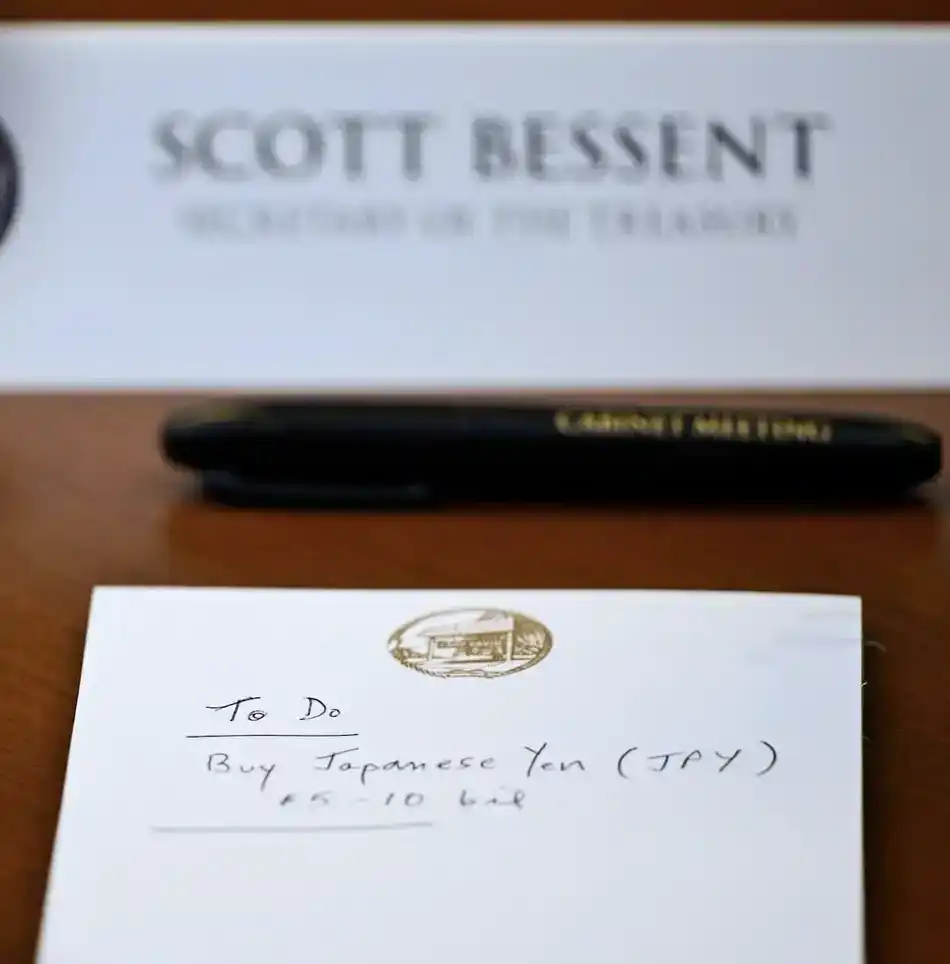
Signals of joint US-Japan intervention in the yen gathered force around Aug. 3, after officials on both sides confirmed that Tokyo and Washington had coordinated yen purchases.
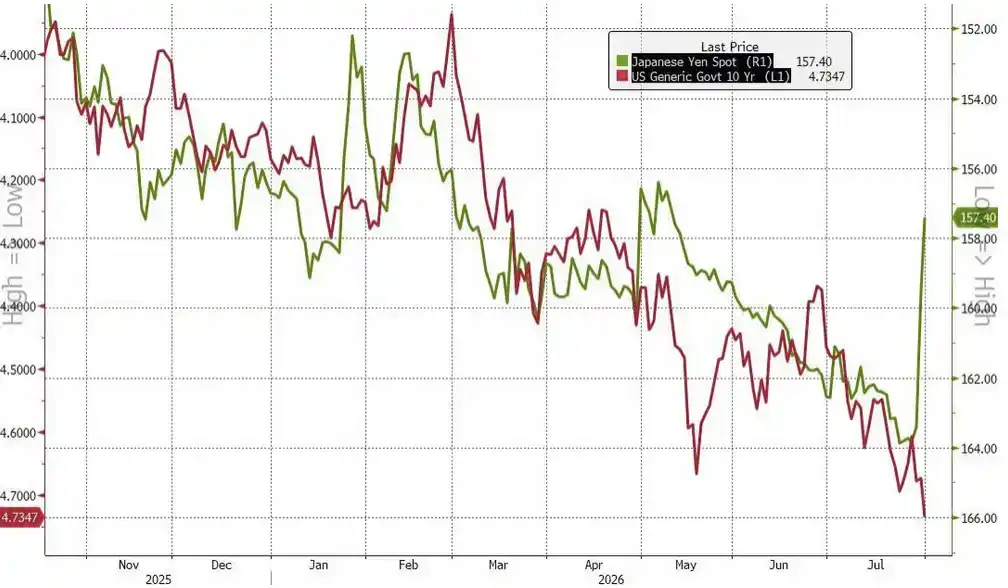
Japanese Finance Minister Satsuki Katayama said Japan’s Ministry of Finance had worked with the US Treasury to buy yen. US President Donald Trump and Treasury Secretary Scott Bessent later confirmed American participation and said they would not rule out another joint move. Following those statements, USD/JPY dropped quickly from levels near 164 seen last week, touching around 155.20 at one point. The Associated Press recorded the pair near 156.34 in early trading on Aug. 3.
Washington moved beyond verbal support
The main shift in this episode is not simply that Japan sold dollars and bought yen again. It is that the US moved from verbal backing to direct coordination.
For traders who had spent years betting on yen weakness, the old logic has not disappeared. US rates still sit well above Japanese rates, and dollar assets still offer carry. But the structure of the trade has changed. In the past, markets mainly had to judge how large unilateral Japanese intervention could be and how long it might last. Now they also have to factor in US participation, the possibility of repeat action, and the chance that officials are drawing a policy line around specific levels.
By late July, USD/JPY had approached 164 and the yen had slid to roughly a 40-year low. A weak yen can boost the value of overseas earnings for Japanese exporters when translated back into local currency, but it also raises the cost of imported energy, food, and raw materials. As the exchange rate pushed through areas such as 150 and 160 that had already been treated as sensitive, the Japanese government’s political tolerance for further depreciation appeared to fall.
Japan had intervened on its own before, but those moves often produced only brief rebounds. The market was used to a familiar sequence: the Ministry of Finance steps in, shorts cover for a while, and the US-Japan rate gap eventually pulls money back into dollar assets.
This time, that script changed.
Japan’s finance ministry explicitly used the term “coordinated intervention.” Bessent said the Treasury would remain in contact with Japan and “would not hesitate” to join another operation if needed. Officials may not need to spend huge sums repeatedly. If traders believe USD/JPY near 164 could once again trigger two-sided intervention, the tail risk of pressing fresh short-yen positions rises sharply.
A Reuters photo put a $5 billion to $10 billion figure in view
Reuters published a July 31 photograph showing Bessent’s notepad during a Camp David cabinet meeting. Under a “To Do” heading, the note read: “Buy Japanese Yen (JPY) $5-10 bil.”
The image does not prove how much yen the US ultimately bought. At the time the photograph surfaced, the Treasury had not confirmed a specific amount. What the note did show was that the department had at least considered a yen-buying operation of meaningful size, rather than limiting itself to diplomatic support for Japan.
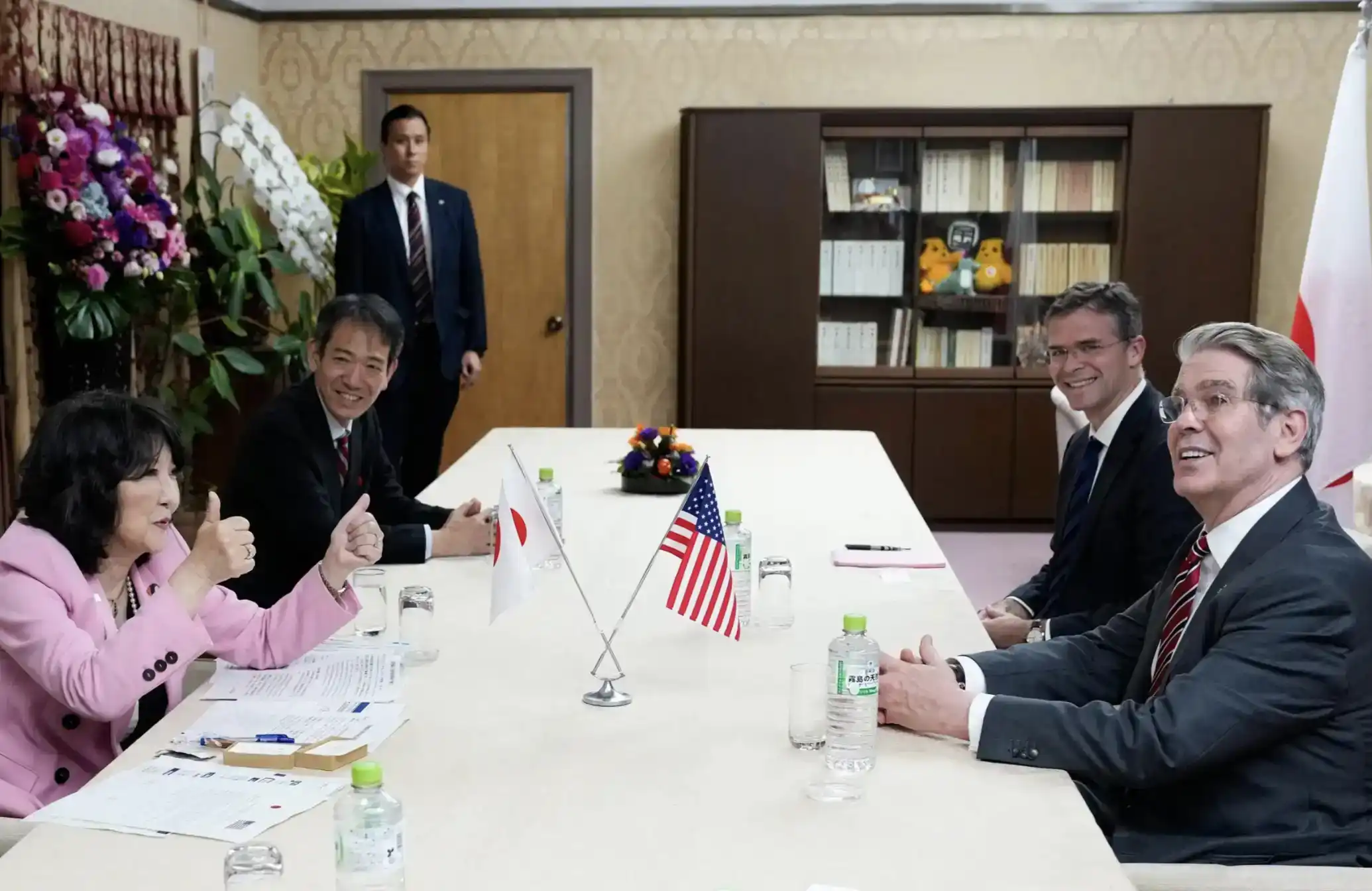
After both governments formally confirmed the joint intervention, the market significance of that photo increased. Bessent also said publicly that the US was willing to act again if necessary. A $5 billion to $10 billion operation may not be enough to alter the long-run supply and demand balance of the global foreign-exchange market, but it is large enough to force highly leveraged yen bears to recalculate stop levels and position size.
Intervention also works through channels beyond official spot buying.
When USD/JPY falls quickly, investors that borrowed yen to buy dollar assets take foreign-exchange losses. Some leveraged accounts need to post more margin, while trend-following and options positions can hit stop levels. Those liquidations require selling dollars and buying back yen, amplifying the currency’s short-term rebound.
The move from around 164 into the 155 to 156 zone likely reflected not only official transactions, but also concentrated deleveraging in carry and trend positions.
The carry trade is not gone, but the payoff has changed
Claims that the yen carry trade is over are still premature.
The Federal Reserve left its federal funds target range unchanged at 3.50% to 3.75% on July 29. The Bank of Japan kept its short-term policy rate at 1% on July 31. Even before hedging costs are considered, short-term rates in the US remain well above those in Japan, so the basic income advantage behind borrowing yen and holding dollar assets is still there.
What changed is the trade’s risk-reward profile.
Previously, investors could assume that unilateral Japanese intervention would create only temporary volatility, making it easier to rebuild short-yen positions after a rebound. Now they also have to pay a higher risk premium for the possibility of renewed US participation, more frequent intervention, and an earlier Bank of Japan rate increase.
That may push yen shorts to cut leverage, trim positions, or buy more options protection. It does not mean capital has fully abandoned carry. As long as the US-Japan rate gap stays wide, fresh selling pressure can return each time the yen rallies.
A more precise way to frame the shift is this: coordinated intervention has compressed the leverage space available to yen bears, but it has not removed the macro case for betting against the currency.
Treasury spillover risk exists, but the transmission channel has changed
The global implications of yen intervention do not stop at foreign exchange. They also depend on how Japan raises the dollars needed to support the currency.
US Treasury TIC data showed that Japan held about $1.143 trillion in US Treasuries as of the end of May 2026, making it the largest foreign holder. TIC data can be distorted by custody arrangements and does not map final ownership perfectly, but Japan’s position still matters when markets assess spillover risk.
The traditional chain is straightforward. Japan’s Ministry of Finance uses foreign-exchange reserves to sell dollars and buy yen. If it needs more cash dollars, it can in theory sell dollar assets, including Treasuries. Large and sustained Treasury sales could add supply to the market and put upward pressure on longer-dated US yields.
That transmission is not automatic.
Bessent said the Federal Reserve’s FIMA repo facility for foreign and international monetary authorities played a role in the operation. The facility allows foreign official institutions to pledge Treasuries held at the New York Fed in exchange for dollar loans, providing intervention liquidity without forcing immediate outright sales of US government debt. Bessent also said the tool should be expanded in the future.
That suggests one purpose of the US-Japan coordination may have been to help Japan support the yen while trying to avoid concentrated Treasury selling that would raise US funding costs.
For that reason, Treasury risk needs to be viewed on two levels. In the near term, the FIMA facility can cushion forced selling pressure. If intervention grows much larger and lasts much longer, Japan could still adjust its dollar asset allocation, and only then would the supply impact on the Treasury market become more pronounced.
Intervention can buy time, but rates still decide the longer trend
Coordinated intervention can reshape short-term positioning, yet it is unlikely to determine the yen’s medium- to long-term direction on its own.
The Bank of Japan has been moving away from ultra-loose policy, with its policy rate now at 1%, but the pace of tightening is still constrained by domestic growth, government financing costs, and stability in the Japanese government bond market. On July 31, the BOJ voted 8-1 to leave rates unchanged, with only one member arguing for an immediate increase to 1.25%.
That leaves Japanese policy under visible tension. The finance ministry wants to stop an overly rapid yen slide and reduce imported inflation along with political pressure. The central bank cannot rush into rate hikes just for the exchange rate, because that could lift Japanese government bond yields and raise financing costs for the state, companies, and households.
In that sense, intervention looks more like a tool for buying time. By creating two-way volatility and forcing shorts to reduce leverage, it can open a window for the BOJ to continue policy normalization gradually.
But the exchange-rate trend still comes back to fundamentals. If the BOJ keeps raising rates and US yields fall, narrowing the rate gap, the yen’s rebound has a better chance of lasting. If the gap stays wide for a long period, gains after intervention may still fade over time.
Still far from any “new Plaza Accord” narrative
Markets have already started using phrases such as a “new Plaza Accord” or the “end of the yen carry era,” but the current facts do not support conclusions that large.
The 1985 Plaza Accord involved multiple major economies coordinating a broad effort to drive an orderly decline in the dollar and reshape the global exchange-rate system. The current action is much narrower. Its immediate aim is to contain excessive and disorderly yen weakness and to limit the spread of currency and bond-market volatility into the wider financial system.
What can be established now is more limited but still important: the US and Japan jointly bought yen; Bessent’s notepad showed that Washington had considered a $5 billion to $10 billion operation; both sides said another round of intervention remains possible; and USD/JPY then fell quickly from near 164 into the 155 to 156 range.
That is enough to alter short-term trading behavior. It is not enough to prove that the yen has entered a durable appreciation cycle.
The next questions are clear. Will the US take part in another real market operation? Will the Bank of Japan accelerate rate hikes? And can the FIMA facility keep supplying dollars to Japan without creating a visible shock in the Treasury market?
Until those questions are answered, yen shorts are unlikely to disappear. But it is already much harder for them to assume, as they once did, that Japanese intervention is only a brief disruption and nothing more.