

The U.S. will release its July nonfarm payrolls report later tonight Beijing time, and the market enters the print with a wide split in expectations. Consensus stands at about 80,000 jobs, but published forecasts range from 40,000 to 157,000, leaving investors to weigh whether the recent run of disappointing July payroll reports will show up again.
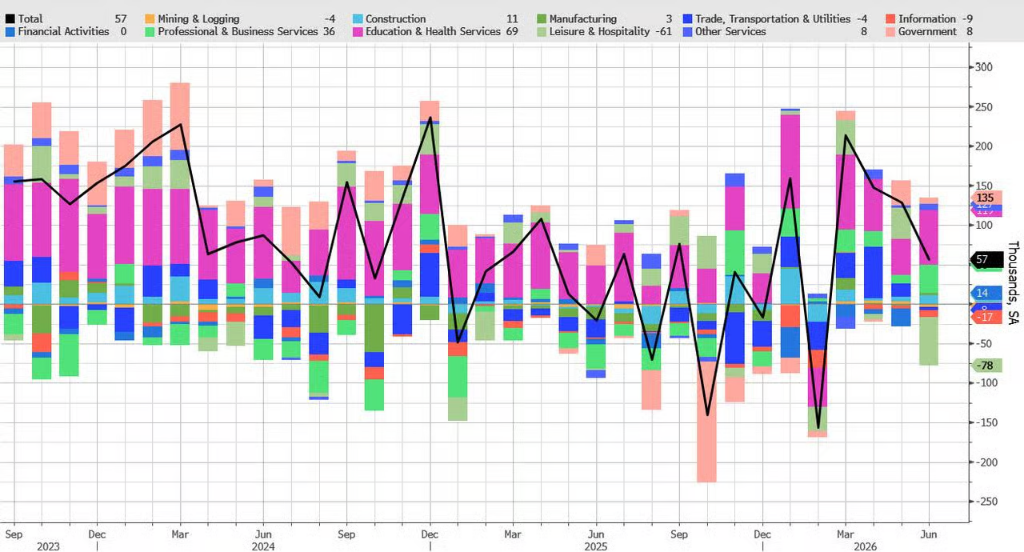
Goldman Sachs expects payroll growth of 75,000, slightly below consensus. Vanguard is far more cautious at 18,000, arguing that job figures in the spring were boosted by weather, World Cup-related hiring, and early local government recruitment, which could leave July exposed to a sharper payback. ADP private payrolls rose only 44,000, well below expectations, adding to concerns that the official number may disappoint.
A weak July pattern is back in focus
One of the main reasons this report is drawing so much attention is the recent tendency for July payrolls to miss expectations.
According to Goldman Sachs research, over the past three years, U.S. July nonfarm payroll gains have averaged 66,000 below the three-month average in place at the time and 35,000 below market consensus. Those weaker-than-expected releases also came with large downward revisions to the prior two months, with the average revision totaling 112,000.
Goldman economists Ronnie Walker and Jessica Rindels said that pattern is one of the central arguments for downside risk this time. The alternative job-growth indicators they track averaged 65,000 in July, down from 79,000 in June.
Barclays analysts also flagged revision risk in the June employment report itself. They said the report was based on only about half the usual survey response rate, leaving the Bureau of Labor Statistics, or BLS, more reliant on model-based estimates than normal. Barclays expects a sizable revision in this release, though the direction remains unclear.
World Cup hiring and low layoffs offer some support
Not every signal points lower. Several data points still suggest the labor market had some support in July.
Goldman sees World Cup-related hiring as one of the main offsets in its forecast. Homebase data showed that employment growth in World Cup host cities outpaced other areas during the survey reference weeks spanning June to July. Goldman estimates that effect could add about 10,000 jobs to July payrolls, mainly in leisure and hospitality, professional and business services, and trade and transportation. The same data, though, showed that the effect started to fade after the July reference period ended.
Layoff indicators have also looked constructive. Initial jobless claims fell to 210,000 during the BLS survey window in July, below 224,000 in June. In the specific week that aligned with the survey window, claims dropped to 188,000, the lowest since September 1969. Challenger, Gray & Christmas reported that announced job cuts fell by 12,000 from the previous month to 33,000 in July, the lowest level since July 2024.
Government hiring has shown signs of recovery as well. After roughly a year and a half of contraction, government employment has increased by an average of 12,500 a month over the past four months, and government job openings have recently rebounded.
Unemployment and participation rates may shape the read-through
Beyond the headline payroll number, the unemployment rate and labor-force participation rate are central to the market reaction.
Goldman expects the unemployment rate to edge up to 4.3% in July from 4.2%, above the consensus call for no change. The bank ties that partly to a reversal of June’s sharp drop in participation. In June, the participation rate fell to 61.5%, the lowest since March 2021 and, outside the pandemic period, the lowest since June 1976. Among prime-age workers aged 25 to 54, participation posted the biggest one-month decline on record outside April 2020.
Vanguard economists expect upward pressure on unemployment as some workers who left the labor force return to job seeking but do not find work as quickly as they re-enter. Vanguard’s year-end unemployment forecast stands at 4.6%.
Citi economist Veronica Clark said the labor market is currently in a “low-hiring, low-firing” equilibrium, a setup that is especially difficult for new entrants. She expects the unemployment rate to move above 4.5% in the coming months. If that happens, market focus could shift back toward rate-cut expectations. Citi’s base case is for cuts to restart in the fourth quarter of this year.
Fed officials still frame inflation as the bigger issue
For the Federal Reserve, the report’s policy value lies mainly in whether it hardens or loosens the market’s higher-for-longer baseline.
Recent comments from Fed officials have broadly described the labor market as stable. Fed Chair Warsh called it “resilient and stable.” Logan said it was “resilient and improving slightly.” Schmid described it as “roughly balanced.” Paulson and Hammack said it had stabilized. Barkin was more cautious, saying the market “doesn’t feel tight.” As a group, officials have treated inflation, not employment, as the more pressing policy challenge.
Oxford Economics said that even if average hourly earnings rose 0.4% month on month in July, the annual rate would still be only 3.6%, a pace it sees as consistent with the Fed’s 2% inflation goal. Wage pressure, in that view, is not a major inflation risk at this point.
According to Bloomberg, analysts said a strong payrolls report could push real yields higher, especially after Warsh previously said that markets had already done some of the Fed’s tightening work.
JPMorgan sees a “good news is bad news” setup
JPMorgan’s market intelligence team said this payrolls release may trade under a “good news is bad news” framework. A strong jobs number would reinforce pricing for rates to stay high for longer, lift yields, and weigh on rate-sensitive sectors. A softer or only mildly weak report, by contrast, could pull yields lower and nudge pricing in a more dovish direction, which may help equities.
JPMorgan laid out the following scenario analysis:
- If payrolls rise by more than 150,000, the S&P 500 is expected to fall by 50 to 175 basis points, with a 10% probability.
- If payrolls come in between 100,000 and 150,000, the index is seen between down 50 basis points and up 25 basis points, with a 25% probability.
- If payrolls land between 60,000 and 100,000, the expected move is down 25 basis points to up 50 basis points, with a 30% probability.
- If payrolls come in between 20,000 and 60,000, the index is expected to rise by 25 to 75 basis points, with a 25% probability.
- If payrolls are below 20,000, the index is seen between down 125 basis points and up 50 basis points, with a 10% probability.
Options pricing has been relatively restrained. Contracts expiring on Aug. 7 imply a move of only about 0.7%, suggesting that some uncertainty had already been absorbed as geopolitical tensions eased earlier. As of midday on Aug. 6, the 2-year Treasury yield had retreated to about 4.24% from a recent high of 4.35%.
Tonight’s payrolls figure, unemployment rate, and wage data are set to provide the next major test for how markets price the U.S. rate path.