With one week left before the Nov. 3 U.S. midterm elections, the crypto industry is focused on a basic question: what kind of Congress will Donald Trump face over the next two years? The presidency is not up for a vote, but control of the House and Senate is. For crypto, that distinction matters. A White House willing to support a policy does not guarantee Congress will move it forward.
The industry has already seen that gap this year. In September, the Digital Asset Market Clarity Act, or CLARITY Act, ran into resistance in the Senate. Even with support inside the administration and allies on Capitol Hill, the bill did not secure enough votes to advance. That is why crypto companies are still spending on elections: the fight is over who writes the rules, who can move legislation, and who may insist on reopening the terms.
What the midterms decide, and why crypto cares
U.S. presidents serve four-year terms, but Congress faces elections every two years. The election held in the middle of a presidential term is the midterm election. In 2026, Election Day falls on Nov. 3, and Trump himself is not on the ballot.
Congress has two chambers, the House of Representatives and the Senate, and each is elected under a different structure.
All 435 House seats are up for election. Representatives serve two-year terms, and seats are apportioned by population, with one member elected from each district. In a full House, 218 seats are enough for a majority.
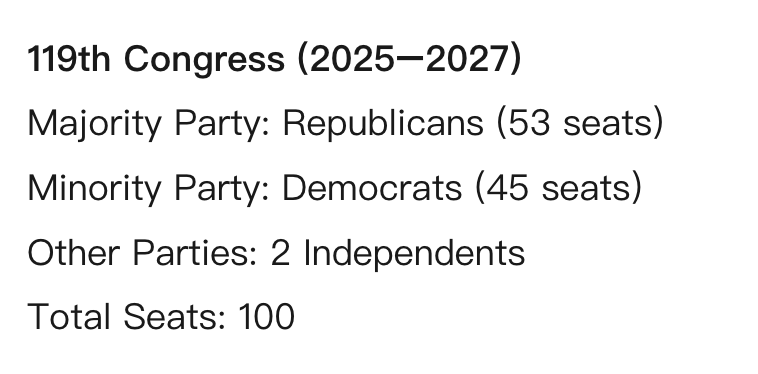
The Senate has 100 seats, with each state holding two. Senators serve six-year terms, and elections are staggered. This year, 35 seats are being contested: 33 regular elections and two special elections to fill unexpired terms. Control of the chamber depends on the 65 seats not up this year as well. Republicans currently hold 53 seats. Democrats and two independents who caucus with them hold 47. Democrats would need a net gain of four seats to reach 51 and flip the chamber. Republicans, if the Senate lands at 50-50, can still rely on the vice president to break a tie.
Voters cast ballots by state or district, and only after those individual races are counted does the balance of Congress become clear.
For a crypto exchange, a friendlier regulatory tone is useful, but the practical questions are more specific: is a token treated as a security or a commodity, which agency does a platform register with, and what rules apply to custody of customer assets? Different answers change both product design and compliance costs.
Regulators can adjust policy under existing law. Congress can change the law itself. In October 2024, Coinbase Chief Executive Officer Brian Armstrong said on an earnings call that support for Fairshake and Stand With Crypto had been among the company’s highest-return policy investments. His view was that clearer rules would help bring institutions and capital into the market.
That still leaves the legislative hurdle. On Sept. 15, the Senate held a cloture vote on a motion to proceed to consideration of CLARITY. The result was 49 in favor, 50 against, with one senator not voting, short of the 60-vote threshold. The procedural step failed, and the bill never reached a final floor vote.

One of CLARITY’s central aims is to define how the Securities and Exchange Commission, or SEC, and the Commodity Futures Trading Commission, or CFTC, divide oversight of digital asset markets. In the Senate, most ordinary legislation needs 60 votes to end debate. A simple majority is often not enough.
The dispute is not limited to market structure. Republican sponsors have said the revised text absorbed many Democratic changes and added strict ethics limits. Senator Elizabeth Warren, a Massachusetts Democrat, has argued those provisions still do not go far enough to address conflicts of interest involving the president and crypto businesses tied to him.
That helps explain why being “pro-crypto” is not a universal pass. Once lawmakers get into the details, they still argue over the text, and they still vote no.
Who is spending, and where the support is going
Legislation needs votes, and lawmakers need to win elections. That is where crypto money enters the picture.
Fairshake is one of the best-known super PACs in the sector. Its major backers include Coinbase, Ripple, and entities and individuals tied to Andreessen Horowitz, or a16z. Fairshake also has two affiliated groups: Defend American Jobs, which mainly backs Republican candidates, and Protect Progress, which mainly backs Democratic candidates. All three are part of the same industry funding network, not official party organizations.
These committees support or oppose candidates through independent expenditures such as advertising rather than direct donations to campaigns. Under Federal Election Commission rules, independent spending cannot be coordinated with candidates, their authorized campaign committees, or party organizations. So when a group says it is spending $1 million to support someone, that usually means ads and related activity built around that race.
On Oct. 5, Fairshake said it was backing 32 incumbent House members, including 19 Republicans and 13 Democrats. According to the Associated Press, those lawmakers shared one trait: all had supported the House version of the CLARITY Act. Among the six candidates slated to receive $1 million in support, French Hill chairs the House Financial Services Committee, and Bryan Steil chairs the panel’s subcommittee on digital assets, financial technology, and artificial intelligence. Those posts can shape drafting, hearings, and amendments.
Outside Fairshake, Fellowship PAC links another set of donors. Its disclosed contributions include $10 million from Cantor Fitzgerald and $1 million from Anchor Labs, the parent company of Anchorage Digital Group. In September 2025, Fellowship PAC said it had secured more than $100 million in funding commitments.
Fellowship PAC Chair Jesse Spiro also serves as Tether’s head of government affairs. Its donors have business ties to Tether as well: Anchorage Digital Bank issues its U.S. stablecoin USAT, and Cantor Fitzgerald handles designated reserve custody.
According to The Intercept, Fellowship PAC’s early spending mainly supported Republican candidates. In the summer, it also spent a combined $600,000 backing Democratic incumbents Ritchie Torres, Mark Warner, and Maggie Goodlander. The pattern, again, was not confined to one party.
Stand With Crypto, the advocacy group backed by Coinbase, has taken a different route through endorsements and voter mobilization. On Sept. 30, it announced its first three Senate endorsements: Republican Jon Husted, Republican Ashley Hinson, and Democrat Chris Pappas. Hinson and Pappas were both still House members at the time and were running for the Senate. The same announcement added endorsements for four House candidates.
Ohio offers one of the clearest examples of how these efforts diverge. Stand With Crypto backed Jon Husted, while Fairshake said in September that it planned to spend about $30 million opposing his rival, Sherrod Brown. Brown, a 73-year-old U.S. politician and former chair of the Senate Banking Committee, has sharply criticized risks and misconduct in crypto markets and in 2022 called for comprehensive federal crypto legislation to address potential financial stability risks and strengthen consumer protection.
Ripple co-founder Chris Larsen disagreed with that move. In a Bloomberg interview on Oct. 9, he called it “a really bad decision” and said Brown was not anti-crypto. According to the report, Larsen personally put $4 million behind Brown, while Ripple as a company has contributed $48 million to Fairshake in this election cycle. A Ripple spokesperson said at the time that Larsen and Chief Executive Officer Brad Garlinghouse were evaluating whether to continue funding Fairshake, with the final decision resting with Garlinghouse.
Where the race stands now
At this stage, Democrats appear more likely to retake the House, while the Senate remains much harder to call. National polling, seat-by-seat ratings, and prediction markets each show a different slice of the race.
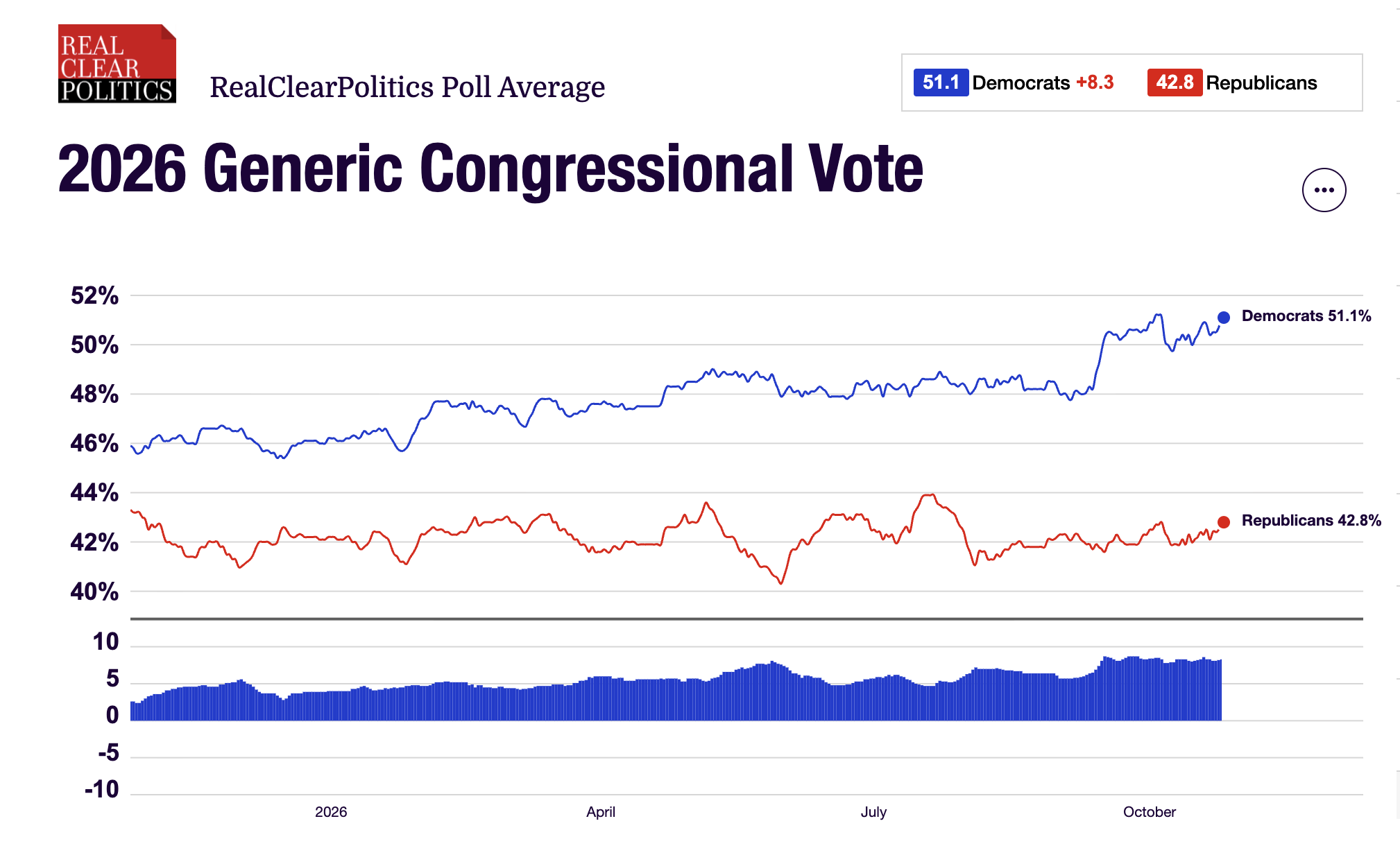
Start with national polling. As of Oct. 26, the RealClearPolling average for the generic congressional ballot showed Democrats at 51.1% and Republicans at 42.8%, a Democratic lead of 8.3 percentage points. The surveys included in that average were conducted between Oct. 8 and Oct. 23.
A CBS News/YouGov poll released on Oct. 25 also showed Democrats ahead, 53% to 45%. That survey was conducted from Oct. 21 to Oct. 23.
Still, a national congressional preference poll does not translate directly into House seats. It captures the national mood, but all 435 House races are decided district by district, where candidate quality and local conditions matter.
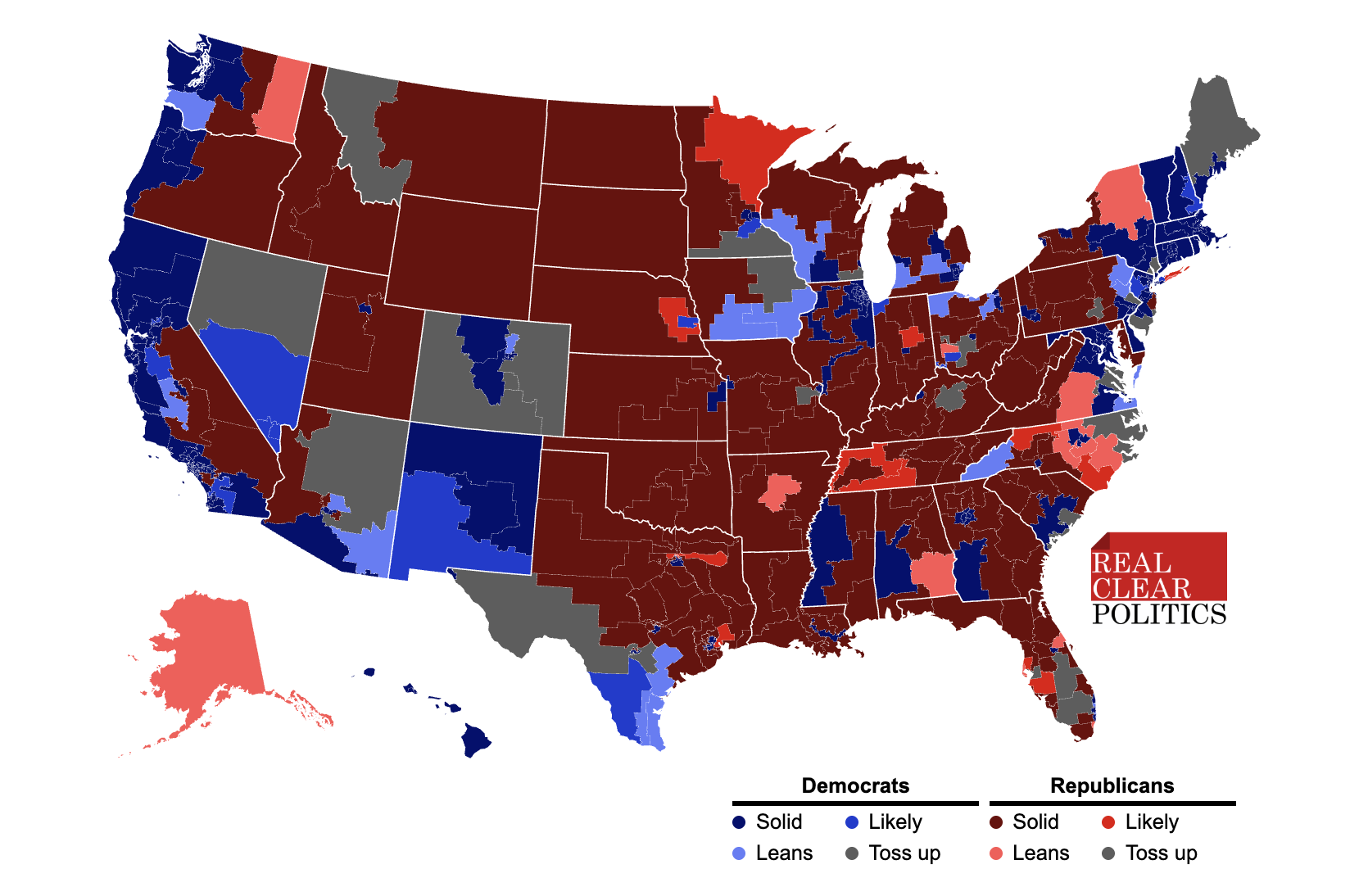
A district-level map gives a clearer picture of the House battlefield. As of Oct. 26, the RealClearPolitics House map rated 227 seats as at least leaning Democratic, 183 as at least leaning Republican, and 25 as too close to call. On that basis, the Democratic side was already above the 218 seats needed for a House majority. But “lean Democratic” is still a pre-election judgment, not a result.
The Senate is more complicated. Only part of the chamber is up this year, so even favorable national numbers matter only if they show up in the states holding elections. As of Oct. 26, the RealClearPolitics Senate map, combining the seats not up this year with race ratings, put Democrats at 46 seats and Republicans at 44, with 10 seats still highly competitive and unresolved. Ohio, Maine, Iowa, Texas, and Michigan stand out among the states to watch.
Ohio, already central to crypto spending, is one of those races. In polls compiled by RealClearPolitics from Sept. 22 through Oct. 22, Sherrod Brown led Jon Husted by 48.2% to 44.9%. Brown had an edge, but his average support was still below 50%, and the underlying surveys did not all point in the same direction.
Prediction markets offer another lens. As of Oct. 27, Kalshi showed Democrats with about a 90.5% chance of winning the House and about a 64% chance of winning the Senate. On Polymarket, the comparable contracts were about 92% and 66%.
Those figures reflect market pricing, not voter support. What they suggest is a fairly concentrated expectation that Democrats will take the House, while the Senate remains much less settled.
For crypto, that means watching not only which party controls Congress but also which individual candidates survive these races. Party control shapes the agenda. Individual winners shape how many votes a bill can actually command. Advertising can buy attention. It cannot supply the votes needed to pass legislation.
How crypto rules could change after the election
The first question is who will run the relevant committees. The key panels are the House Financial Services Committee, the Senate Banking Committee, and the Agriculture Committees in both chambers. The Agriculture Committees matter because they oversee the CFTC, and any attempt to divide authority between the SEC and CFTC over digital assets runs through that jurisdiction.
The majority party usually controls committee chairmanships, which gives it more power over hearings, bill markups, and investigations. In the Senate, those committees also review nominees for regulatory posts before sending them to the full chamber. A new Congress can therefore change three things at once: which bills move first, which regulatory decisions face scrutiny, and which people can enter the agencies. The specific chairs will only be known after the new Congress completes its organizing process.
There is also a timing issue. After the November vote, the current Congress still has time left in session. If CLARITY does not become law before this Congress ends, it would need to be reintroduced in the next Congress and go through the legislative process again from the start.
Based on the current seat map and the status of digital asset legislation, four broad scenarios frame what the election could mean for crypto.
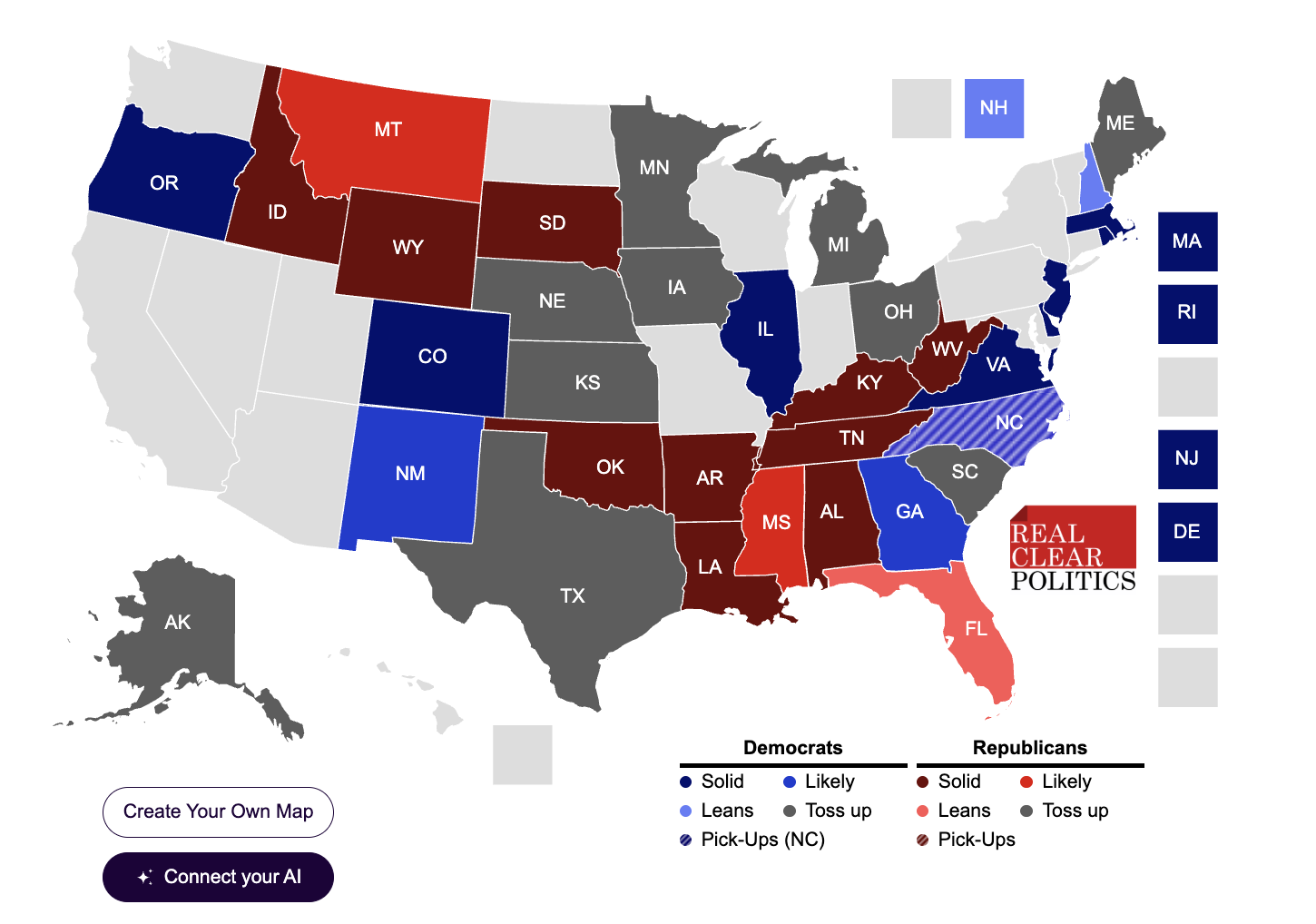
Scenario 1: Democrats win both chambers
On current numbers, this is the most likely outcome described in the article. Democrats would have more room to reorder committee agendas. Given Warren’s objections to the CLARITY Act, issues such as conflicts of interest involving officials with crypto business ties, investor protection, and the scope of regulatory exemptions could become central points in a renegotiation. Exchanges and token issuers might gain a clearer legal status only by accepting tighter limits.
Trump would still be president and would still hold veto power. A new Congress would not automatically remove current SEC or CFTC officials either. Democrats could push for rule changes, but whether any bill becomes law would still depend on agreement with Republican lawmakers and the White House. Overriding a veto would require two-thirds support in each chamber.
Scenario 2: Democrats win the House, Republicans keep the Senate
House Democrats could press for changes to ethics limits, customer protections, or regulatory design, while Senate Republicans could try to preserve the core of the existing framework. Both chambers must pass identical text before a bill can go to the president. If they cannot agree, the wait for a unified rulebook could stretch out.
Scenario 3: Republicans keep both chambers
In that case, Republicans and the White House would be in a better position to align on the agenda, which could help keep CLARITY moving. But the need for bipartisan votes in the Senate, and the disagreements among banks, securities firms, and crypto platforms, would not disappear just because the election ended.
Scenario 4: Republicans keep the House, Democrats win the Senate
This is described as a very low-probability outcome. As of Oct. 26, Polymarket assigned it just a 1% chance. If it happened, the House could still pass an industry-backed bill only to see the Senate demand changes or decline to move it. Any future SEC or CFTC nominees requiring Senate confirmation would also need Democratic support.
One historical pattern is worth noting. In 20 of the 23 midterm elections held from 1934 through 2022, the president’s party lost House seats. But losing seats does not automatically mean losing control of Congress, and election outcomes do not create a fixed relationship with asset prices.
Control of Congress shapes the legislative agenda and the room for negotiation. It does not determine by itself whether a bill passes or stalls. At the same time, banks, Wall Street firms, and crypto companies are all competing to shape digital asset rules. Stablecoin issuers want room to preserve product design and reward structures. Banks worry that stablecoin yields could pull away deposits. Traditional financial institutions are focused on access rules for custody, trading, and tokenized assets.
Those interests are not perfectly opposed, and crypto companies are not fully aligned with one another either. After the election, Congress will still have to balance financial innovation, the banking system, consumer protection, and regulatory authority. Political money can expand the industry’s influence. It cannot erase the conflicts underneath.
What happened to stocks and bitcoin after past midterms
Will markets breathe easier once the election is over? Historical data offers some support for that view, but not a clean answer.

In research published on Oct. 1, BlackRock said the S&P 500 has delivered an average total return of 14.1% in the six months after midterm elections since 1970, compared with 5.7% over the same window in non-midterm years.
Bring bitcoin into the frame, and the pattern becomes less tidy.
Looking back at the 2014, 2018, and 2022 midterms: in 2014, Barack Obama’s Democratic Party lost the Senate, giving Republicans control of both chambers; in 2018, Trump’s Republican Party lost the House but kept the Senate; in 2022, Joe Biden’s Democratic Party also lost the House while keeping the Senate. In all three cases, the sitting president’s party lost one chamber, but the starting conditions and market performance were different.
The article compares S&P 500 and bitcoin price performance over the 30 calendar days before and after each midterm Election Day. It notes that pre-election performance is measured from 30 calendar days before the vote to Election Day, and post-election performance from Election Day to 30 calendar days after. All timestamps use 4:00 p.m. New York time, with the most recent close used when the S&P 500 market was shut.
In November 2018, the market widely viewed bitcoin’s sharp drop as being driven mainly by the Bitcoin Cash, or BCH, hard fork and the resulting hash war, on top of a bear market breakdown that had already lasted close to a year and ongoing regulatory pressure.
In 2022, the FTX crisis collided with the election calendar. Midterm Election Day that year was Nov. 8. FTX halted withdrawals the same day and filed for bankruptcy on Nov. 11. With the election and the industry crisis unfolding almost simultaneously, it is difficult to isolate any election effect from that stretch of market action. Bitcoin had already been hit by the crisis at the statistical cutoff point.
Those three samples show concurrent performance, not causation. They also lack a comparison case in which the president’s party held both chambers after the midterms.
Bitcoin’s halving cycle adds another layer of timing overlap. Midterms happen every four years, and bitcoin halvings also occur roughly every four years. The midterm years 2014, 2018, 2022, and 2026 each came two years after the halving years 2012, 2016, 2020, and 2024. But elections follow a legal calendar, while halvings occur every 210,000 blocks. Similar spacing does not mean prices will repeat the same path.
For the crypto industry, the most direct consequence of the election is a change in who gets to debate the rules and which provisions have a chance to pass. Whether that produces clearer operating conditions, draws in more market participants, and eventually shows up in prices depends on what happens after the votes are counted.