
With only days remaining before the Nov. 3 U.S. midterm elections, new polling shows Democrats with a clear lead over Republicans in the national congressional vote. According to statistics compiled by Nate Silver’s Silver Bulletin as of Oct. 29, Democrats were ahead by 8.7 percentage points. That margin widened to 9.2 points when adjusted for likely voters.
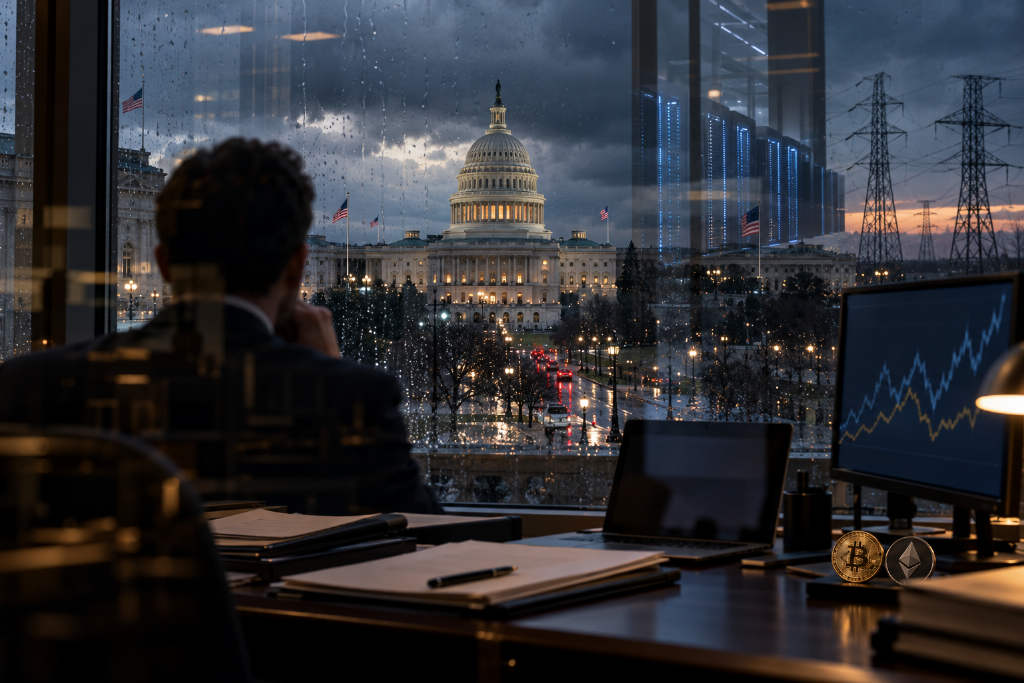
The election is being watched not only for its effect on control of Congress, but also for what it could mean for U.S. policy on artificial intelligence and crypto. The report reviewed recent Democratic positions on AI data centers, electricity costs, federal oversight, and digital-asset market structure legislation.
National polling shows Democrats ahead, but seat outcomes remain harder to map
The U.S. will hold its midterm elections on Nov. 3, with all 435 seats in the House of Representatives and roughly one-third of the Senate up for election. Because Republicans currently control the White House and both chambers of Congress, the vote is also being treated as a major test of public sentiment toward the first two years of Trump’s second term.
Silver Bulletin’s Oct. 29 tally put Democrats ahead by 8.7 points in the national congressional ballot. On a likely-voter basis, the lead expanded to 9.2 points.
A Reuters survey completed on Oct. 26 showed Trump’s job approval at 32%. In the congressional ballot among registered voters, Democrats drew 50% support versus 41% for Republicans. Among likely voters, Democrats led 53% to 44%.
Economic conditions and the cost of living remain among the most important issues for voters. The survey found that 73% of respondents believed the direction of change in U.S. living costs was wrong, and Democratic supporters showed stronger enthusiasm to vote than Republicans.
Still, a national polling lead does not translate directly into congressional seats. House races are shaped by the political makeup of individual districts, while Senate outcomes depend on the states holding competitive contests this cycle.
Two separate polls found broad opposition to new data centers in local communities
A Sept. 1 survey released by The Economist and YouGov highlighted a tension facing the U.S. AI industry. Large technology companies continue to spend hundreds of billions of dollars to expand computing infrastructure, yet most Americans do not want data centers built near where they live.
That survey, conducted from Aug. 28 to Aug. 31, found that 63% of respondents opposed data centers moving into their communities, while only 19% supported them. Opposition cut across party lines.
- Among Democratic supporters, 71% opposed new data centers in their communities and 14% supported them.
- Among independents, 66% opposed them and 15% supported them.
- Among Republican voters, 52% opposed them, compared with 28% who supported them.
Electricity prices were the central concern. The survey found that 60% believed data centers would push up local power bills, while 46% said they would reduce nearby home values. Another 51% said building new data centers would be bad for the U.S. overall, while only 20% said it would be good.
On Sept. 14, a separate national poll from the University of Massachusetts Amherst reached a similar conclusion: 65% of Americans opposed building AI data centers in their own communities, while only 11% supported the idea. Taken together, the two surveys suggest local resistance is no longer limited to isolated protests.
Some Democrats have already moved from efficiency demands to moratorium proposals
That public pressure has started to show up in legislation. Some Democratic lawmakers are no longer focused only on pushing technology companies to improve energy efficiency. They are also arguing for a pause on new AI data center construction until the federal government puts a fuller regulatory system in place.
On June 24, Democratic Representative Alexandria Ocasio-Cortez, or AOC, and several other Democratic lawmakers introduced the Artificial Intelligence Data Center Moratorium Act, H.R. 9442. The bill calls for a halt to new data center construction until Congress passes laws designed to protect the public from AI-related risks.
The report said the bill goes beyond electricity consumption and places the potential risks of AI technology itself inside the regulatory debate. The measure remains in committee and has not become law. It also should not be treated as a unified position of the entire Democratic Party.
Other Democratic lawmakers have taken a less confrontational route, favoring economic incentives and utility regulation that would require data centers to bear more of their own buildout costs.
In August, Democratic Senator Martin Heinrich introduced the GRID Savings Act, which would require large power users such as data centers to pay for added grid infrastructure rather than shifting those costs to households and small businesses. Democratic Senator Ed Markey, in July, put forward a discussion draft for a national data center regulatory framework focused on electricity prices, air pollution, water resources, and public health.
The report also pointed to a late-September vote on the Republican-backed Ratepayer Protection Act. The bill passed the House with 417 votes in favor, but failed to clear the Senate’s 60-vote procedural threshold. Most Democratic senators opposed it because, in their view, it only required regulators to consider cost allocation and did not provide mandatory protections. That split suggests the two parties are not simply divided into pro-data-center and anti-data-center camps; they are arguing over how strong regulation should be.
Local ballot measures are also shaping the outlook for data center expansion
The political risk for data centers does not stop in Washington. According to the report, voters in 10 U.S. states are set to vote on proposals that would limit data center development. Those measures span 38 local jurisdictions and at least 41 proposals, including temporary construction pauses, bans on facilities above certain sizes, and stricter permitting conditions.
Ohio is described as the center of the anti-data-center push, with 21 related proposals across more than 10 local jurisdictions. One proposal in Sunbury would ban data centers using more than 25 MW of electricity, a move that could directly affect Amazon’s $2 billion investment plan.
For large technology companies, the report said, that means constraints on U.S. data center expansion are no longer limited to GPU supply, access to power, and construction costs. Local politics and voter approval are becoming part of the equation.
For crypto, the main issue is tighter oversight rather than an immediate ban
For the crypto industry, the report said the main risk from a Democratic return to congressional power is not an outright prohibition on digital assets. The bigger issue is that Trump administration regulatory changes from the past two years could face tougher political scrutiny.
On Sept. 15, the U.S. Senate failed to advance the CLARITY Act through a procedural motion. The vote was 50 to 49, short of the 60 votes needed to move the bill forward.
The bill was designed to create a broad regulatory framework for the U.S. digital-asset market, clarify the jurisdiction of the Securities and Exchange Commission, or SEC, and the Commodity Futures Trading Commission, or CFTC, and provide a clearer legal basis for exchanges, token issuers, and decentralized finance, or DeFi.
Democratic lawmakers argued, however, that the bill did not adequately address the Trump family’s crypto business interests or possible conflicts of interest involving senior government officials who hold or trade digital assets. Republicans proposed revisions, but they still failed to secure enough support.
The report added that Democrats are not uniformly opposed to crypto policy reform. Some Democratic lawmakers support building a regulatory framework for digital assets, but compared with the Trump administration’s emphasis on deregulation and industry growth, some in the party place more weight on investor protection, political ethics, anti-money laundering, and market integrity.
If Democrats win control of either chamber of Congress, they could use committee investigations, subpoena power, and congressional hearings to examine the Trump family’s crypto businesses, prediction markets, and financial regulators more closely.
Another major variable is legal certainty. With the CLARITY Act stalled, the market may rely more heavily on administrative guidance from the SEC and CFTC. Those rules, however, are more vulnerable than formal legislation to future policy shifts and court challenges.
What could change after the election
Based on bills already introduced, public statements from Democratic lawmakers, and the structure of Congress, the report outlined several possible post-election scenarios.
On AI data centers, if Democrats control at least one chamber, they may step up oversight of electricity costs, environmental effects, and grid infrastructure investment tied to large technology companies. If those policies gain bipartisan backing, future power demand from large data centers may require tech companies to absorb more of the cost instead of passing it on to ordinary ratepayers.
On AI model regulation, some Democratic lawmakers may push for stricter safety testing, consumer protections, and oversight systems. At the same time, the report stressed that Democrats are not internally unified on AI development and regulation, and the moratorium position taken by a small group of lawmakers should not be treated as party-wide policy.
On crypto regulation, market-structure bills such as the CLARITY Act may have to be renegotiated. Democratic lawmakers may seek tougher anti-money laundering, conflict-of-interest, and investor-protection provisions, making legislative compromise harder.
Democrats may also pursue deeper investigations into prediction markets, Trump family-related crypto businesses, and administrative actions by the SEC and CFTC. The report noted, though, that a congressional investigation does not amount to a finding of illegality, nor does it mean existing administrative policy would be revoked immediately.
One institutional point stands out. Even if Democrats win the House, Trump would still control the White House, and the executive branch would not change hands because of the midterms. If Democrats were to win both the House and Senate, they could shape more of the congressional agenda and committee investigations, but major legislation would still usually require the president’s signature, and some Senate procedures would still face a 60-vote threshold.
In the report’s reading, the most immediate effect of a Democratic win on AI and crypto would likely be more frequent congressional investigations, more regulatory proposals, and higher compliance costs for industry, rather than an instant reversal of Trump’s technology agenda.
For AI, the Trump administration has argued that faster infrastructure buildout and fewer administrative barriers are needed to preserve U.S. computing competitiveness. Opponents argue that as technology giants chase AI returns, they may shift higher electricity prices, environmental burdens, and infrastructure costs onto the public.
For crypto, the Trump administration has argued that lighter regulation would help keep innovation and capital in the U.S. Some Democratic lawmakers, by contrast, worry that insufficient oversight would raise investor risk and create conflicts of interest inside government.
The report said companies including NVIDIA, Microsoft, Amazon, Google, and Meta, along with Neocloud operators investing in compute infrastructure, may need to pay closer attention not only to GPU supply, financing costs, and customer demand, but also to whether local governments approve projects and whether data centers will have to shoulder more of the cost of electricity and public infrastructure.


