


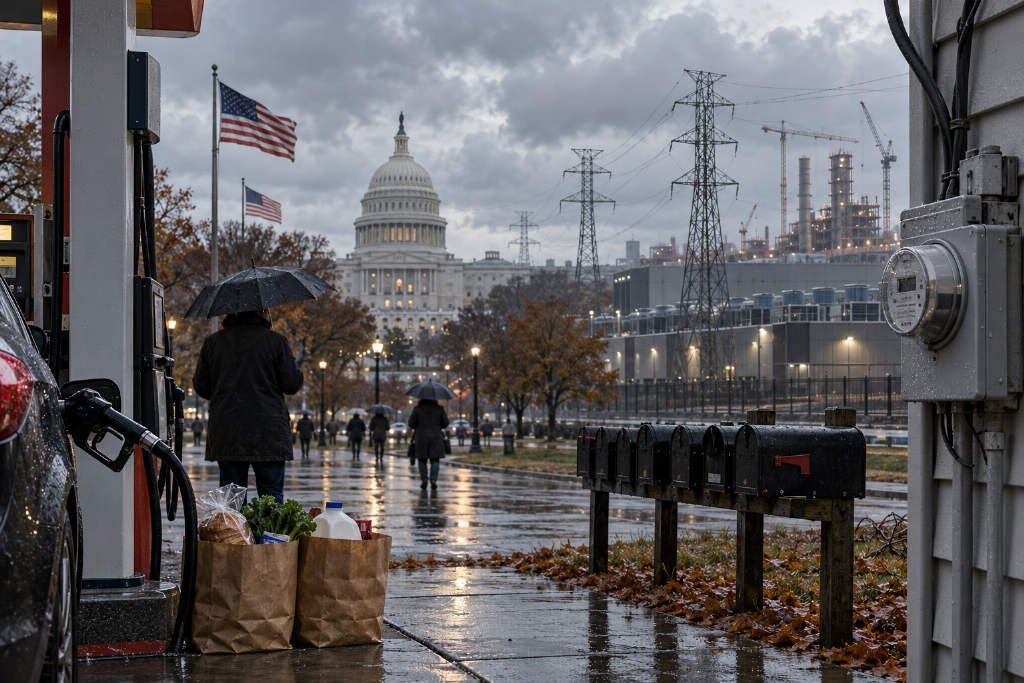
The U.S. 2026 midterm elections are scheduled for Nov. 3, and President Donald Trump has been traveling across states to promote tens of billions of dollars in manufacturing and energy investment projects. The message is straightforward: his tariff policy is helping push the country into a new industrial boom. The problem, as Bloomberg reported on Oct. 9 and Oct. 10, is that many of the projects being highlighted still carry uncertainty around financing, commercial viability and execution timelines, while voters remain focused on gasoline, food and electricity bills.
Bloomberg’s coverage tied the midterm race to energy, finance and AI, and also pointed to the gap between Trump’s promotion of large investment plans and the cost pressures households face every day. As AI data centers expand and power demand rises, the tech sector’s heavy capital spending, once framed mainly as an economic growth driver, is becoming part of a broader political fight.
Polymarket points to a stronger Democratic position
On Polymarket, midterm election predictions show 62% of funds backing a full Democratic victory. Another 29% back a split outcome in which Republicans win the Senate and Democrats take the House. Only 9% back a full Republican victory.
Trump’s investment push meets questions over the Alaska LNG plan
According to Bloomberg’s Oct. 10 report, Trump has made large manufacturing and energy projects a central part of his campaign pitch, including an Iowa steel mill, an Oklahoma aluminum smelter and the Alaska natural gas export project, which has been discussed for decades.
The most closely watched case is Trump’s recent statement that South Korea would invest $54 billion in the Alaska liquefied natural gas, or LNG, project. The plan would move natural gas from Alaska’s North Slope through an interstate pipeline before liquefying it for export overseas.
That project has long been constrained by high construction costs and difficult engineering conditions. Trump described the South Korean funding commitment as a major diplomatic and economic win and praised Alaska Republican Senator Dan Sullivan, who is seeking reelection.
Hours after Trump’s announcement, however, South Korean Minister of Trade, Industry and Energy Kim Jung-kwan said any South Korean investment would depend on the project’s commercial viability and was not an unconditional commitment. The response carried extra weight because South Korea had previously pledged $350 billion in U.S. investment in exchange for lower U.S. tariffs on some exports. Faced with Seoul’s reservations, Trump said the U.S. would raise tariffs on South Korean goods if South Korea pulled out of the investment.
The episode highlights a central issue in Trump’s investment agenda: announced investment totals do not necessarily mean companies have secured financing, obtained permits or started construction, and they do not mean jobs and economic benefits will arrive right away.
Market gains have not eased pressure on household budgets
The Trump administration has continued to point to rising stock prices, larger retirement accounts, reshoring in manufacturing and investment pledges as evidence that its economic policy is working. But the economic picture seen in capital markets looks very different from what many voters are dealing with at home.
Ongoing energy shocks have kept gasoline and diesel prices elevated. Food, housing and other basic expenses have also added to household strain. The Federal Reserve raised rates again in September as inflation pressure persisted, and mortgage rates climbed to their highest level of Trump’s second term.
The University of Michigan said in a preliminary survey released on Oct. 9 that U.S. consumer sentiment fell for a third straight month in October to 46.3, near a historic low. Its gauge of current economic conditions dropped to 44.7, showing deep dissatisfaction with living costs.
That leaves a political contradiction in plain view. Large factories, energy pipelines and AI infrastructure may produce long-term economic gains, but for voters paying high prices for fuel, food and electricity now, those promises do not necessarily solve the immediate problem.
Bloomberg cited Sameera Fazili, former deputy director of the National Economic Council in the Biden administration, as saying the Trump administration is eager to show it has a strong economic program and is repeatedly telling voters that more jobs will be created in the future. White House spokesperson Taylor Rogers pushed back, saying the administration’s pro-growth policies have already delivered tangible results, including historic investment, high-paying jobs and a return of manufacturing.
AI data centers turn electricity costs into a campaign issue
Beyond traditional manufacturing and energy projects, the rapid buildout of AI data centers is reshaping the political debate around the midterms. The Trump administration sees AI as a strategic industry that helps preserve U.S. global tech competitiveness and has backed data center construction, energy supply and large-scale tech infrastructure investment.
As more projects move ahead, local residents have started paying closer attention to grid strain, land use and rising power prices. Bloomberg previously reported that electricity bills in some parts of the U.S. are rising at a pace rarely seen in decades, driven by a mix of data center demand, grid upgrades, tariffs and energy prices.
In the PJM power market, which covers Pennsylvania, New Jersey and Maryland, residential electricity prices in those three states have risen about 40% since 2020. Some households may end up paying for the expansion of power infrastructure even if they do not directly benefit from the AI industry.
In another Bloomberg report from September, polling showed that about 70% of Americans do not want a data center built near their homes. Some political strategists have also warned that strong support for AI infrastructure could clash with voter concerns over living costs.
Bloomberg also noted that data centers are not the only reason electricity prices are rising. Power plant retirements, transmission and distribution investment, natural gas prices and other local factors also matter, and the actual effect still needs to be assessed market by market.