
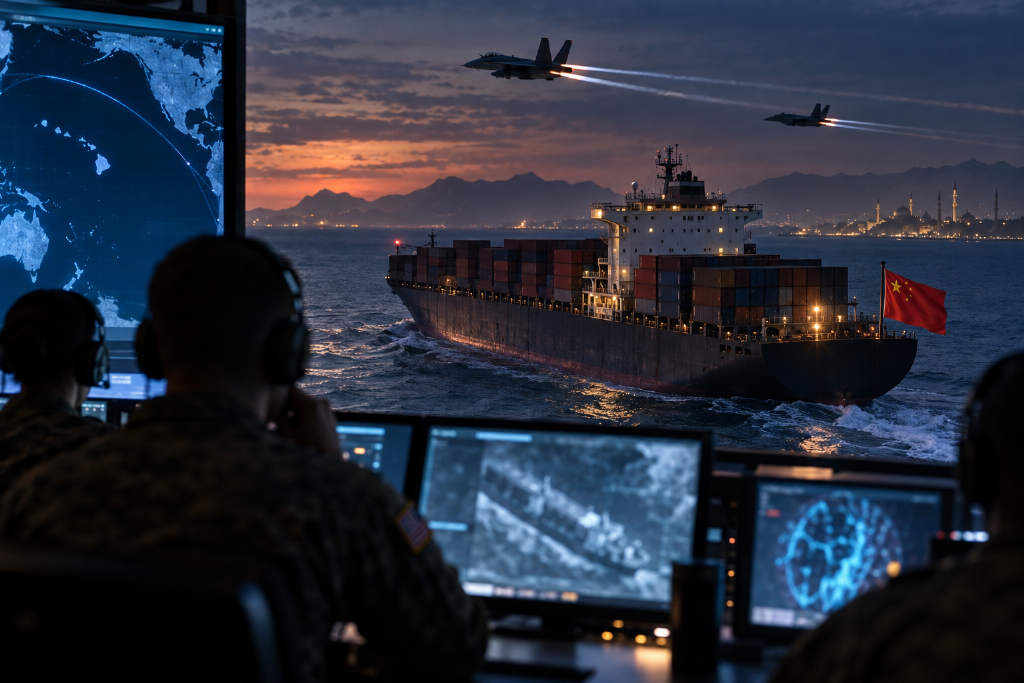
CNN reported that during the U.S.-Iran war this spring, the U.S. military nearly carried out an armed boarding of a Chinese ship sailing in the Middle East after intelligence supported by AI wrongly concluded that the vessel was transporting components for a nuclear weapons program.
CNN cited four people familiar with the matter as saying armed personnel were preparing to board the ship and military aircraft had already taken off. The operation was stopped only at the last moment. One source described the report as "completely wrong" and said it "almost sparked a war."
Chatbot-generated assessment led to the false conclusion
According to the report, the intelligence originated at U.S. Special Operations Command Pacific in Hawaii. An analyst there used a chatbot to examine intelligence tied to the ship's cargo manifest. The chatbot combined open-source information with classified signals intelligence held by the government, then concluded that the vessel was carrying components for a nuclear weapons program.
That conclusion did not hold up. CNN said it was unable to determine what cargo was actually on board, but confirmed that the chatbot had misidentified the shipment. The report presented the case as an example of AI hallucination.
Officials caught the problem just before action
CNN said officials took a closer look at the intelligence just before the operation was set to proceed and then discovered that the assessment had come from AI and that its conclusion was false. Because any U.S. military move against a Chinese vessel could carry serious consequences, sources said the mistake came dangerously close to triggering a broader confrontation.
CNN said it could not determine whether the chatbot involved was a commercial product or a tool developed by the U.S. government. Still, a former senior U.S. official familiar with AI tools used in military intelligence systems told CNN that many internal systems are essentially commercial products with different packaging.
Debate centers on AI in targeting decisions
The report said policy circles in Washington have spent recent weeks debating whether AI could one day slip beyond human control. This case points to a more immediate risk: not a machine acting on its own, but humans making potentially lethal decisions based on wrong answers produced by a machine.
Sources told CNN that the military is moving quickly to use AI in targeting, the process used to decide what should be struck. One person familiar with current military policy said the use of AI in targeting is accelerating, but there is still no real guidance on how a human decision loop should prevent civilian casualties or friendly-fire mistakes.
Sources say similar hallucinations are not isolated
Another source said that since these tools became more common across the government, similar hallucination-style problems have not been isolated incidents inside the intelligence system. Some senior intelligence officials broadly support the military's use of AI, but they are also concerned that the technology is putting analysts under pressure to produce and publish intelligence faster, leaving more room for mistakes.
Multiple sources specifically pointed to younger analysts, saying they are native users of these tools and may be more likely to accept outputs without enough skepticism. As one source put it, "AI can get you to a bad idea faster."
The incident was not disclosed publicly at the time, and the U.S. military ultimately did not act. Still, CNN's account shows how the same process that speeds up military decision-making with AI can also speed up serious errors.