
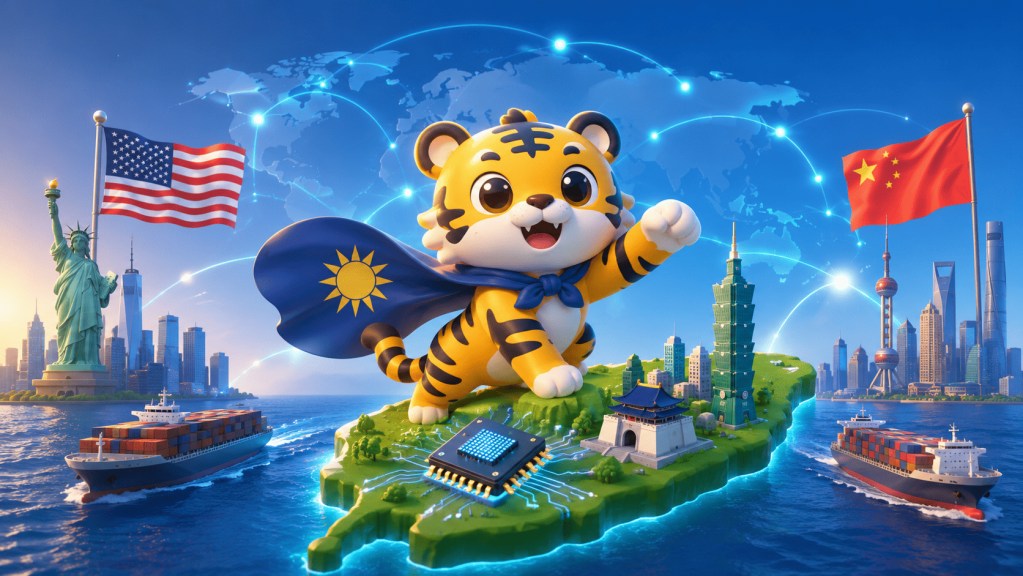
The Wire China says Taiwan is re-emerging as a “Taiwan Tiger,” with its latest rise tied not to China but to AI, semiconductors, and closer integration with U.S. supply chains.
The feature, titled The Return of the Taiwan Tiger, was written by veteran American journalist Chris Horton. Horton has reported from Taiwan for more than a decade and has written for The New York Times, Bloomberg, and Nikkei Asia. He is also the author of Ghost Nation: The Story of Taiwan and Its Struggle for Survival.
The U.S. moves ahead of China
According to the report, U.S. imports of goods from Taiwan totaled $116.1 billion in the first five months of the year, overtaking imports from China, including Hong Kong, which stood at $105.5 billion. The article says that, for Taiwan itself, the U.S. has now replaced China as its largest trade partner.
It contrasts that with 2016, when two-way trade between Taiwan and China was about $180 billion, more than double the $85 billion in Taiwan-U.S. trade. Horton writes that Taiwan’s economic center of gravity has gradually shifted toward the U.S. over the past decade, following supply-chain policies aimed at reducing dependence on China under former President Tsai Ing-wen and their continuation under President Lai Ching-te.
AI demand is driving the change
Horton argues that artificial intelligence is the main force behind the shift. As Apple, Microsoft, Google, Amazon, Meta, and Oracle invest a combined $750 billion to $1 trillion this year in AI infrastructure, demand for advanced chips has surged, and Taiwan sits at the center of that supply chain.
The report says Taiwan’s GDP grew 14.6% year over year in the first quarter, lifted by AI-related exports. A decade ago, Taiwan’s growth rate was still below 2%.
TSMC as a strategic hub
The article says Taiwan Semiconductor Manufacturing Co. is no longer only the world’s largest contract chipmaker. It has become a strategic hinge in U.S.-China technology competition.
Rupert Hammond-Chambers, president of the U.S.-Taiwan Business Council, is quoted in the piece as saying: “TSMC has become an indispensable technology company for the world. In U.S.-China technology competition, Taiwan is the hub of the entire contest.”
Taiwanese investment is being redirected
Fifteen years ago, more than 80% of Taiwan’s outbound investment went to China, according to the article. That share has now fallen to less than 1%.
In its place, U.S. states including Arizona and Oklahoma are actively trying to attract Taiwanese manufacturers and have set up offices focused on Taiwanese investment. Taiwan is also planning a new economic and cultural outpost in Arizona.
The report adds that commercial traffic has become more active as well. It points to Starlux Airlines launching a Phoenix route and EVA Air adding direct Washington-Taipei service as signs of warming economic ties.
The geopolitical question behind the numbers
Horton writes that the deeper issue is not the trade figures alone, but what tighter economic alignment could mean geopolitically.
In the article, former minister without portfolio and Tsai administration chief trade negotiator John Deng says that closer economic ties mean U.S. corporate interests, supply chains, and investment are becoming more deeply tied to Taiwan. In that framing, any conflict in the Taiwan Strait would impose a far higher economic cost on the U.S. than in the past.
Three structural challenges remain
Even as the report describes a new phase of growth, it also identifies three structural problems Taiwan still needs to address:
- AI-driven fab expansion is putting more pressure on power supply and grid construction
- Water shortages and climate change are increasing operational risk for the semiconductor industry
- Low birth rates and an aging population are worsening demographic strain
From factory base to AI hub
Horton’s conclusion is that Taiwan is going through its most important economic transition in nearly a decade. The island, which had gradually lost some of its “Asian Tiger” shine as China rose, is again becoming a key node in global technology and geopolitics because of the AI boom, TSMC’s position in the global chip chain, and the restructuring of Taiwan-U.S. supply links.
He argues that this is not a short-term business cycle. Instead, it reflects a new strategic position shaped by ten years of supply-chain reorganization: a move away from an export model centered on the China market toward a role as an AI-era hub tied to U.S. technology demand.