
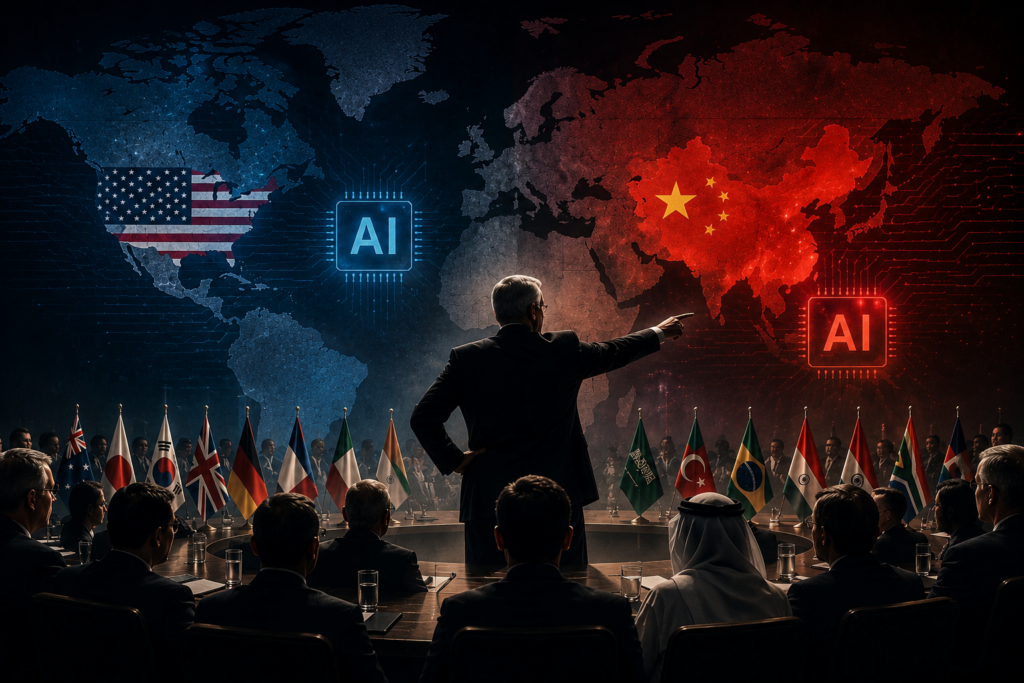
The US State Department is preparing to send a letter to 35 countries telling them they must choose between the American and Chinese AI camps, according to a draft internal document obtained by Reuters. Under the draft, countries that also join China-led WAICO would be shut out of cooperation under Pax Silica.
The draft targets 35 signatories of the AI Opportunity Statement
The letter was drafted by the State Department and is expected to go to the 35 countries that signed the “AI Opportunity Statement” in June. Reuters said those countries also overlap with members of the Pax Silica framework.
The AI Opportunity Statement was signed by 35 countries that expressed a willingness to work with the United States on cross-border AI research, critical minerals, and infrastructure. The report named the United States, Japan, South Korea, Australia, the United Kingdom, Germany, the Netherlands, India, Singapore, Israel, the United Arab Emirates, Qatar, and Kazakhstan among the main participants.
Pax Silica is nonbinding, but Washington is treating it as a political test
Pax Silica was launched by the United States in December 2025 and focuses on trusted supply chains for semiconductors, AI models, and critical minerals. It is a nonbinding framework, which means signing it does not create legal obligations. Even so, the report said Washington is now using it as a threshold for political alignment. About 25 countries have signed the declaration so far, including US allies such as Japan, Australia, and South Korea.
Reuters drew a distinction between the two US-led formats. Pax Silica members can take part in shared AI investment projects, while countries that signed the AI Opportunity Statement have so far only signaled agreement with US “common goals” and a “common vision.” The report added that Taiwan is not a formal member of Pax Silica but has separately expressed support for its principles.
Reuters said it could not confirm when the letter would be sent, and it remains unclear whether the draft will be revised before any final version goes out. The State Department told Reuters it would not comment on what it described as a leaked internal document.
Kazakhstan has become the warning case
Reuters said the immediate trigger for the US move was Kazakhstan. The Central Asian country, which holds large reserves of critical minerals, was promoted by Washington in June as the first Central Asian member of Pax Silica. At the same time, it also joined Beijing’s side. Reuters described Kazakhstan as the only known country currently straddling both camps, a case that “rang alarm bells” in Washington.
An unnamed US official told Reuters that the letter was meant to make one point clear: 「You can’t have both.」 The official said it is difficult for a country to claim to be a trusted partner in one technology ecosystem while also joining an initiative designed by China to advance a competing vision, adding that 「it doesn’t make sense logically.」
The official spoke on condition of anonymity because the issue was still being discussed inside the US government. Reuters said that reflected genuine concern in Washington over the Kazakhstan case. In July, Chinese President Xi Jinping launched the World AI Cooperation Organization, or WAICO, promoting an open-weight technology path that challenges US leadership in the field.
WAICO has moved faster than Pax Silica
Behind the pressure campaign is a wider contest over AI development. Reuters said China’s open-weight models are rapidly closing in on the closed systems built by US companies such as OpenAI and Anthropic. The growth in AI systems with autonomous hacking capability has also forced governments to reassess the risks tied to the technology.
WAICO was established in mid-July and signed up 29 countries within a month. Its headquarters are in Shanghai. By contrast, the United States took more than half a year to secure about 25 signatories for Pax Silica. Reuters framed that as a sign that China’s push has been faster and more aggressive.
Beijing also holds what the report described as a near-monopoly position in critical minerals. It said that after the Trump administration launched a tariff war last year, China repeatedly used mineral export controls as a countermeasure. That supply chain exposure is one of the reasons Washington is eager to draw resource-rich states such as Kazakhstan into its own bloc.
An exclusivity demand inside a nonbinding framework
The report also pointed to a contradiction in the draft letter itself. Pax Silica remains a nonbinding framework, and the main tangible benefit Washington can offer is access to shared investment opportunities. The letter, however, asks other countries to give an exclusive commitment, creating what Reuters described as an uneven exchange.
Kazakhstan illustrates that tension. With large critical mineral reserves, it may hold more leverage than Washington if it is forced to make a hard choice. Reuters said WAICO emphasizes open membership, capacity building, and multilateral governance, with a focus on Global South countries and a lower barrier to entry. Pax Silica, by comparison, centers on a trusted inner circle, supply chain resilience, and export controls, which sets a higher bar.
For core US allies such as Japan, Australia, and South Korea, the cost of choosing sides may be close to zero. Across the full list of 35 signatories, Reuters said, that is unlikely to be true for every country.