
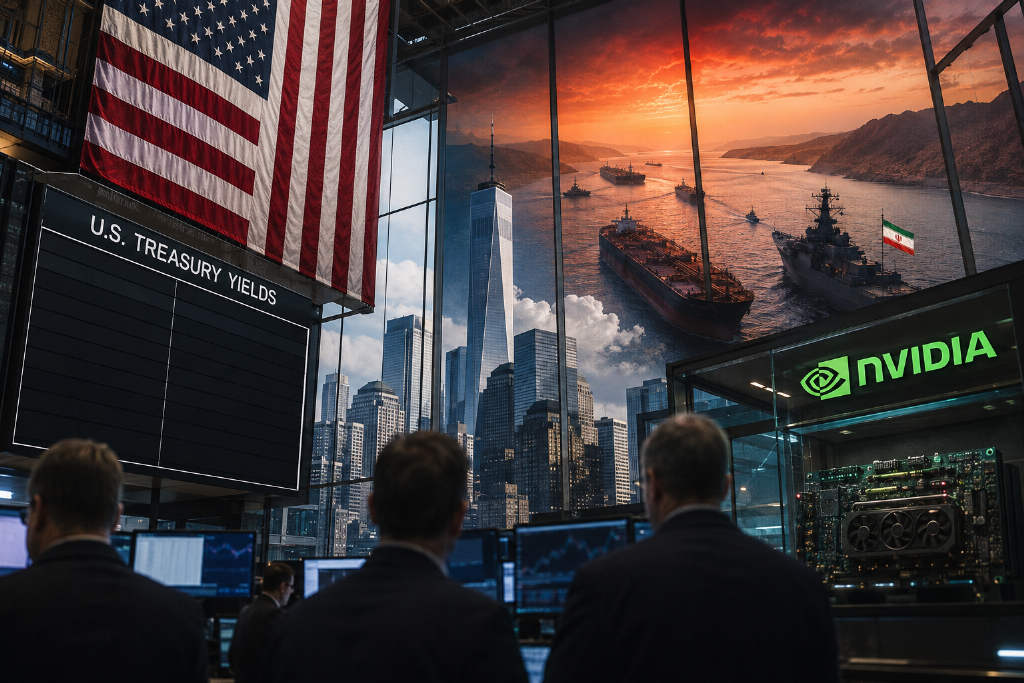
U.S. stocks fell together on Friday, ending a two-session advance, after August nonfarm payrolls came in far stronger than expected and pushed investors to reprice the odds of a September rate increase by the Federal Reserve. The S&P 500 dropped 0.38% to 7,718.60, the Nasdaq slipped 0.29% to 26,506.99, and the Dow Jones Industrial Average lost 0.51% to 53,414.25. For the week, the Dow fell 0.27%, the S&P 500 edged down 0.08%, while the Nasdaq still gained 0.54%.
The report said the jobs data became the main weight on the broader market, lifting short-dated Treasury yields to their highest levels in more than a year and a half. At the same time, capital did not leave equities across the board. Money rotated into semiconductors, where investors kept backing names tied to AI infrastructure and hardware demand. Over the weekend, another source of volatility emerged as tensions between the United States and Iran intensified around the Strait of Hormuz, sending WTI crude higher at the start of Asian trading on Monday.
Payroll surprise shifts focus back to Fed tightening
August U.S. nonfarm payrolls beat expectations by a wide margin, prompting markets to again price in a possible Fed hike in September. The 2-year Treasury yield rose 3.4 basis points to 4.3703% and touched 4.416% intraday, its highest level since January 2025. The 10-year Treasury yield held near 4.78%. The U.S. dollar index gained 0.27% to 99.177, reversing its earlier decline.
That change in rate expectations hit richly valued assets first. According to the report, market pricing for a September hike moved back above 50% after the payroll release. The pullback spread across the major benchmarks, while large-cap technology stocks were broadly weaker. The Wind U.S. Magnificent Seven Index fell about 1.13%, with Tesla leading the decline, down 5.92%. The report tied Tesla’s weakness to the macro rate backdrop, noting that high-valuation, high-growth stocks are especially sensitive to changes in interest rates. Lululemon also remained under pressure after falling more than 17% in after-hours trading earlier.
Chips outperform as investors stay with AI-linked fundamentals
The market move was not a simple risk-off exit. Funds continued to rotate into sectors backed by visible industry demand, and chip stocks stood out. The Philadelphia Semiconductor Index climbed 3.37% to 11,735.26, reaching its highest close since Aug. 27. Memory and optical communication names led the gains, while Nvidia rose more than 2%.
The report pointed to a clear industry case behind the move. Orders tied to AI infrastructure have continued to validate demand, Dell’s earlier guidance for record AI server orders was still feeding through the market, and Broadcom raised its AI revenue guidance to $58 billion while laying out a long-term roadmap of $230 billion by 2028. Rising rate expectations may weigh on broad market valuations, but segments with strong operating fundamentals are still attracting capital.
Iran signals Strait of Hormuz "restricted zone," oil opens higher
Geopolitical risk became a major market variable again over the weekend. On Sept. 6 local time, Rezaei, secretary of Iran’s Supreme National Security Council, said Iran would announce a "restricted zone" in the Strait of Hormuz in the coming days. On the same day, the Navy of Iran’s Islamic Revolutionary Guard Corps said it had sunk a U.S. military unmanned surface vessel that tried to enter the strait.
Before that, U.S. forces had already been increasing pressure in the area. U.S. Central Command said that as of Sept. 6, American forces had ordered 92 commercial vessels to change course as part of a maritime blockade operation against Iran, rendered three commercial vessels inoperable, and boarded two ships for inspection. Iran’s Revolutionary Guard, for its part, said it had launched ballistic missiles targeting a U.S. aircraft carrier and a destroyer.
The report described the confrontation in the Strait of Hormuz as moving beyond isolated friction toward a broader contest of blockade and counter-blockade. Iran’s planned restricted zone would mean any foreign vessel entering the area without permission could face military risk, directly threatening one of the world’s key crude shipping routes.
WTI crude opened higher in early Monday trading in Asia. On Friday, WTI settled up 0.20% at $91.48 a barrel, while Brent crude rose 0.80% to $96.28 a barrel. Both benchmarks gained about 9% for the week. U.S. diesel retail prices also hit a record at $5.85 per gallon.
Gold reverses after sharp intraday drop as reserve strategies shift
The report also highlighted changes in official-sector gold allocation. According to the latest World Gold Council survey, 19% of central banks increased the share of gold held domestically or diversified their reserve setup over the past 12 months, compared with 7% a year earlier. The number of central banks storing gold in vaults in New York and London has continued to decline, showing how rising geopolitical risk is reshaping reserve management.
Spot gold fell 0.97% on Friday to $4,429.29 an ounce. It dropped more than 2% intraday to as low as $4,365.25 before recovering most of the loss in a V-shaped rebound.
What markets are watching this week
U.S. August CPI
After the payroll surprise, the August CPI report due on Thursday will be the next key test for rate expectations. The report said the inflation data will help determine whether Fed Governor Christopher Waller’s earlier view that disinflation is continuing can still hold. If CPI comes in above expectations, the probability of a September hike could rise further. If inflation prints weaker, the dovish interpretation of Waller’s remarks could regain ground.
Developments in the Strait of Hormuz
After Iran’s statement on the coming restricted zone, the market is watching how the United States responds and whether shipping through the strait faces additional disruption. Brent already gained about 9% last week. If the confrontation escalates again, oil prices could move higher and add to inflation expectations.
Anthropic’s IPO schedule
Media reports cited in the article said Anthropic is now expected to begin its IPO roadshow as early as mid-October and complete the listing a few days before the U.S. midterm elections in November. Earlier expectations had pointed to a prospectus filing as soon as next week, but that timeline has now been pushed back to late September. As one of the most closely watched IPOs in AI, any change in its listing schedule could affect sentiment across the AI trade.
The report said three market drivers are now in focus for the week ahead: renewed rate-hike concern after the payroll data, continued strength in chip stocks supported by industry fundamentals, and a geopolitical premium in oil as the U.S.-Iran standoff in the Strait of Hormuz intensifies.