
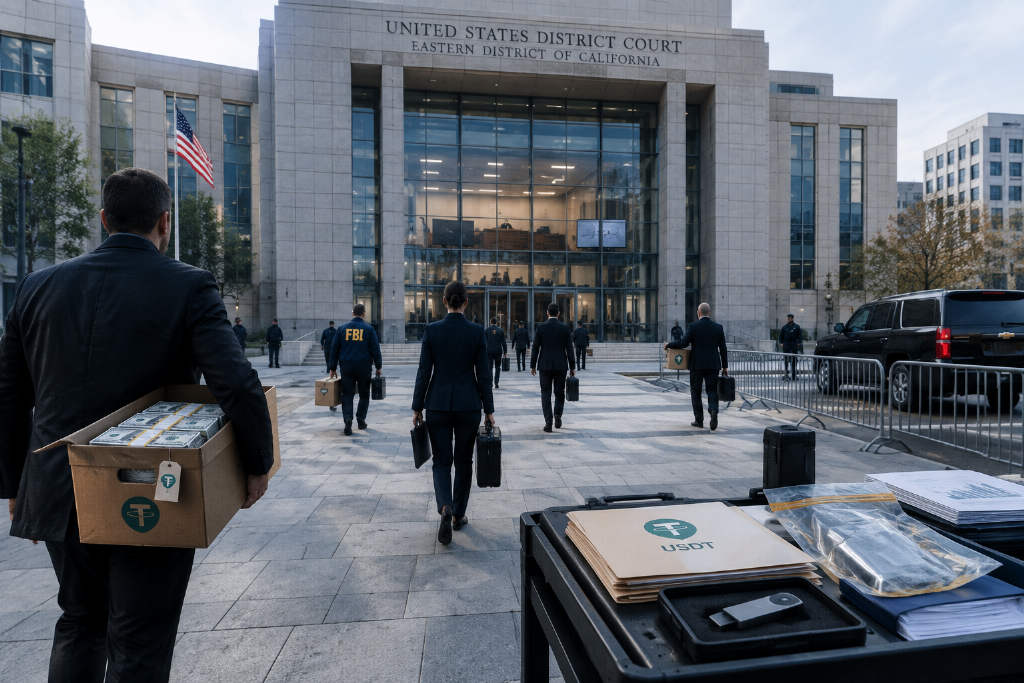
The U.S. Department of Justice wants to keep $84.2 million that prosecutors say moved through accounts used to process payments for Tether.
A civil forfeiture complaint filed on July 15 in the U.S. District Court for the Eastern District of California, before Judge Dale A. Drozd, targets Capstone Ltd., a Montana-based payments firm. Prosecutors say Capstone operated as an unlicensed money transmitter in at least six states and presented itself to banks as a standard IT services company.
Capstone and its owners named in the complaint
The complaint identifies Capstone’s owners as Kotaro Shimogori and Mary Jeanne Thompson. The FBI also executed a search warrant at a residence in Sacramento.
According to the Financial Times, their attorney said the company “denies any wrongdoing” and hopes to “resolve this matter quickly.”
How the $84.2 million is split
Of the $84.2 million at issue, $79.11 million came out of a Wells Fargo Securities account in Capstone’s name on September 14. Civil forfeiture allows the government to seize funds tied to alleged criminal conduct without first obtaining a criminal conviction against the owner of the money.
Another $2.06 million was held at JPMorgan Chase, $1.86 million sat in a separate Wells Fargo account, and just over $1.1 million was spread across two wallets holding USDT, Tether’s stablecoin designed to trade at $1.
Prosecutors point to EQIBank
Behind Capstone sits EQIBank, a digital bank licensed in Dominica, and prosecutors say it directed how the processor moved the funds.
EQIBank has already warned that losing the money, roughly 80% of everything the bank holds, could push it into liquidation.
Tether says it was unaware of the alleged conduct
In a statement provided to Reuters, Tether confirmed that EQIBank handled transfers for USDT purchases and redemptions. The company also said it had “no knowledge of the conduct by Capstone alleged by the Department of Justice.”
A spokesperson said total exposure was under 0.034% of group assets. Tether reported $187.75 billion in assets at the end of the second quarter.
Not the first legal clash involving Tether and Bitfinex
This is not the first time Tether and its sister company Bitfinex have faced scrutiny from prosecutors over how money was moved. In 2021, the two companies reached a settlement with the New York Attorney General after admitting that USDT was not always backed dollar-for-dollar as advertised. They paid an $18.5 million fine and agreed to stop trading in the state.
Capstone and EQIBank have filed a defense
Capstone and EQIBank have already filed an innocent-owner defense over the seized funds. Under Supplemental Rule G, which governs these forfeiture cases, any claimant has 21 days to answer the government’s complaint once a formal claim has been filed with the court.