
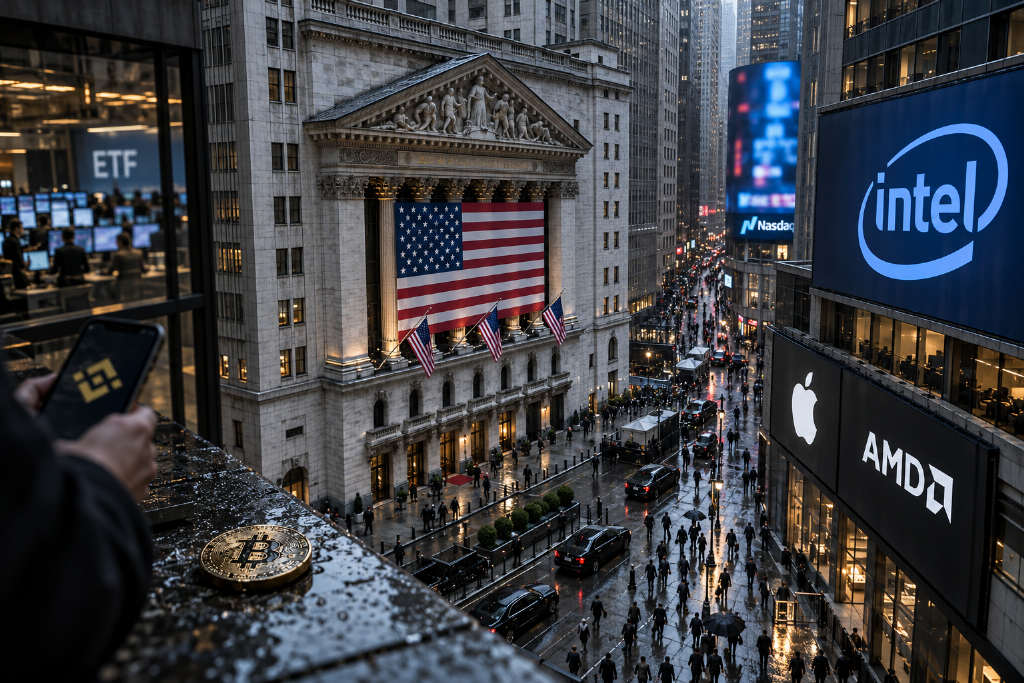
Technology stocks led a broad sell-off on Friday, with semiconductors taking the hardest hit and rising AI financing costs adding a new layer of pressure across markets. Intel was the main drag after issuing fourth-quarter guidance below expectations, sending its shares down 28.58% in a single session.
The Nasdaq Composite fell 2.86%, the S&P 500 lost 1.82%, the Nasdaq 100 dropped 3.46%, the Dow Jones Industrial Average slipped 1.09%, and the Russell 2000 declined 1.66%. The Philadelphia Semiconductor Index tumbled 7.20%, while the VIX rose 12.91% to 19.41. According to Seeking Alpha, the S&P 500 fell 0.57% for the week, the Nasdaq lost 2%, and the Dow fell 0.85%.
Intel guidance rattles chip stocks
Intel said fourth-quarter revenue is expected to come in between $15 billion and $16 billion, below market expectations of about $17 billion. Its non-GAAP earnings per share guidance of $0.25 also missed expectations of roughly $0.43. The company also said fourth-quarter client business revenue is expected to fall more than 20% quarter over quarter, and it cited the impact of an accident at its Fab 28 plant in Israel.
Its third-quarter revenue and earnings per share came in above expectations, but investors focused on the weaker outlook. One report said the drop may have been Intel’s biggest one-day decline since 1974. The stock was down nearly 26% for the week.
The weakness spread across the AI hardware chain. Tower Semiconductor fell 11.41%, Coherent dropped 11.34%, Qualcomm lost 11.12%, Astera Labs fell 10.93%, AMD dropped 10.88%, and Dell lost 10.77%. The report said Intel and Amazon earnings helped intensify concern over spending pressure at hyperscale cloud companies, with optical module names among the weakest groups. AMD, Astera Labs, Qualcomm and Coherent are all scheduled to report this week.
Fed holds rates steady, Logan strikes a hawkish tone
The Federal Reserve kept its policy rate unchanged at 3.75%-4.00% last week in a 10-2 vote. Dallas Fed President Lorie Logan later took a hawkish stance, saying the Fed likely still needs at least two more rate hikes of 25 basis points each. She said current rates are not high enough to bring inflation back to 2% and called a failure of inflation to move lower “unacceptable.”
In rates and FX, the 10-year Treasury yield was flat at 4.933%, the 2-year yield rose 0.6 basis points to 4.600%, and the 30-year yield stood at 5.310%. The U.S. dollar index edged up 0.02% to 101.98.
Earnings season advances as Magnificent Seven growth expectations cool
According to LSEG IBES data, more than half of S&P 500 companies have reported, and third-quarter earnings growth is on track to reach 31.6%. Analyst John Butters said expected earnings-per-share growth for the Magnificent Seven has fallen to 22.6% from 33.6% a month ago, below the 32.6% expected for the other 493 S&P components. If that holds, it would mark the first time since the fourth quarter of 2022 that the group has lagged the rest of the index.
Apple fell 1.23% on Friday, leaving it with a market value of about $5.03 trillion. Based on Bloomberg’s tally, Apple moved back ahead of Nvidia as the world’s most valuable company. Apple also said the first batch of Apple Intelligence features will open for testing in China starting Nov. 4, with Alibaba’s Qwen integrated. Its earnings are due after the U.S. close on Monday.
Nvidia fell 4.22%, bringing its market value down to $4.93 trillion and putting it behind Apple again. Alphabet lost 1.40% after third-quarter revenue of $127.58 billion missed expectations and ad revenue from search and other channels also came in below forecasts. Its shares fell 12.2% for the week and have dropped below recent stock offering prices.
Amazon slipped 1.41%. Third-quarter capital expenditure topped $77 billion, above expectations. The company said AWS growth should remain above 40% in 2027 and 2028, and it is targeting $1 trillion in revenue within five to 10 years. An SEC filing showed Amazon holds 164 million non-voting preferred shares in Anthropic.
Meta fell 1.53% and also dropped below recent stock offering prices. The Information reported that Meta and Fourier built a humanoid robot prototype in about three months and currently have no plan to sell it. Microsoft lost 1.55% after pricing a $25 billion bond sale in 10 tranches, with the longest maturity extending to 2066 and coupons ranging from 4.85% to 6.35%. It was Microsoft’s first U.S. dollar bond issuance since 2017. Tesla fell 0.87%, the smallest decline among the Magnificent Seven. Reuters reported over the weekend that Tesla and Samsung oppose new U.S. tariffs on Vietnam.
AI spending faces tougher scrutiny as funding costs rise
The latest leg lower began after Alphabet’s earnings on Wednesday, when revenue from search and other advertising channels missed expectations. Intel then disclosed supply-chain issues involving data-center components, and Amazon’s third-quarter capital spending above $77 billion added to doubts over how long the current pace of AI investment can continue.
Intel, Alphabet and Meta have all fallen below subscription prices from stock offerings completed in recent months, leaving participating investors with paper losses. That makes follow-on fundraising harder. It also clouds whether Anthropic’s IPO can match or exceed SpaceX’s record fundraising scale.
Pressure is also building in memory. Kioxia forecast third-quarter operating profit of about JPY 2 trillion, below market expectations of JPY 2.35 trillion, dragging SanDisk sharply lower. SanDisk fell 13.47% on the day. An English-language report said Kioxia believes the rise in flash memory prices is losing momentum. Goldman Sachs, however, kept a Buy rating on SanDisk, citing tight NAND supply-demand conditions, data-center expansion and long-term supply agreements.
Credit markets were flashing warning signs before equities did. Frank Curzio, chief executive officer of Curzio Research, said the cost of insuring Nvidia’s debt against default has more than tripled this year and is now above Meta’s, the first time that has happened since at least November 2025. Goldman Sachs said AI-related debt issuance has reached $489 billion since the start of 2026, far above its earlier forecast of $322 billion.
One $5 billion loan to an AI cloud services company had to offer a higher rate to get fully subscribed, pushing the final yield above 11%. As of the end of June, CoreWeave had $51.6 billion in debt, more than its equity market value. Goldman clients described the setup as “a crisis without a crisis”: chip demand remains strong, but the scarce resource is now lenders willing to extend capital.
Private markets are cooling as well. OpenAI has cut its latest fundraising target by $10 billion and is now seeking about $20 billion at a $1.25 trillion valuation. Last month, the plan was to raise $30 billion at a $1.4 trillion valuation. After-hours reporting also said some investors have reduced their commitments, and the first close is expected to come in below $20 billion.
Demand has not disappeared. Intel said server CPUs remain in short supply and expects shipments to grow by more than 30% in both 2026 and 2027. Amazon said AWS growth should stay above 40% in 2027 and 2028.
Crypto-linked stocks fall; Binance later resumes withdrawals
Crypto-related equities were broadly lower on Friday. Bullish fell 16.05%, Galaxy Digital dropped 11.75%, Bitdeer lost 11.48%, Coinbase fell 10.62%, Circle dropped 9.31%, Strategy lost 7.84%, and Robinhood fell 7.21%.
The report said about $6.3 billion in assets was stolen from Binance hot wallets, and the FBI later identified North Korea as the actor behind the theft. Spot Bitcoin ETFs recorded a net outflow of $643 million that day. Even so, analysts at Cantor Fitzgerald, TD Cowen and Compass Point said the incident is unlikely to derail the crypto market recovery.
Binance later resumed withdrawals. Between 14:00 and 23:30 on Nov. 1, the exchange processed $4.649 billion in withdrawals and $1.01 billion in deposits, for net outflows of about $3.64 billion, equal to 2.10% of its $171 billion in total assets.
Another crypto-related development involved OKXICE, the tokenized securities platform jointly backed by OKX and ICE under the name OKXICE TSV. More issuers have objected to its tokenized stock offering. Nvidia, Walmart, Eli Lilly, Micron and Costco were added to the list, bringing the number of opposing companies to 50. ICE deleted and republished its announcement on cooperation with trade.xyz, changing the wording to “plans to introduce” and “subject to regulatory approval.”
Other notable stock moves
Reddit plunged 29.22% after reporting third-quarter results. Its user growth outlook missed expectations, and changes to Google AI search reduced U.S. traffic to the platform. Roblox fell 18.05% as its quarterly report exposed cost pressure and a softer holiday-season outlook. Twilio dropped 15.24% after results showed slower growth in its messaging business.
Datadog fell 11.50% as concern over AI spending spread into cloud software. MongoDB, Snowflake and DigitalOcean also moved lower. Datadog is scheduled to report before the U.S. open on Wednesday.
FedEx Freight rose 14.91% after raising its outlook, with the CEO saying contract renewal pricing is the strongest in years. Global Payments gained 12.97% after a report said a consortium led by CD&R and joined by GTCR is seeking to take the company private in a deal that could be worth about $40 billion. It was the stock’s biggest one-day gain in more than eight months.
In after-hours and overnight trading, Zebra Technologies fell 4.59% after the close, having already dropped 4.27% in the regular session. Compass fell 4.11% after hours after losing 4.15% during the day.
Oil, precious metals and the dollar
WTI crude futures were last at $101.03 a barrel, down 2.97%, while Brent crude futures traded at $110.35, down 2.72%. COMEX gold futures were at $3,916.20 an ounce, up 0.44%, and silver futures were at $49.93 an ounce, up 1.33%.
Gold and silver had sold off sharply on Friday. Spot gold settled at $3,876.89 an ounce and fell 6.7% in October, while silver lost more than 18% for the month. Early Monday, spot gold moved back above $3,900 and spot silver broke through the $50 level.
Politics and geopolitics
Donald Trump said “the Iran war will end soon, one way or another.” Earlier, he had said the United States would not strike Iran before the election.
Reuters reported that the White House has for months been preparing for a scenario in which Democrats take control of Congress, reviewing executive actions that would not require congressional approval. The areas under review include immigration, tariffs, housing costs and federal spending.
Deutsche Bank said AI-driven market adjustments are weakening the dollar’s safe-haven appeal. The bank noted that overseas investors hold more than $20 trillion in U.S. equities, and that technology stocks and the dollar have recently weakened at the same time.
What markets are watching this week
Monday, Nov. 2
In China, financial regulators are set to hold meetings. According to Cailian Press, the People’s Bank of China, the National Financial Regulatory Administration and the China Securities Regulatory Commission will meet with major banks to study optimization of relending policies tied to stock buybacks and shareholding increases. According to 21st Century Business Herald, the PBOC and the CSRC are also meeting in the morning to discuss tools that support capital markets.
On earnings, Cipher Digital, Marriott International and Estée Lauder are due before the U.S. open. Apple, Palantir and Vertex Pharmaceuticals are scheduled after the close. Apple and Nvidia are the only two Magnificent Seven companies yet to report the latest quarter, and expected EPS growth for the group has fallen to 22.6%.
Tuesday, Nov. 3
The U.S. midterm elections are on the calendar, with timing still to be confirmed. Crypto industry super PAC Fairshake has spent nearly $56 million to block Democrat Sherrod Brown from winning the Ohio Senate race. Adding $7.2 million from a PAC tied to the Winklevoss brothers brings industry spending in the race to about $63 million. Polling shows Brown narrowly ahead, within the margin of error.
Shopify and Pfizer are due before the open. AMD, Arista Networks and Astera Labs are scheduled after the close. MARA’s timing is still to be determined.
Wednesday, Nov. 4
Apple Intelligence opens for testing in China and will integrate Alibaba’s Qwen.
Macro releases include the eurozone’s preliminary October CPI at 18:00, covering both annual and monthly readings; the U.S. September trade balance and the Treasury’s quarterly refunding announcement at 21:30; the final October S&P Global services PMI at 22:45; and the October ISM non-manufacturing PMI at 23:00.
Datadog and Circle are due before the open. Arm, Qualcomm, Coherent and AppLovin report after the close.
Thursday, Nov. 5
The eurozone’s September PPI month-on-month reading is due at 18:00. U.S. initial jobless claims for the week ending Oct. 31 are due at 21:30.
Sony reports before the open. Cloudflare, Airbnb, Lumentum and IREN are due after the close.
Friday, Nov. 6
At 17:30, New York Fed President John Williams and European Central Bank chief economist Philip Lane are scheduled to take part in discussions at the ECB Money Market Conference 2026.
At 21:30, the United States will release the October nonfarm payrolls report, including the unemployment rate, nonfarm payroll growth, and average hourly earnings on both annual and monthly bases. At 23:00, the University of Michigan’s preliminary November consumer sentiment index and one-year inflation expectations are due.
Berkshire Hathaway is scheduled at an unspecified time. Moderna, Vistra and TeraWulf report before the open.




