
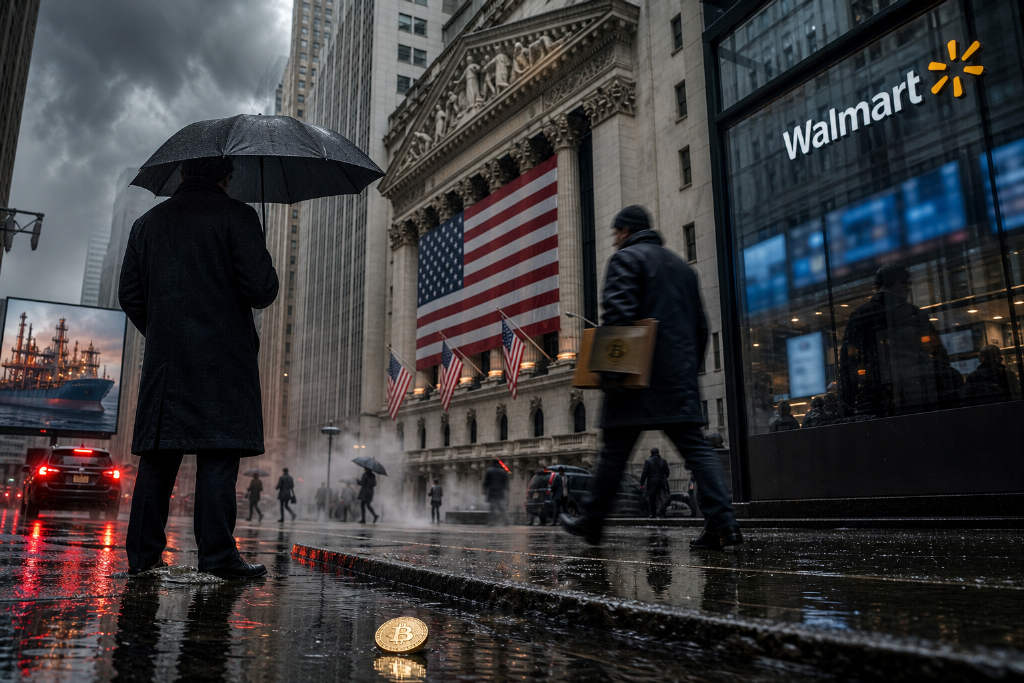
U.S. equities fell back under pressure overnight after a brief pause driven by the Treasury Department’s expanded buybacks of long-dated bonds. Long-end yields moved higher again, oil prices rose, and Walmart’s results added another warning sign on consumer demand. The Dow Jones Industrial Average dropped 703.84 points, or 1.32%. The S&P 500 fell 0.87% to 7,641.16, while the Nasdaq declined 1.00% to 26,067.17. The Nasdaq 100 logged a fifth straight loss. The VIX rose 7.51% to 16.38, its largest one-day increase since late July.
The report’s main message is blunt: Treasury action can ease bond-market liquidity stress for a short period, but as long as the 30-year Treasury yield moves back toward recent highs, high-valuation assets will struggle to stage a real recovery. This was not a sell-off driven by technology alone. Oil’s jump revived inflation concerns, Walmart exposed pressure on the consumer side, and the so-called Magnificent Seven broadly retreated. Pockets of relative strength remained in memory, optical communications, crypto, and resource-linked names.
Long-end pressure returned as the Treasury buyback effect faded in a day
The Treasury Department’s expanded long-bond buyback only held the market for one session. Overnight, the 10-year U.S. Treasury yield rose 4.35 basis points to 4.6902%, moving above the level seen before the department announced the larger buyback program. The 30-year yield climbed about 4 basis points to around 5.26%, almost fully reversing Wednesday’s decline and moving back toward the Aug. 18 high of 5.3361%, a level the report describes as near a 20-year high. The 2-year yield rose 1.88 basis points to 4.1811%.
That, according to the article, is where the real concern sits. Buybacks may improve short-term liquidity in the long-bond market, but they do not change the structural forces behind the move in yields: the scale of U.S. debt, the fiscal deficit, sticky inflation, and competition for capital from AI spending. The report says U.S. federal debt has passed $40 trillion, more than doubling over the past decade. At the same time, technology companies are raising large amounts of capital for AI data centers, while the Treasury must keep issuing debt. Both forces push funding demand onto the long end of the curve.
The article also points to comments from Bessent that buybacks could be expanded further. Rather than calming markets, that message was read as a sign that the Treasury itself does not have a durable fix for long-dated bonds. If buybacks were enough to solve the problem, the report argues, there would be no need to keep signaling that the program could be increased again.
Moves in foreign exchange markets told a similar story. The U.S. dollar index staged a V-shaped rebound and at one point rose 0.38% from the day’s low. The yen weakened about 0.6% during the session, while the earlier strength in offshore yuan cooled. In the article’s reading, markets are not in full dollar-selling mode. They are instead demanding higher compensation for long-term debt risk.
Oil revived inflation concerns and added pressure alongside consumer weakness
The second major theme overnight was oil. The report says Donald Trump issued stronger sanction threats against Iran, while shipping risks in the Strait of Hormuz added to supply concerns. WTI crude futures settled up 2.33% at $87.83 a barrel, and Brent crude futures rose 2.36% to $93.78 a barrel. Both reached their highest levels since July 24.
The move mattered well beyond the energy sector. The article says rising oil prices weakened confidence that inflation is on a steady path lower and pushed up the risk premium embedded in long-term rates. One day after the Treasury managed to suppress pressure in long bonds, oil brought the inflation trade back into focus.
Higher oil also eats into household disposable income, and that consumer pressure showed up in retail. Walmart was the biggest drag on the Dow. The company posted second-quarter revenue of $187.94 billion and adjusted earnings per share of $0.81, both above market expectations, yet the stock still dropped more than 9%.
What investors focused on instead was the slowdown in U.S. same-store sales growth to 2.6%, the weakest pace in more than six years, along with full-year profit guidance that came in below expectations. The article argues that Walmart matters beyond one earnings release. As the largest U.S. retailer, it offers a window into the real purchasing power of lower- and middle-income consumers. Transaction counts are still holding up, but spending per transaction is falling, a sign that households are becoming more cautious. Hopes for a retail recovery that had been supported by Target’s results a day earlier were not sustained by Walmart, leaving the consumer trade split again along company fundamentals.
Tech kept breaking apart internally, and the biggest names failed to support the tape
Moderna plunged more than 23% on Thursday after surging nearly 180% the previous day on successful phase-three results for its mRNA cancer vaccine. Merck also pulled back, falling about 5%. The article says the 180% rally had already priced in an extremely aggressive set of expectations. Markets effectively translated a successful phase-three trial into commercial success, even though there is still a long distance from trial data to approval, launch, and stable cash flow. After Wednesday’s spike, traders moved quickly to take profits, showing that short-term speculative momentum faded faster than expected.
Moderna’s drop was only one part of the pressure inside technology shares. The larger drag on the indexes came from a broad decline in the Magnificent Seven. The article says those names were mostly lower overnight, with Amazon down more than 2% and leading losses among large-cap tech shares. Tesla also pulled back sharply. On a day when the broader market fell, the biggest technology stocks did not provide support.
Semiconductors, however, were not uniformly weak. Memory and optical communications names moved higher against the broader trend. Marvell rose 5.8%, Lumentum gained 6.2%, and Micron advanced 3.97%. The report ties those moves to concrete industry catalysts: Marvell was supported by the logic around its custom AI chip work with Google, while Micron was also helped by a planned $10 billion investment in memory R&D over the next decade.
That did not mean the pressure on AI hardware had disappeared. The article points to slowing revenue growth at OpenAI, Anthropic’s push toward an IPO, and Broadcom seeking more than $60 billion in debt financing. Together, those factors are shifting valuation in the AI supply chain away from a simple order-growth story and toward a tougher question: can capital spending keep going? Money has not left the AI complex, the article says, but the filter has changed. Markets are now asking more directly who has real cash flow and who is still relying on financing.
Bitcoin broke above $72,000 while gold stayed in a tug-of-war near $4,500
Digital assets rose for a second straight day. Bitcoin moved above $72,000 for the first time since early June, gaining about 5% on the day and 15% for the week. Ether rose more than 20% over two days.
In precious metals, gold briefly slipped below $4,500 before recovering its intraday losses and rebounding more than 2% from the session low. Spot gold closed up 0.08% at $4,519.36 an ounce, while spot silver gained 1.16% to $68.09 an ounce. The article says gold remained locked in repeated back-and-forth trading around $4,500. Geopolitical risk and a softer dollar offered support, but the rebound in Treasury yields limited the upside.
Chinese ADR attention shifted back to earnings and cash flow
Among Chinese names, Alibaba reported second-quarter revenue up 9% year over year to RMB 268.95 billion, slightly ahead of expectations. But spending on AI infrastructure pushed capital expenditures higher, and net free cash outflow for the quarter widened to RMB 44.7 billion. On its earnings call, the company said annual recurring revenue from AI-related products had exceeded RMB 49.5 billion, and that T-Head chips would continue scaling in the second half of the year.
Alibaba Cloud’s external commercial revenue rose 45% year over year, and AI-related revenue has now posted triple-digit growth for 12 straight quarters. The article’s conclusion is that AI cloud revenue is already being monetized, but the capex cycle is still weighing on near-term cash flow.
Another signal came from the robotics space. Unitree Technology fell more than 18% on its second day after listing. Founder Wang Xingxing said commercialization still needs time. In the article’s framing, the sector is moving away from scarcity-based pricing and toward delivery-based pricing.
Two market variables are now in focus
The report says Friday’s attention is centered on two questions.
- First, whether long-dated Treasury yields can stabilize. After the Treasury buyback effect faded quickly, the 30-year yield holding below 5.3% will directly shape the room for a recovery in technology stocks.
- Second, remarks from Federal Reserve Chair Warsh at the Jackson Hole global central bank symposium. Minutes released on Wednesday had already signaled a hawkish tone. His comments are expected to set the tone for the September meeting. If he keeps stressing inflation risk, rate-hike expectations will rise further. If he mentions downside risks to growth, market sentiment may get some relief.
The article’s bottom line is that markets have now accepted that Treasury support for bonds can buy time, but not reverse the trend. From here, long-dated Treasuries remain the main switch, oil remains the inflation switch, and a durable stabilization in technology shares will depend on whether both the Philadelphia semiconductor index and the Magnificent Seven can recover at the same time.
