

U.S. financial markets produced an unusual combination in September 2026: Treasuries were hit by a sharp selloff, while technology stocks, especially semiconductors, kept moving higher.
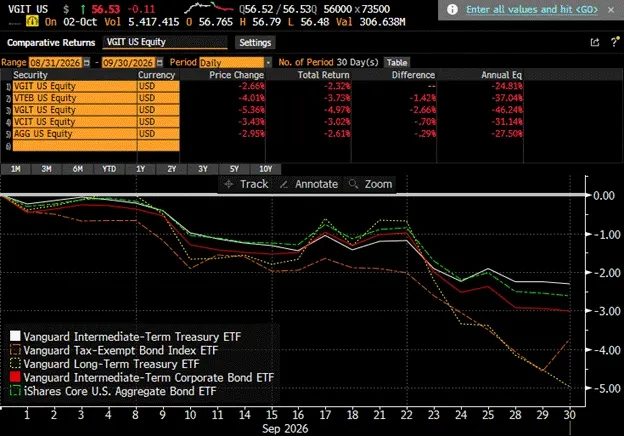
According to U.S. Treasury data cited in the article, the 10-year Treasury yield climbed from 4.75% at the end of August to 5.29% at the end of September, up 54 basis points in one month. QuantStreet Capital said some U.S. fixed-income assets fell between 2.3% and 5% during the month. Equities did not fall in a broad, synchronized move. Bitcoin, momentum strategies with major holdings in semiconductor and technology companies, and the Nasdaq all held up well, while U.S. small caps, the equal-weight S&P 500, and rate-sensitive sectors such as real estate investment trusts, utilities, and financials came under pressure.
Under normal valuation logic, a sharp rise in long-term yields raises financing costs and lowers the present value of future profits, a setup that usually weighs on high-valuation stocks. The split performance seen in September suggests investors may be assigning very different prices to the future return profiles of different assets.
Harry Mamaysky, founder of QuantStreet Capital, argued in his latest monthly investment letter that the first step in understanding the move is to answer a basic question: what exactly is the bond market pricing?
September’s Treasury move was mostly about real yields
The article says the key feature of the September Treasury selloff was that the rise in nominal yields came mainly from higher real yields, not from a large parallel increase in inflation compensation.
It breaks the structure of yields into three concepts. Nominal yield is the Treasury yield investors usually see. It includes compensation for future inflation, the required real return, and other risk factors. Real yield can be understood as the return after stripping out inflation compensation. In the U.S. Treasury market, Treasury Inflation-Protected Securities, or TIPS, are commonly used to observe how the market prices real returns. The gap between nominal and real yields is the breakeven inflation rate, often used as a reference point for long-term inflation expectations, though the article notes that it also reflects inflation risk and liquidity factors and is not a pure inflation forecast.
The September move in the 10-year Treasury can be decomposed further. The nominal 10-year yield rose from 4.75% on Aug. 31 to 5.29% on Sept. 30, a 54-basis-point increase. Over the same period, the real yield rose from 2.44% to 2.93%, up 49 basis points, while implied inflation compensation increased only from 2.31% to 2.36%, or 5 basis points.
That means more than 90% of the rise in the 10-year Treasury yield during September corresponded to higher real yields rather than higher inflation compensation. On that market-based breakdown, the main shift in the bond selloff was not inflation compensation. It was real rates.
The distinction matters because rising real yields and rising inflation compensation usually point to different macro stories. If yields rise mainly because inflation compensation rises, investors may be demanding more nominal return because they are worried about future price growth and weaker purchasing power. If the move comes mainly from real yields, attention shifts to growth expectations, the future path of real policy rates, and the compensation investors require to hold long-dated bonds.
The article does not say inflation risk has disappeared. Inflation itself remains elevated, and oil prices, fiscal policy, and the Federal Reserve’s rate path can still shape expectations. But based on the September yield breakdown, a simple “inflation fears are back” explanation does not fully account for the Treasury selloff.
The market may be repricing growth and AI-related capital demand
Why did real yields rise so sharply? Mamaysky discussed several possible explanations in his investment letter.
One explanation is that confidence in the U.S. dollar is being questioned. The article pushes back on that view, noting that the dollar actually appreciated in September, which does not fit a broad confidence crisis in dollar assets.
A second explanation is that investors have become more worried about the U.S. government’s ability to service its debt. The author argues that if concern about U.S. fiscal credibility were showing up mainly through future inflation risk, long-term inflation compensation should have risen more clearly. September’s data did not show that pattern.
That still does not rule out fiscal risk. A larger supply of Treasuries and a higher risk premium for holding them could push long-term yields higher even if inflation compensation stays relatively stable.
Mamaysky places more weight on another possibility: the market may be repricing stronger economic growth while also repricing the capital needs created by continued AI infrastructure expansion at large technology companies.
AI is the central variable in that framework. As investment in artificial intelligence infrastructure keeps expanding, hyperscalers are spending heavily on data centers, GPU purchases, computing capacity, and related power and network infrastructure. Those outlays first and foremost imply demand for capital.
At the macro level, if companies want to expand investment at the same time and the pool of long-term capital does not increase in step, the price of capital can come under upward pressure. At the same time, if investors believe AI will lift future productivity and generate more corporate profit, they may also demand a higher long-term real rate of return.
Both forces could be linked to higher real yields, but they work through different channels. One emphasizes capital demand and financing conditions. The other emphasizes expectations for future economic returns. The article also notes that recent research from ING pointed in a similar direction, arguing that AI may affect bond yields not only through debt financing by technology companies but also through productivity and long-term growth expectations reflected in real yields.
Still, the article is careful on causality. These are market interpretations, not confirmed cause-and-effect relationships. Higher real yields alone do not prove that AI is accelerating U.S. economic growth, nor do they prove that AI financing demand is the dominant driver of the Treasury selloff.
For Mamaysky, the appeal of this explanation comes largely from the way equities behaved. If the jump in Treasury yields fully reflected a worsening economic outlook, stocks would usually face broader pressure. Instead, AI-linked shares, especially semiconductors, remained strong in September, suggesting investors still hold a constructive long-term view on at least part of the technology sector.
Why AI stocks kept rising even as real yields moved up
Traditional valuation logic says higher long-term real yields are usually bad news for growth stocks. Equity prices are based on the discounted value of future cash flows. The higher the required rate of return, the lower the present value of future profits. That effect is usually stronger for companies whose profits are expected further out in time.
September’s AI trade suggested the market may have been leaning on another force.
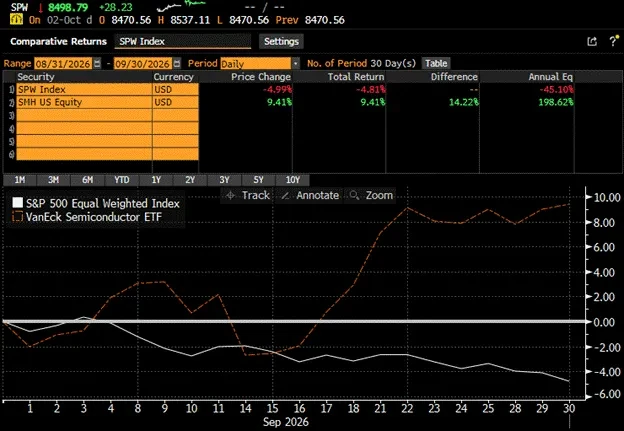
The article says the VanEck Semiconductor ETF, SMH, rose about 9.4% in September, while the equal-weight S&P 500, SPW, fell about 4.8%, a clear split between technology and the broader market. Mamaysky described this as a fight between the numerator and the denominator in valuation. A higher discount rate raises the denominator and pressures valuations, but stronger expected future profits raise the numerator and can offset part or even all of that drag.
In other words, the market may not be ignoring higher rates. It may be deciding that future earnings growth tied to AI is large enough to absorb a higher cost of capital. During September, momentum ETFs with major holdings in AMD, Micron, Intel, Cisco, and Applied Materials performed strongly, and semiconductors remained a major engine of market gains.
There is a business logic behind that move. AI infrastructure buildout requires chips, servers, and related equipment first, so upstream suppliers in the chain can capture orders and revenue earlier than the rest of the economy.
But the article also highlights the issue Mamaysky finds most important. Semiconductor shares kept rising while the equal-weight S&P 500 stayed weak. That suggests a clear gap between what investors expect for AI infrastructure suppliers and what they expect for the broader corporate sector.
Mamaysky refers to the companies outside semiconductors as ROCS, short for the Rest of the Corporate Sector. In his framework, companies buying AI chips are willing to commit large sums because they believe they will eventually earn an economic return through higher productivity. Markets are also willing to finance those profits before they are fully realized.
That is why the absence of synchronized growth across every industry is not, by itself, surprising. The harder question is that equity markets are forward-looking. If investors were already convinced that AI would materially improve the future earnings power of the rest of corporate America, those expectations should begin to show up in valuations there as well.
That broad move did not appear in September. Chip suppliers are already making money, while the companies buying the chips have not yet shown a widespread improvement in profits. The article says this leaves the current AI trade with a business loop that still needs to be validated: revenue earned by upstream suppliers ultimately has to be supported by durable economic value created downstream. If AI fails to generate enough profit for the broader corporate sector, rising chip purchases, data-center construction, and financing costs could gradually erode investment returns.
Mamaysky does not argue that AI is already a bubble. He says he still believes in AI’s long-term economic value, but the market needs more evidence that the gains are spreading from the technology sector to the rest of the corporate economy.
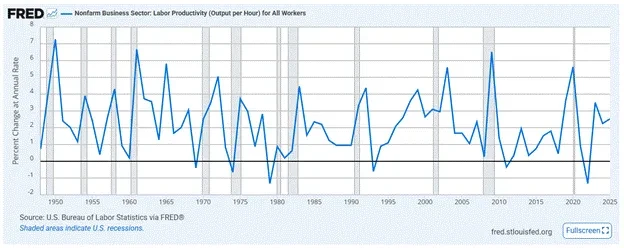
The article points to U.S. Bureau of Labor Statistics labor productivity data as one encouraging sign. Productivity growth in recent years has been above the long-term average since 2010. Even so, that improvement cannot be fully attributed to AI, and it does not directly prove that companies have already generated enough incremental profit to cover the cost of investment. In that sense, both the bond market and the stock market are waiting for the same answer: can future growth deliver the returns that are already being priced in today?
Term premium is the other risk in the picture
Reading higher Treasury yields as a sign of stronger growth can explain part of the cross-asset performance, but the article says that interpretation has an important limit. Higher real yields do not automatically mean the market has become more optimistic about future growth.
Long-term Treasury yields reflect not only expectations for future short-term rates but also term premium, the extra compensation investors demand for bearing the price volatility and other risks of holding long-duration bonds.
Term premium can capture rate uncertainty, fiscal supply, market supply and demand, and other risk factors. Even if inflation compensation does not rise much, long-term yields can still move higher if investors are less willing to lock up capital for long periods and demand more compensation for doing so.
The article cites a Reuters market analysis dated Oct. 7 saying the term premium on the U.S. 10-year Treasury had risen to around a 12-year high. That suggests the rise in long-term yields may include not only stronger growth expectations but also a reassessment of fiscal conditions, monetary policy, and the risks of holding long-dated government debt.
It also stresses that real yields and term premium are not two cleanly separable figures that can simply be added together. TIPS real yields may themselves contain a real term premium. So the roughly 49-basis-point rise in real yields during September does not mean all 49 basis points came from stronger growth expectations.
The distinction matters for asset prices. If higher real yields mainly reflect better growth expectations, future corporate profits may rise as well, allowing some equities to withstand a higher discount rate. If higher real and nominal long-term yields are being driven more by term premium, companies may instead face persistently higher financing costs without a matching improvement in earnings. In that case, higher rates would put more direct pressure on equity valuations, bond prices, and corporate investment.
That is why the article says the rise in AI stocks alone is not enough to conclude that the Treasury selloff is a positive growth signal.
QuantStreet’s positioning remains cautious
For QuantStreet, the market still does not offer enough evidence to justify a full shift toward any single asset class. The firm remains relatively overweight value stocks and low-volatility equities, aiming to keep exposure to the broader corporate sector while continuing to hold some technology shares in portfolios with higher risk tolerance.
Its bond allocation has also started to change at the margin. Mamaysky said that when the 10-year Treasury yield reached about 5.25%, bonds began to look more attractive on a prospective basis. QuantStreet therefore started to modestly extend duration in lower-risk portfolios, increasing exposure to bonds that are more sensitive to rate moves.
That does not mean the firm has turned broadly bullish on long-duration bonds. Its models still do not favor longer-duration assets, and overall bond duration remains below benchmark, though the underweight has narrowed.
The author also mentioned that for suitable investors, some evergreen private equity funds and other alternative assets may offer diversification benefits, though liquidity and valuation risks still need to be assessed separately.
Those adjustments reflect a cautious stance. Long-term yields have started to look somewhat more attractive, but there is still no clear answer on whether the forces pushing yields higher have run their course.
What the market needs to watch next
The article says investors should focus on three sets of signals next.
- How long-term real yields and term premium evolve, to separate growth expectations from risk compensation.
- Whether AI investment begins to improve productivity, margins, and cash flow in non-technology companies.
- Whether Federal Reserve policy expectations, fiscal financing needs, and long-term Treasury supply continue to push yields higher.
If growth and corporate earnings keep improving, high real yields and strong equities could coexist for a period. If term premium keeps rising while AI investment returns fail to materialize, the technology shares that have so far resisted higher rates may face a much tougher valuation test.
The article’s closing point is that the most important signal from September’s Treasury selloff was not a renewed loss of control over inflation expectations. It was a clear rise in the long-term real return investors now demand.
The unresolved question is where that higher required return is coming from: confidence that the economy will generate more profit in the future, or a growing cost of bearing long-duration risk. Both explanations can push Treasury yields higher. They imply very different paths for stocks, bonds, and the AI investment cycle.