

U.S. long-term borrowing costs continued to climb this week as two Treasury auctions at the long end of the curve pushed required investor compensation to levels rarely seen in recent decades, adding real pressure for the Treasury and the Trump administration.
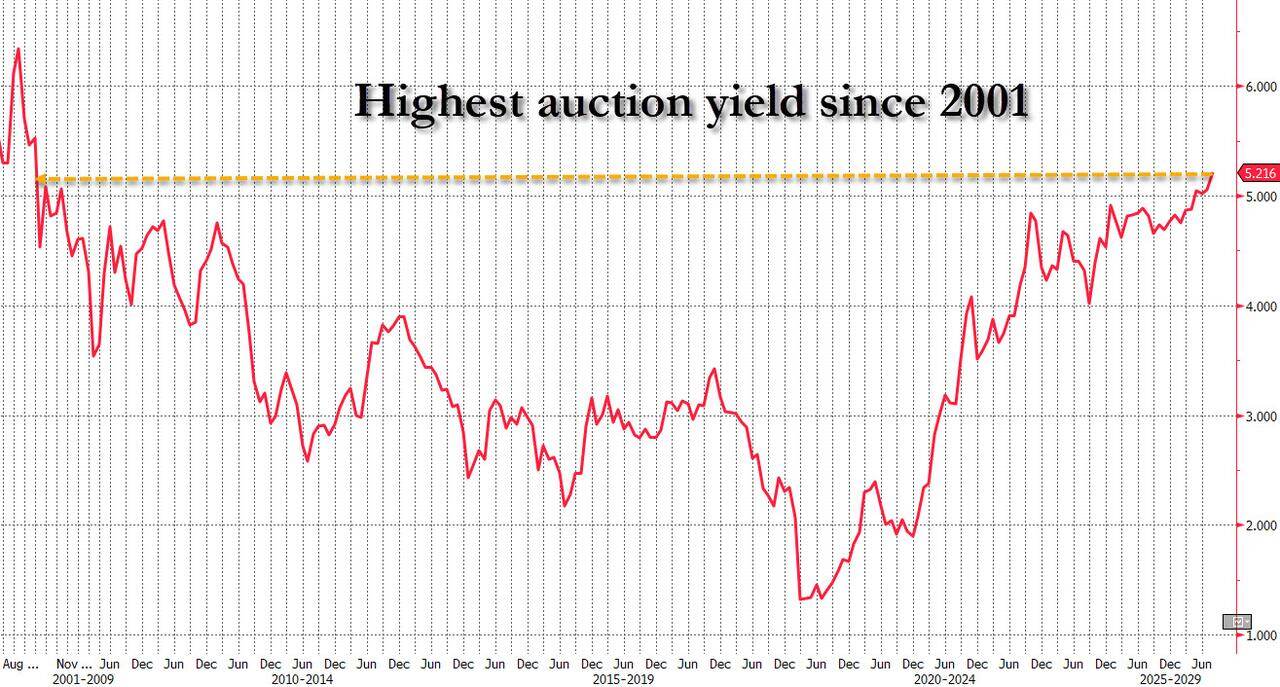
30-year and 10-year sales both reset multi-year highs
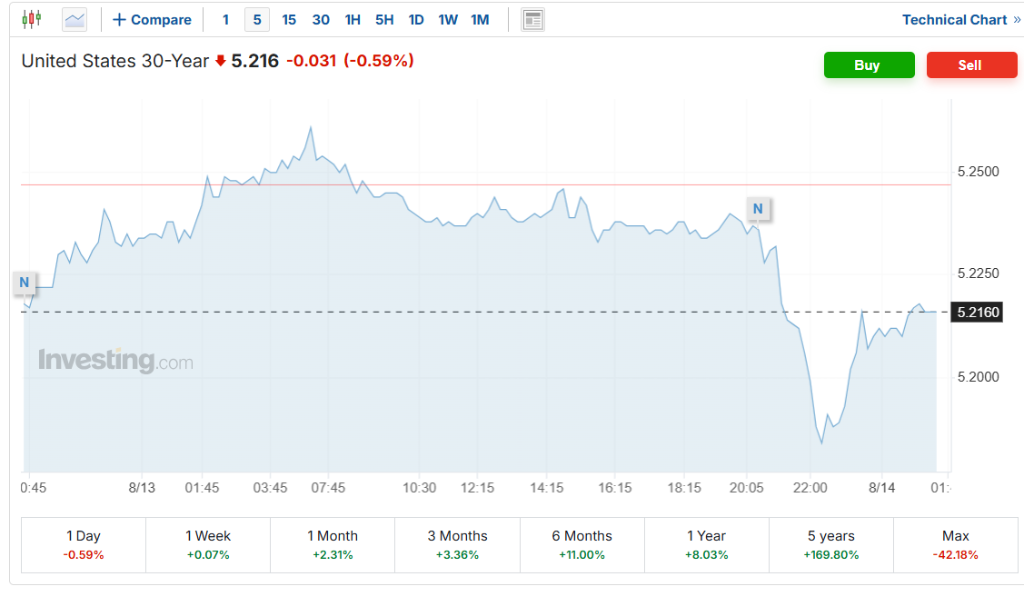
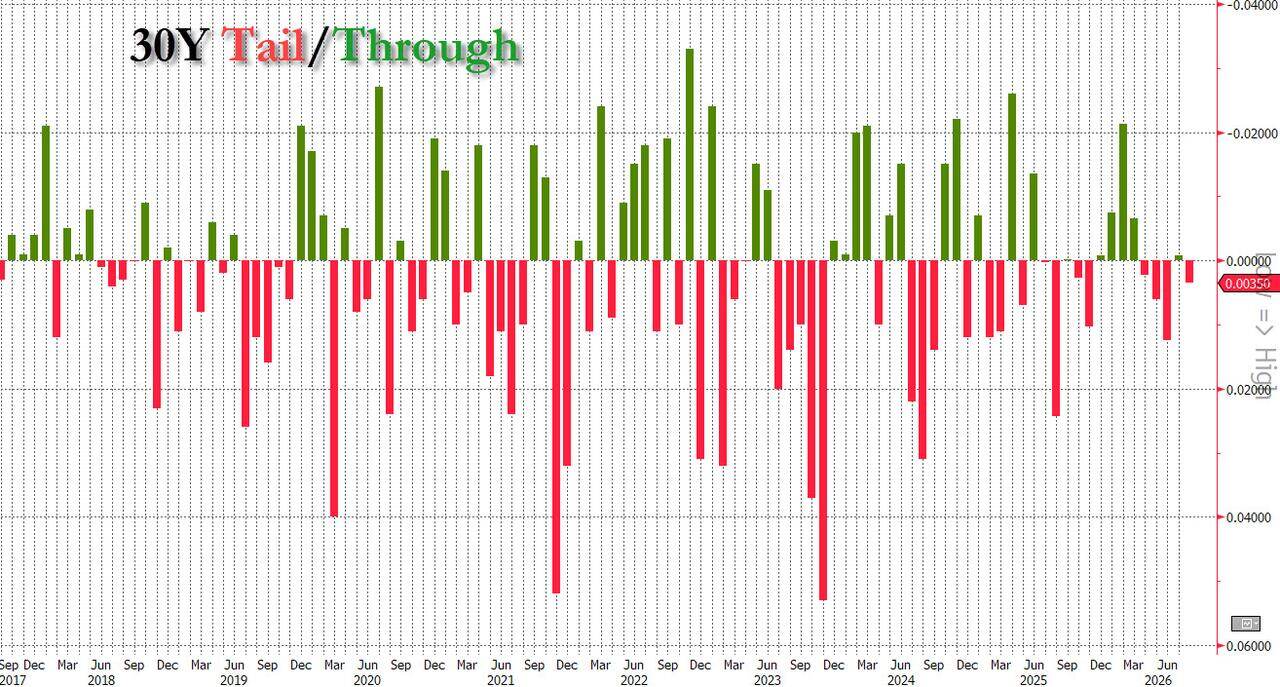
On Thursday, the U.S. Treasury sold $25 billion of 30-year bonds at a high yield of 5.216%, the highest since 2001. The auction stopped with a small tail, with the high yield about 0.4 basis points above the pre-sale yield, a sign that investors demanded a higher return than the market had been pricing during the session.
A day earlier, the Treasury auctioned $42 billion of 10-year notes at 4.683%, the highest result since the 2007 global financial crisis.
The significance of the two sales extended beyond the auctions themselves. The 30-year Treasury yield finished the day about 4 basis points lower, but the spread between 5-year and 30-year Treasuries widened further to its broadest level since May. The yield curve kept steepening, showing that pressure on the long end had not faded with a one-day market move.
Michal Stanczyk, portfolio manager on the global fixed income team at Allspring Global Investments, said: 「If investors continue to demand greater compensation for inflation and fiscal risk premiums, long-end yields may rise further and break above the 5% threshold.」
Demand held up, but the buyer mix shifted
On the surface, Thursday’s 30-year auction was not weak. The bid-to-cover ratio was 2.39, above the 2.36 average for the previous six comparable sales, indicating that absolute demand did not materially shrink.
The more notable change was in allocation. Indirect bidders, a category that reflects demand from foreign central banks and other overseas institutions, took 66.8% of the sale. That was down from July’s near-record 77.7% and slightly below the 67.0% average of the prior six auctions. Primary dealers were awarded 11.5%, up 150 basis points from July and above the recent 10.6% average. Because dealers usually serve as the backstop, the higher dealer share paired with a lower indirect share suggested that part of the gap in end-investor demand was absorbed by dealers.
Wednesday’s 10-year auction looked somewhat different. Its tail was a narrower 0.1 basis points, and the primary dealer take declined, indicating that end investors still showed some capacity to absorb supply. Even so, the 4.683% stop was itself the highest in nearly two decades. Gennadiy Goldberg, head of U.S. rates strategy at TD Securities, said: 「Strong absorption of supply shows demand is there — it just has a price.」
Supply, deficits and term premium are driving the long end
The latest rise in long-dated yields has become harder to explain through Federal Reserve expectations alone.
After the July CPI report, expectations for a September Fed rate hike cooled. Traders now put the probability of a September increase at about 35%, down from around 50% earlier in the week. Yet yields on 10-year and 30-year Treasuries did not fall with that shift in policy pricing. They stayed near multi-year highs, while the yield curve steepened further.
Market analysts have pointed to expanding fiscal deficits, increased Treasury supply and a rising term premium as independent drivers of long-end yields. In a research note, the team led by Demi Hu at Barclays wrote: 「As the market becomes increasingly dependent on price-sensitive investors, the same amount of Treasury supply may require a larger yield concession to clear.」
Outstanding U.S. debt now stands at about $31 trillion, roughly double the 2018 level. Fitch Ratings on Thursday affirmed the U.S. sovereign rating at AA+ with a stable outlook, while warning that the fiscal deficit relative to the size of the economy could widen further in 2026 because of tax cuts and tariff rebate measures. So far this fiscal year, U.S. interest expense has reached $1.17 trillion, up 15% from a year earlier.
Treasury issuance strategy is under debate
Against that backdrop, the Treasury last week quietly changed the wording in its quarterly borrowing statement. It replaced language about 「continuing to evaluate possible future increases」 in coupon-bearing debt and floating-rate note issuance with language saying it would 「consider possible adjustments.」 The market read that shift as a sign that officials are keeping room for a potential reduction in long-bond issuance.
Market expectations are that if the Treasury expands fixed-income debt issuance, the focus would likely fall on the 2-year to 7-year sector. That would extend the existing strategy of shortening duration. The government has already tilted issuance toward Treasury bills with maturities of less than one year to avoid locking in high long-end yields, though that approach also raises refinancing risk.
John Fath, managing partner at BTG Pactual Asset Management US LLC, questioned how sustainable that strategy is. He said: 「I think the only clear solution is for the U.S. government to tighten its budget. Concentrating issuance at the short end only works up to a point. Beyond that, it becomes what I would call irresponsible.」
Higher Treasury yields are feeding into mortgage costs
The impact of higher long-dated Treasury yields has already spread into broader parts of the economy. As a benchmark for U.S. financial markets, Treasury yields directly influence borrowing costs across corporate debt and home mortgages. Last week, the average rate on a 30-year fixed mortgage in the U.S. rose to 6.69%, the highest since July 2025.
Matt Wrzesniewsky, head of fixed income client portfolio management at Vanguard, said current yield levels offer investors 「another entry point.」 Vanguard expects the 10-year Treasury yield to remain in a 4.25% to 4.75% range and prefers adding rate exposure through intermediate maturities rather than 30-year bonds.
In the near term, the successful completion of both auctions shows that the market can still absorb supply. Even so, issuing 30-year debt at 5.216% sends a clear message on its own: with larger deficits, heavier supply and persistent inflation uncertainty all in play, U.S. long-term funding costs are sitting at unusually elevated levels for this century. Demand in the next several medium- and long-dated Treasury auctions will be a key window into whether that trend deepens.