
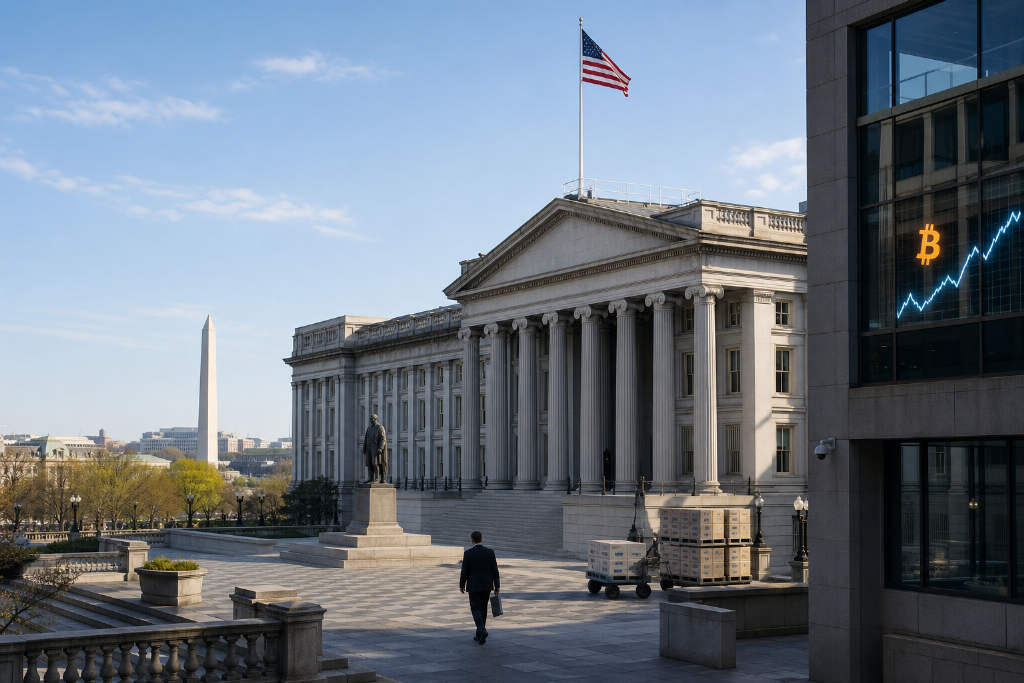
Bitcoin rallied after the U.S. Treasury said it would increase long-dated bond buybacks to curb a surge in borrowing costs and improve risk appetite. On Aug. 21, BTC briefly moved above $79,000 and reached an intraday high of $79,319.

Mark Connors, chief investment officer at Risk Dimensions, said the Treasury’s larger repurchase program could help relieve a source of selling pressure that has weighed on the crypto market for an extended period. He said that shift could open the way for Bitcoin to advance toward $180,000.
Treasury comments put focus on bond yields
Speaking to CNBC, Treasury Secretary Bessent said, 「We want the market to know that current bond yields do not reflect the true fundamentals, and the government still has many policy tools available.」
At the time of his remarks, the U.S. 10-year Treasury yield was around 4.68%, up 3 basis points on the day, though below its session high. Bitcoin extended gains on the news and climbed to its daily peak soon after.
Connors calls the move an early signal
Connors, who has spent years investing in bond markets, said the Treasury’s decision to expand buybacks was unusual but significant. In his view, it shows the government is beginning to address the pressure created by rising long-term borrowing costs.
「This is the first signal,」 Connors said. He expects buybacks could continue to grow as the U.S. government deals with the challenge of absorbing large Treasury supply and finding enough buyers.
Why lower yields matter for Bitcoin
The link to Bitcoin is straightforward. Higher Treasury yields tend to draw capital into government debt and away from risk assets such as equities and cryptocurrencies. Buybacks can support bond prices and help push yields lower. If pressure on long-term yields eases, some capital that had shifted into Treasuries could move back into higher-risk trades.
Connors said the Treasury’s initial buyback size remains relatively small for now, but he expects the government’s liquidity support could eventually expand to between $10 billion and $30 billion per month. That would be far above the previously announced $4 billion level cited by Bessent.
$180,000 near-term objective, $180,000 to $360,000 by 2030
That view has led Connors to revise his Bitcoin outlook. He had previously expected the market, following the traditional four-year cycle, might not begin its next major leg higher until November. Now he says investors may not have to wait that long.
He also pointed to a possible next policy step: changes to the Supplementary Leverage Ratio, or SLR. The rule affects how much U.S. government debt banks can hold relative to their capital base and assets. If those constraints are loosened, banks would have more room to absorb Treasury issuance and support the government bond market.
Connors said, 「When all of this happens, Bitcoin will begin a full push toward the $180,000 target.」
He added that in the bull cycle running toward 2030, Bitcoin’s ultimate target could land in a range of $180,000 to $360,000.
Short positioning around $72,000 is also on the radar
Jim Ferraioli, head of crypto research at Charles Schwab, recently cited model data showing a large concentration of Bitcoin short positions around $72,000. If Bitcoin can hold that level and continue higher, traders betting on a decline may choose to exit those positions at a loss, or be forced out through liquidation.
Because closing a short requires buying Bitcoin back, that process can add fresh demand, push prices higher, and trigger a broader chain of liquidations commonly described as a short squeeze.
Near-term downside risk still tied to the CLARITY Act
Even so, Connors said a possible short squeeze is not the main issue for him in the near term. He is more focused on what Treasury buybacks signal about liquidity conditions across markets.
If the U.S. government continues to expand the program and pressure on long-dated yields comes down, the main headwinds facing Bitcoin could begin to fade, he said. Still, he warned that if the CLARITY Act shows no clear progress around Sept. 15, Bitcoin could come under short-term pressure.
Connors said, 「Short-term price risk depends entirely on the CLARITY Act. If the bill does not move forward as scheduled around Sept. 15, I think Bitcoin will break below the $72,000 line.」