
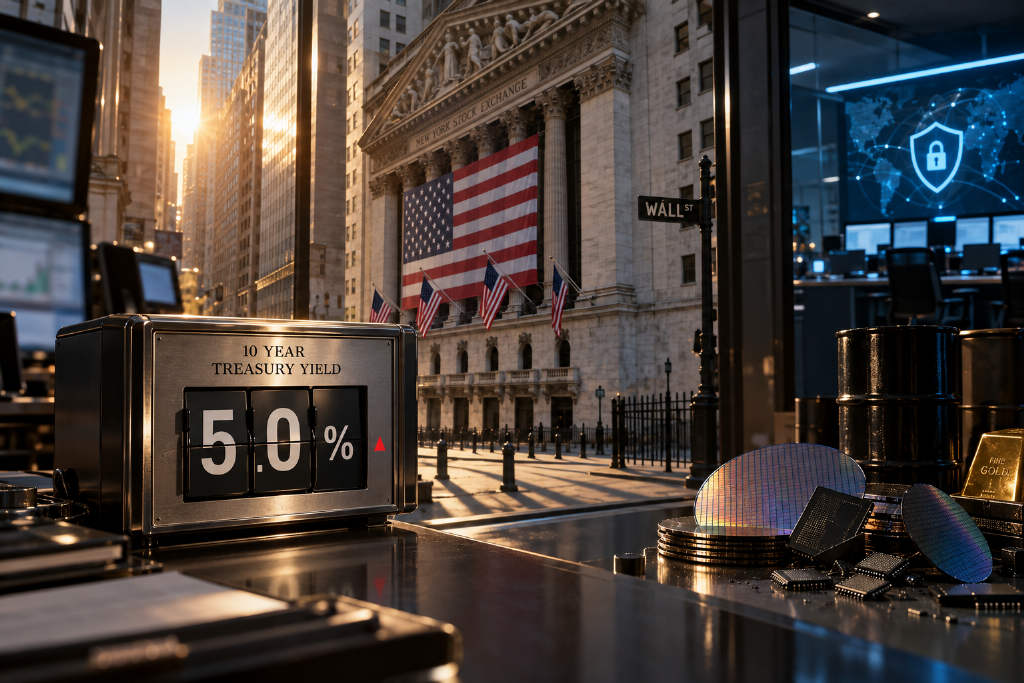
U.S. equities ended lower Monday, with Treasury yields driving the macro tone and a sharp split emerging inside the technology sector. The Dow Jones Industrial Average fell 0.29% to 52,421.20, the S&P 500 dropped 0.48% to 7,619.98, and the Nasdaq lost 0.56% to 26,186.410. The CBOE Volatility Index, or VIX, jumped nearly 8% to 17.10. The market's main pressure point came from Treasuries, where the 10-year yield moved above 5% intraday for the first time since 2023, touching 5.017%. CME data showed pricing for a 25-basis-point Federal Reserve rate hike in September had risen to 92.4%.
Inside tech, the divergence was striking. The Philadelphia Semiconductor Index sank nearly 6%, and the memory chip index fell 6.1%. Software and cybersecurity shares moved the other way, with Palo Alto Networks up 13.2% and CrowdStrike up 13.9%. The Federal Reserve's September policy meeting is due this week.
Treasury yields break above 5% intraday as rate-hike pricing nears 93%
The U.S. Treasury market was the central macro driver on Monday. The 10-year yield briefly rose through the 5% threshold and hit 5.017%, the first move above that mark since October 2023, before slipping back below 5% and ending late trading at 4.992%. The 30-year Treasury yield touched 5.386%. Over the past month, the 10-year yield has climbed by about 25 basis points.
According to CME FedWatch data, the probability that the Fed leaves rates unchanged in September fell to 7.6%, while the probability of a cumulative 25-basis-point increase reached 92.4%. By October, the probability of a cumulative 50-basis-point increase had climbed to 44%. Economists at Morgan Stanley expect the Fed to raise rates by 25 basis points in both September and December. Goldman Sachs, which had previously expected the central bank to stay on hold, shifted last Friday to a forecast for a 25-basis-point hike in September.
Several forces were cited behind the rise in long-end yields. August CPI and PPI both came in above expectations. Core CPI rose 0.3% month over month, above the 0.2% estimate, while communication services prices jumped 5.94% in a single month, a record. Government debt has also continued to expand, with net interest expense moving above $1 trillion. At the same time, geopolitical conflict in the Middle East pushed oil prices higher and added to inflation expectations.
AI-related stocks split hard as chips and optical names tumble
Outside the rates story, what the report described as a landmark turn in the AI sector over the weekend was aggressively repriced in Monday trading. The market reacted sharply to a joint call from the AI "big three" to slow down. The Philadelphia Semiconductor Index dropped 5.92% to 10,689.46, with nearly every one of its 30 components closing lower.
NVIDIA fell 3.36% to $210.96. Broadcom lost more than 3.6%, AMD dropped more than 4%, Intel fell more than 5%, and Marvell Technology slid 7%. Memory chip names were also under pressure, with SK Hynix down more than 7%, Micron Technology off nearly 6.7%, and both SanDisk and Western Digital down more than 5%. Optical communications shares sold off sharply as well: Corning fell more than 12%, Coherent dropped more than 12%, and Lumentum lost nearly 10%.
Software was one of the few bright spots. Shares that had long been seen as vulnerable to AI disruption moved higher instead. ServiceNow gained more than 5%, Adobe rose nearly 4%, and Workday added more than 2%. Cybersecurity stood out even more, with Palo Alto Networks up 13.2% and CrowdStrike up 13.9%. Capital rotated within tech, moving out of chips and optical communications and into software and cybersecurity.
Moves among megacap technology stocks were mixed. Alphabet rose more than 3%, Meta gained more than 2.7%, Microsoft added nearly 2%, and Apple rose 0.24% to $333.08. Amazon fell 1.26% and Tesla lost 1.77%. The Wind U.S. Tech Top Seven Index edged up 0.07%.
Chinese stocks listed in the U.S. outperformed. The Nasdaq Golden Dragon China Index rose 0.36%, with iQIYI up more than 4% and NetEase up 2.06%.
Oil jumps above $109 intraday on Middle East tensions, then sees a softer signal after hours
Geopolitical risk formed the other major theme of the session. Yemen's Houthi forces used dozens of ballistic missiles and drones to attack the Saudi air base in Khamis Mushait, heightening concerns over a possible disruption to Middle East oil supply.
Crude prices surged during the session. Brent futures jumped as much as 4.96% and broke above $109 a barrel, reaching a high of $109.80. WTI futures rose as much as 4.9% and touched $104.95. By the close, New York October light crude settled up 1.34% at $101.39 a barrel, while London November Brent settled up 1.02% at $105.68 a barrel.
After the close, the market got a softer signal. Donald Trump wrote on social media that Iran currently "wants to reach an agreement as soon as possible," and said the country's willingness to do so was "very urgent." During a visit to Ireland on Sept. 13, he also said the Iran conflict would end after the U.S. midterm elections in November, at which point "gasoline prices will fall quickly." Pricing of geopolitical risk premium remains caught between the reality of supply disruption concerns and expectations of easing through negotiations.
Financial stocks also came under pressure from higher rates. Bank of America fell more than 5% after CEO Brian Moynihan said third-quarter investment banking fee income would decline year over year. Goldman Sachs dropped nearly 4%, while JPMorgan Chase, Citigroup, and Wells Fargo each fell more than 1%.
Gold falls below $4,300 while Bitcoin holds above $78,000
Precious metals and crypto assets moved in different directions. Rising Treasury yields and a stronger dollar put heavy pressure on metals. Spot gold fell below $4,300 an ounce and kept sliding, touching an intraday low of $4,281.64, down more than 1.5%. Spot silver dropped more than 2.4%. European bond markets were under pressure as well. The U.K. 10-year gilt yield reached 5.4107%, the highest since July 2007, while Italy's two-year government bond yield rose 10.8 basis points in a single day.
Crypto assets traced the opposite path. Bitcoin rose above $78,096, up 1.7% over 24 hours. Ether climbed to $2,524, up 1.59% over the same period. Bitcoin held the $78,000 area despite the combined pressure of geopolitical risk and rising rates.
What the market is watching next
One focus is whether the chip sell-off continues. The Philadelphia Semiconductor Index fell 5.92% on Monday, the memory chip index lost 6.1%, and several optical communications stocks dropped more than 10%. Tuesday's session may show whether the move was a short-term release of sentiment or the start of a broader correction. Order data tied to AI infrastructure is still being tested, and the tension between industry fundamentals and valuation pressure remains central.
The other focus is whether the 10-year Treasury yield can stay above 5%. After touching 5.017% on Monday, it closed back at 4.992%. The 5% line remains a key resistance level not seen since October 2023. If yields continue higher on Tuesday and break through decisively, richly valued assets may face another round of valuation compression. Positioning adjustments ahead of the Fed meeting will also shape the next move in rates.