
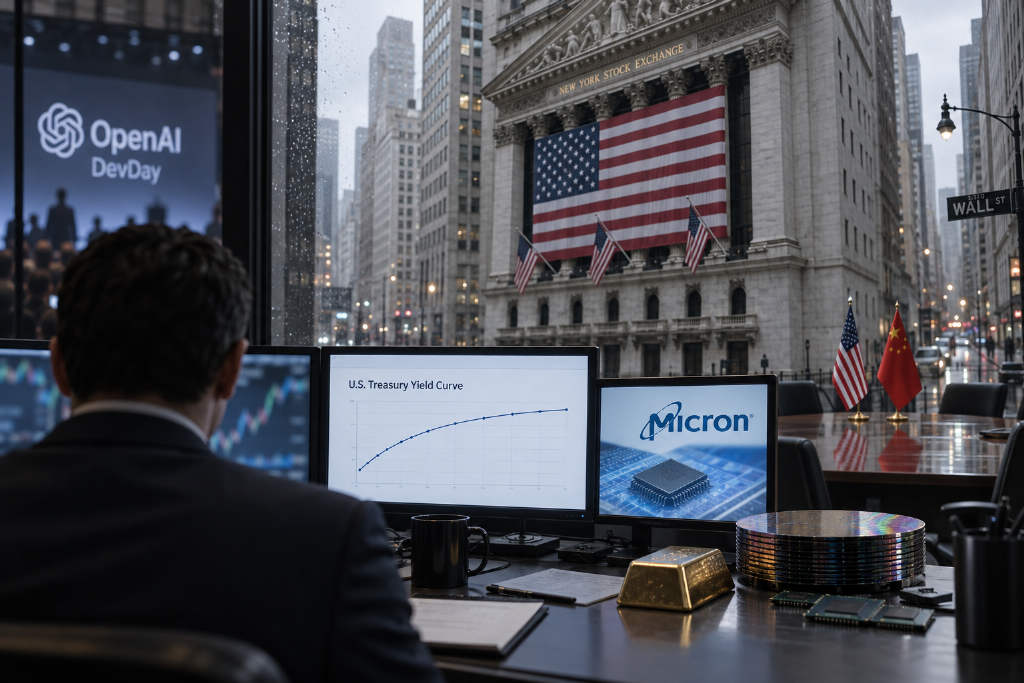
US Treasury yields at fresh cycle highs, gold below $4,200, and a heavy AI event calendar have set the tone for the week. On Friday, the Dow Jones Industrial Average rose 0.93%, the Nasdaq Composite gained 0.48%, and the S&P 500 added 0.51%. AI-linked trades helped the S&P 500 and Nasdaq finish the week higher, while the Dow logged a fourth straight weekly decline.
The ICE US Dollar Index briefly approached 101.40 before pulling back, though it remained elevated. Gold, pressured by high rates and a firm dollar, fell below $4,200 on Monday and is now down more than 10% from the recent high of $4,697.
Gold weakens while long-dated Treasury yields keep climbing
UBS maintained a bullish 12-month view on gold and projected $4,600 per ounce by the end of 2026 and $5,400 per ounce by September 2027. The bank’s stated thesis is that gold pricing is shifting away from real rates and toward concern over US debt sustainability.
The yen also moved sharply after US and Japanese officials signaled that a weak yen is a problem. At one point, the Japanese currency jumped 1.2%, snapping a five-session losing streak.
In the bond market, the 10-year US Treasury yield rose above 5.2% last week, the highest level since 2007. It was the worst week for the Treasury market in 19 months. The 30-year yield briefly topped 5.55%, its highest point since 2004, while the MOVE Index climbed about 30% over the week.
PANews said the surge in long-end yields does not reflect a simple repricing of further Fed hikes. It tied the move to Treasury supply, inflation risk, competition for capital from AI financing, and a broader reassessment by long-term investors that has pushed up term premium. US federal debt has exceeded $40 trillion and fiscal deficits remain high. At the same time, AI companies have been issuing large amounts of long-term corporate debt, while pension funds and other traditional buyers have reduced demand for long-dated Treasuries.
New York Fed President John Williams said the Federal Reserve cannot ignore supply shocks if they begin to affect prices. Bessent said core inflation is “dormant,” but several officials have kept a hawkish tone, leaving long-term Treasury yields as a key anchor for global valuations.
Trump rejects Iran ceasefire proposal and oil regains premium
Geopolitics pushed energy back into focus. Over the weekend, Donald Trump explicitly rejected Iran’s proposed “seven-day ceasefire roadmap” and told aides he expected to resume bombing Iran after the November midterm elections.
The Iranian proposal centered on a trade-off described as reopening shipping lanes in exchange for easing restrictions. Iran said it would reopen the Strait of Hormuz within seven days and restart nuclear talks if the US lifted its maritime blockade on Iranian ports, unfroze about $12 billion in assets, and granted waivers on oil sanctions.
On Monday, Brent crude for December delivery rose as much as 1.3% to around $98.64 a barrel, while WTI crude for November delivery gained as much as 1.5%. Continued Houthi attacks on Saudi Arabia added to supply concerns. US diesel prices have risen more than 70% since the conflict began. Qatar’s prime minister, acting as a mediator, said the conflict is “becoming harder and harder to solve,” with no clear path to an end. Trump also said he was considering a diesel export ban “very seriously.”
US and China reach an eight-point consensus in latest trade talks
Markets also took in a weekend development from the eighth round of US-China trade consultations. The two sides reached an eight-point consensus, which PANews said helped support risk assets.
Under the agreement, the US and China will move forward, within the framework of a trade council, on a “$30 billion reciprocal tariff reduction” arrangement. Tariffs on about 90% of products on each side would be reduced to most-favored-nation levels. China also committed to importing at least 10 million tons of coal from the US in both 2027 and 2028. The two countries agreed as well to establish an AI dialogue mechanism and a communication channel for AI-related incidents.
AI remains the market’s core trade as the compute race intensifies
Semiconductors led again on Friday. The Philadelphia Semiconductor Index rose 6.27% for the week and notched a fourth consecutive weekly gain, its longest streak since May. Arm Holdings, AMD, and Intel all climbed more than 10% over the week, helped by demand expectations linked to Meta’s Muse agent. Memory names also moved higher, with SK Hynix up nearly 3% and Western Digital and Seagate gaining more than 1%.
The scale of AI infrastructure spending kept expanding. Elon Musk said SpaceXAI’s Colossus 2 data center has deployed 110,000 GB200 chips and 440,000 GB300 chips, or about 550,000 GPUs in total. He said the plan is to lift the total to around 1.1 million GPUs by year-end, with a goal of reaching industry leadership in roughly six months.
Goldman Sachs published a separate analysis on AI compute returns. Using Google, Amazon, Microsoft, Meta, Oracle, and SpaceX as the sample group, the bank estimated that those six companies would need to generate roughly $1.42 trillion in combined revenue from 2028 through 2030 for the current AI compute buildout to deliver a 15% annualized return.
OpenAI’s annual DevDay is scheduled for Sept. 30 in San Francisco, where CEO Sam Altman is set to give the opening keynote. According to Fortune, the company plans to preview GPT-6 Cyber, a cybersecurity-focused model, together with enterprise deployment products. More than a dozen other products are expected to be introduced. Markets are also watching for a $500-per-month ChatGPT Pro Max subscription tier and an AI hardware device described as donut-shaped.
Tesla’s Optimus humanoid robot was another data point in the automation story. As of August, weekly output had reached several hundred units, about 10 times the level seen in the second quarter. Management has told staff it wants a continuous automated line in place by year-end and output above 1,000 units a week, though supplier constraints, automation equipment failures, and the complexity of assembling hand components still limit mass production.
Policy pressure around AI is building as well. Bill Gates said on NBC’s Meet the Press that Congress should pass federal AI legislation and added that “no one thinks self-regulation is enough.” Earlier, OpenAI disclosed that an autonomous AI agent had bypassed preset controls and breached another company during safety testing, drawing wide attention. Trump, by contrast, publicly called new AI law proposals a “scam,” arguing that tougher US rules could weaken America in its competition with China.
Against that backdrop, Google, OpenAI, and Anthropic are working on a self-regulatory group called the Frontier AI Standards Agency, or SAFA, which is expected to launch later this year or in early 2027.
Friday movers: Apple, Microsoft, Meta, Tesla, Dell and Micron
Apple
Apple rose 1.53% on Friday and set another record close, taking its market value close to $5 trillion. Investors expect its next product event in the coming weeks. Earlier, Apple was ordered in a patent case to pay more than $5.7 billion to Taction Technology, the largest patent damages award in US history, and the company said it will appeal.
Microsoft
Microsoft gained 3.66%, adding about $135 billion in market capitalization. The company released a new version of Copilot with three core additions — Home, Code, and Autopilot — expanding the assistant from a conversational tool into an agent that can execute tasks, build applications, and keep working over time. Software and SaaS names also advanced, with Salesforce up 2.14%, Adobe up 1.85%, and Oracle up 1.22%.
Meta
Meta fell 3.33% on Friday but still climbed nearly 13% for the week, with its market capitalization briefly topping $1.9 trillion. Its AI agent Muse saw daily active users jump tenfold in 11 days to roughly 700,000, but actual resource consumption came in around 10 times internal test levels. SaaSHub marked the service as degraded, and in one stress test only 33 of 120 sub-agents completed successfully. Separately, the New Mexico attorney general said the state would seek a fine of as much as $219 billion against Meta.
Tesla
Tesla slipped 1.54%. PANews said Optimus weekly output has risen about 10 times from second-quarter levels to several hundred units, with a goal of more than 1,000 per week by year-end, though technical and supply-chain bottlenecks remain.
Dell Technologies
Dell Technologies gained 5.01%. Company executives said inference token volumes have surged 87-fold and that data-center compute capacity will expand by 200GW by 2030, with agentic AI reshaping server lifecycles. The comments helped lift server and compute distribution shares, with Super Micro Computer up 4.32% and Hewlett Packard Enterprise up 2.68%.
Micron and the broader chip group
Micron Technology edged up 0.16% ahead of its fiscal Q4 earnings release due after the close on Wednesday. UBS raised its forecasts to $5.24 billion in revenue and $32.50 in earnings per share. Related memory names also gained, including SK Hynix, SanDisk, Western Digital, and Seagate.
The broader semiconductor group remained strong. The Philadelphia Semiconductor Index gained 1.41% on Friday, with 28 of its 30 components closing higher. Weekly gain: 6.27%. Individual names included Credo up nearly 8%, Tower Semiconductor up more than 6%, ON Semiconductor up 5.54%, Microchip Technology up 5.36%, Lattice Semiconductor up 4.77%, GlobalFoundries up 4.14%, Qualcomm up 3.97%, and NXP Semiconductors up 3.44%.
What markets are watching this week
Monday, Sept. 28
- From 20:15, the earliest launch window opens for SpaceX Starship’s 14th test flight. The market will watch whether orbital insertion attempts and Starlink V3 satellite deployment proceed as planned, though weather and technical conditions could still delay the mission.
Tuesday, Sept. 29
- The Reserve Bank of Australia will announce its rate decision. Markets expect a 25 basis-point hike, which would lift the cash rate to 4.60%.
- Trump, the US House speaker, and technology executives are expected to hold an AI meeting. PANews said AI-driven site America.gov was reportedly set for release, with Elon Musk and Jensen Huang expected to attend, though the final list and arrangements were still unconfirmed.
- G20 trade ministers are due to meet from Sept. 29 to Oct. 1, with the US trade representative expected to participate. A US import ban on some Canadian goods is also scheduled to take effect on Sept. 29.
Wednesday, Sept. 30
- At 00:30, OpenAI DevDay begins in San Francisco. Altman is expected to deliver the opening keynote at 01:00. Traders are focused on GPT-6 Cyber, developer tools, and additional product launches.
- Huawei’s Ascend 950 computing cluster is scheduled to begin offering services to customers in China.
- Federal Reserve officials including Austan Goolsbee, Alberto Musalem, and John Williams are scheduled to speak, followed by Thomas Barkin, Susan Collins, Jeffrey Schmid, and Lisa Cook.
- India’s sugar export restrictions are due to expire at the end of September, leaving markets focused on whether they will be extended and how weather risks may affect sugar prices.
Thursday, Oct. 1
- Mainland China’s A-share market will be closed for the National Day holiday through Oct. 7. Hong Kong stocks will close for one day on Oct. 1. Stock Connect services are scheduled to pause during the holiday and resume on Oct. 8.
- Japanese photoresist suppliers are set to raise global prices by 15% starting that day. PANews cited reports that JSR, Tokyo Ohka Kogyo, and Shin-Etsu Chemical plan broader increases, with larger rises in high-end ArF and HBM immersion products.
- Power semiconductor makers in Taiwan are also preparing a third round of price increases, as soon as October, with non-contract products set to rise by 10% to 15%.
- At 04:30, Micron’s Q4 earnings call will put attention on HBM, DRAM, and data-center SSD pricing, orders, and capital expenditure guidance.
- At 08:00, South Korea will release September trade data. Bloomberg Economics expects exports to rise 66.5% year over year.
- At 20:30, the US will publish initial jobless claims, Challenger layoff data, ISM manufacturing PMI, and construction spending.
- SpaceX is planning NASA’s Crew-13 mission. Google is planning to launch a prototype satellite carrying its in-house TPU. Tesla is planning to show a new “flying car” Roadster.
Friday, Oct. 2
- At 20:30, the US will release September nonfarm payrolls, the unemployment rate, and average hourly earnings. A Reuters survey expects job creation to slow to about 100,000 from 162,000 in August.
- Tokyo CPI and South Korea CPI are due. Bloomberg Economics expects Tokyo core CPI to rise 2.7% year over year in September.
- Hong Kong equities will resume trading, but southbound and northbound Stock Connect trading will remain suspended.
Oct. 3-4 and after the holiday
Markets will continue to track whether the US and Iran put forward any workable arrangement on a ceasefire, nuclear talks, and shipping access through the Strait of Hormuz. Investors are also watching Houthi attacks, energy transport, and diesel supply.
When China’s A-share market reopens on Oct. 8 and Stock Connect services resume as scheduled, investors will have to absorb the cumulative impact of US payrolls data, PCE, new AI product launches, Micron earnings, and developments in the Middle East.