
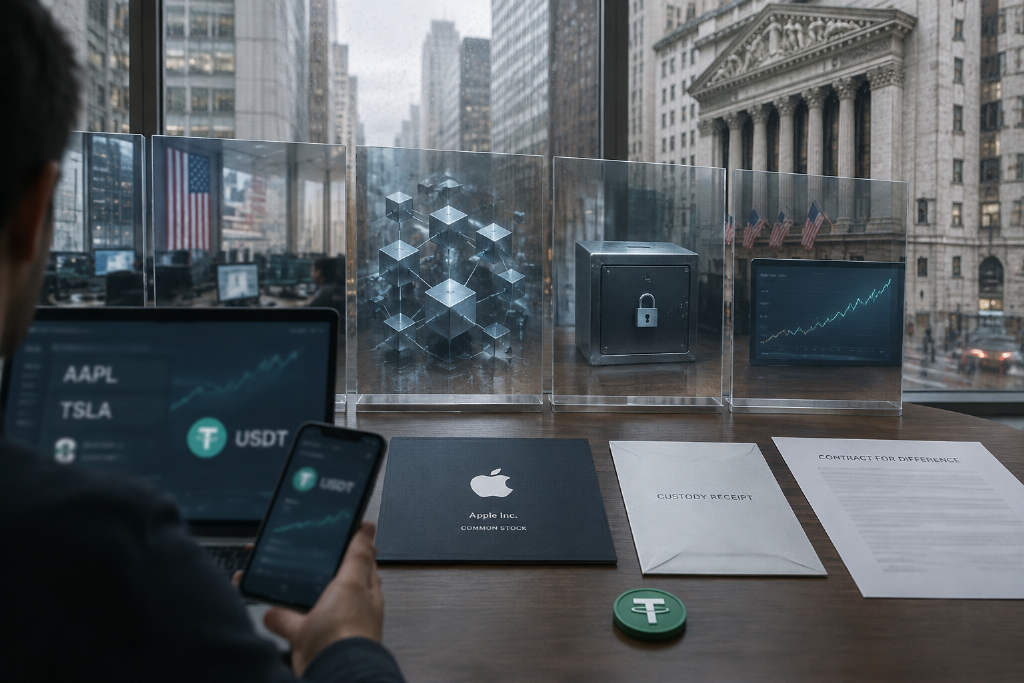
MarsBit has published a close read built around one plain question behind a crypto product category that is growing fast: when a platform says users can buy Apple, Nvidia, or Tesla with USDT, what do they actually own in the end?
The piece, written by Shao Jiadian, says screens on crypto exchanges, Web3 wallets, onchain apps, and tokenized stock sites are starting to look a lot like securities apps. But what sits behind that screen can be something else entirely. A user might get actual shares held through a broker. Or a stock certificate issued by a third-party vehicle. Or just a contract that settles gains and losses off the stock price.
Stablecoins describe the payment method, not the legal asset
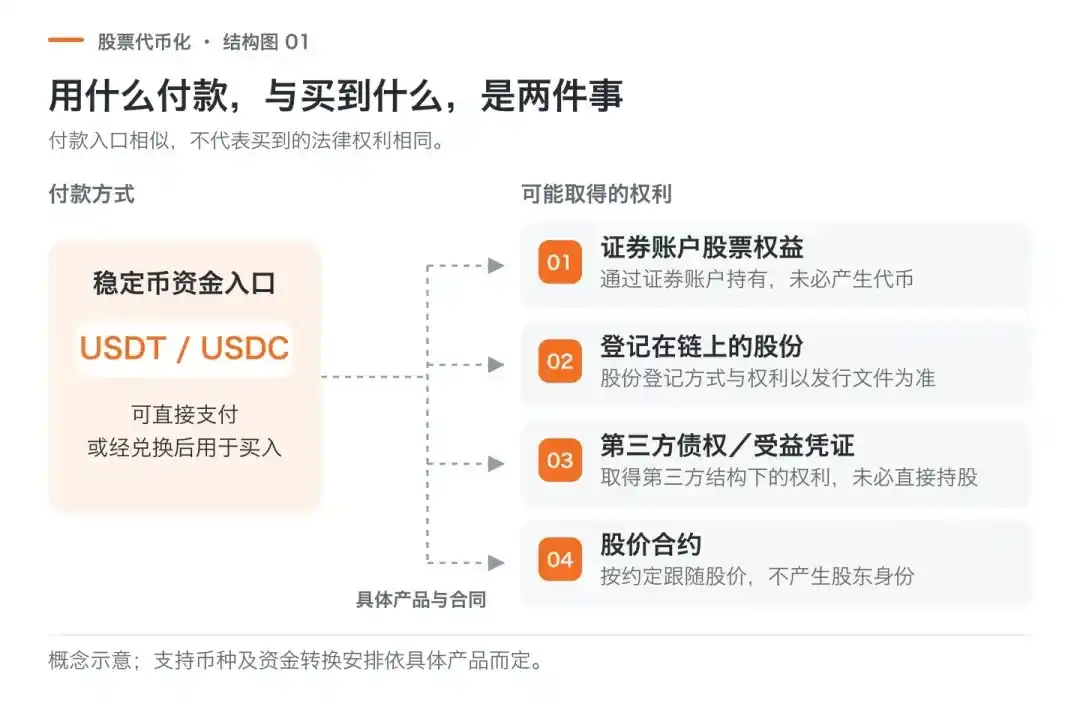
The article opens with a distinction plenty of retail users miss. In day-to-day crypto use, “U” usually means USDT, and sometimes USDC or another dollar stablecoin. That tells users how they are paying. It tells them nothing about whether the thing they receive is a real stock, a claim on an issuer, or a derivatives contract.
Stablecoins can be turned into U.S. dollars and wired into a brokerage account to purchase shares. They can also buy a stock-linked instrument issued by a company, or a contract tied to the market price of a stock. And “tokenized” just describes how rights are recorded and moved around. Because a blockchain can work as a jointly verified ledger, real shares, debt claims, and derivative agreements can all show up as tokens.
So an asset marked AAPL on a screen may still stand for very different rights, depending on the setup underneath.
One stablecoin payment can follow four very different paths
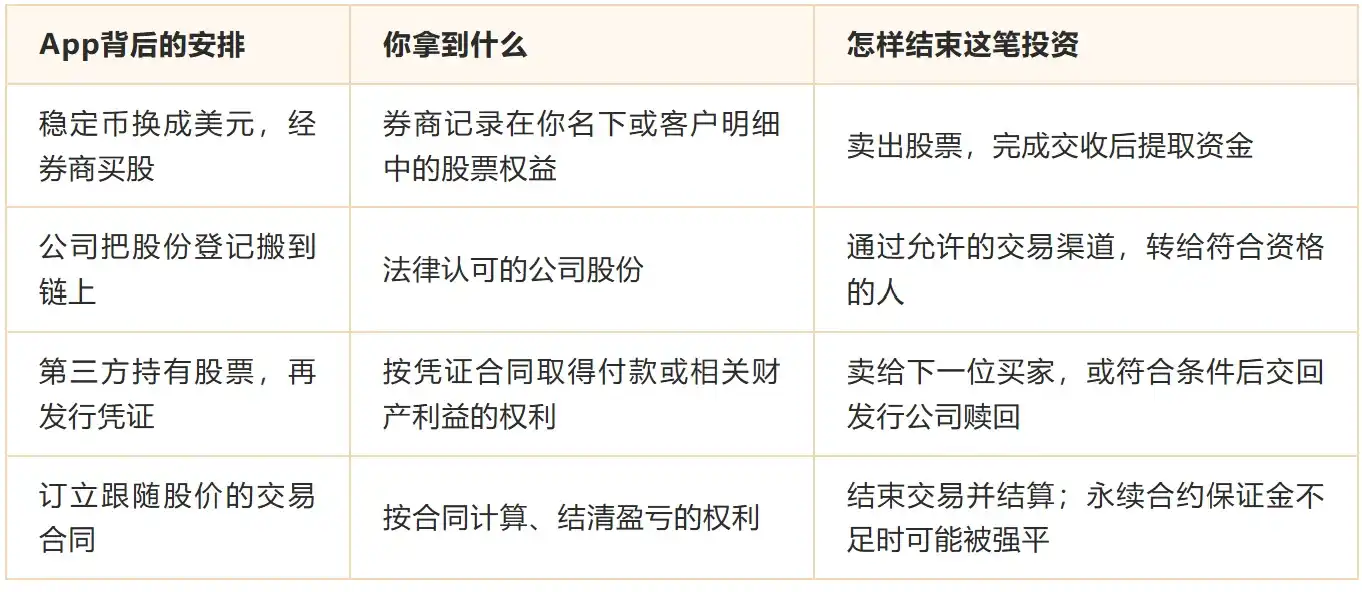
1. Stablecoins are converted into dollars, then a broker buys real shares
The first model comes closest to a standard brokerage trade. Stablecoins are exchanged for dollars through a partner channel, those dollars land in a securities account, and the broker places the stock order. In that arrangement, the user holds stock rights recorded inside the brokerage system. The stablecoin is just the funding and withdrawal rail.
MarsBit points to Interactive Brokers, or IBKR, as one example. A partner takes in the stablecoin, converts it into dollars, and credits the proceeds to the securities account. After the customer sells stock, eligible dollar balances can be converted back into a supported stablecoin, subject to platform rules covering token type and regional availability.
The article says Binance has built a similar service into its app. Nest Trading takes the instructions and displays the account, while Alpaca executes and custodies the stock. Shares sit in a master customer asset account, and customer-level positions are tracked in sub-records. The terms treat users as Alpaca customers for SIPC protection purposes, though the article says there are exceptions when stock is on loan. After a stock sale settles, the proceeds go into the Binance funding account in USDC.
The report quotes Section 4(a) of Binance’s Securities Trading Product Terms: 「Alpaca will not establish any accounts in your name」.
2. Real shares are registered and moved onchain
The second structure does not swap the stock out for a synthetic token. It takes the share registration process and puts it on a blockchain. The listed company is part of the arrangement, and a transfer agent links wallet addresses to shareholder records. When an onchain transfer happens and meets the rules, the legal holder record changes too.
The article cites Galaxy and Superstate’s GLXY setup as an example. Investors who pass identity and wallet reviews can hold Galaxy Class A common stock in an approved wallet. Those shares are still ordinary company stock with one vote per share, and voting, dividends, and corporate actions still follow standard stock rules.
To get out, a holder can move the onchain shares back into the traditional registry and then into a brokerage account for sale, or transfer them through an approved channel to another eligible investor. The article also says some companies may issue new shares directly and accept stablecoins as payment. In each case, blockchain changes the registration and settlement method. But securities issuance, investor eligibility, and trading channels still have to comply with securities rules.
3. A third party holds stock and issues its own certificate to users
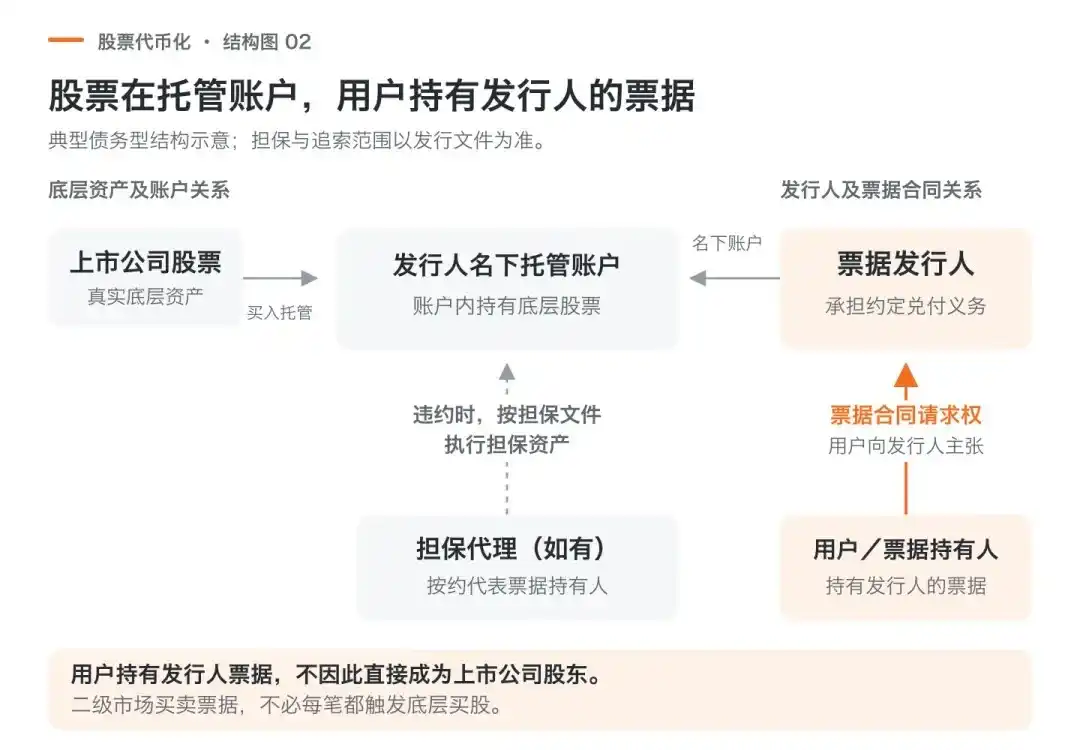
The third model puts an issuing company between the user and the listed issuer. That company holds stock through brokers and custodians, then issues its own certificate or note to users. MarsBit says a lot of stock tokens seen on trading platforms and wallets use this structure.
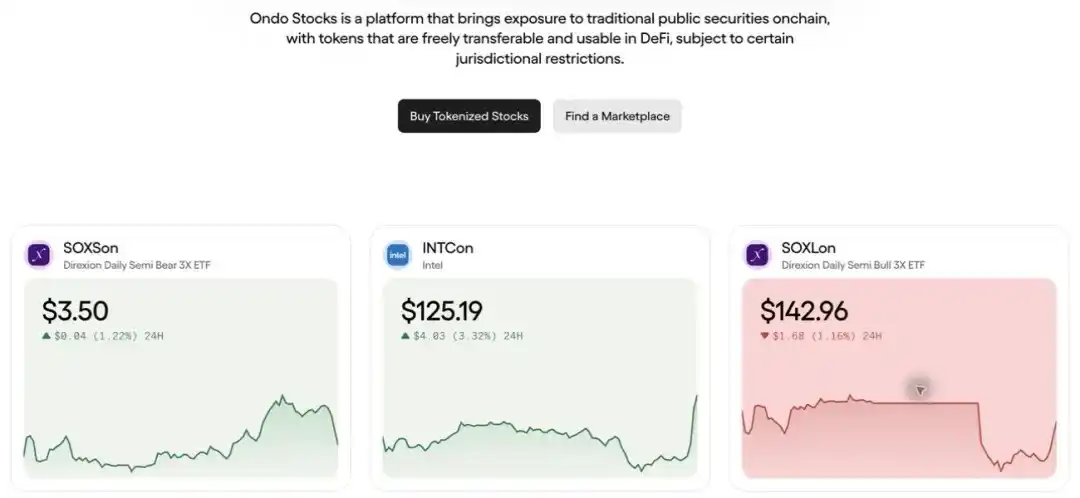
xStocks and the offshore Ondo products covered in the article are described as debt-security structures. The user does not directly own the underlying listed company share. Instead, the user owns the issuer’s contractual payment obligation, and the value is shaped by stock price moves, dividends, taxes, and fees. The listed company remains responsible for its own shares. Whether the stock token pays as expected depends on the issuance documents and the arrangement supporting the assets.
The article says that “1:1 backing” in these products usually means the issuing company holds matching stock or related assets against the amount of certificates outstanding. Those assets may be placed in a collateral arrangement. If the issuer defaults, a security agent may sell the collateral under the contract. That lowers the chance of a totally unsupported claim. But the investor’s direct claim is still against the issuer.
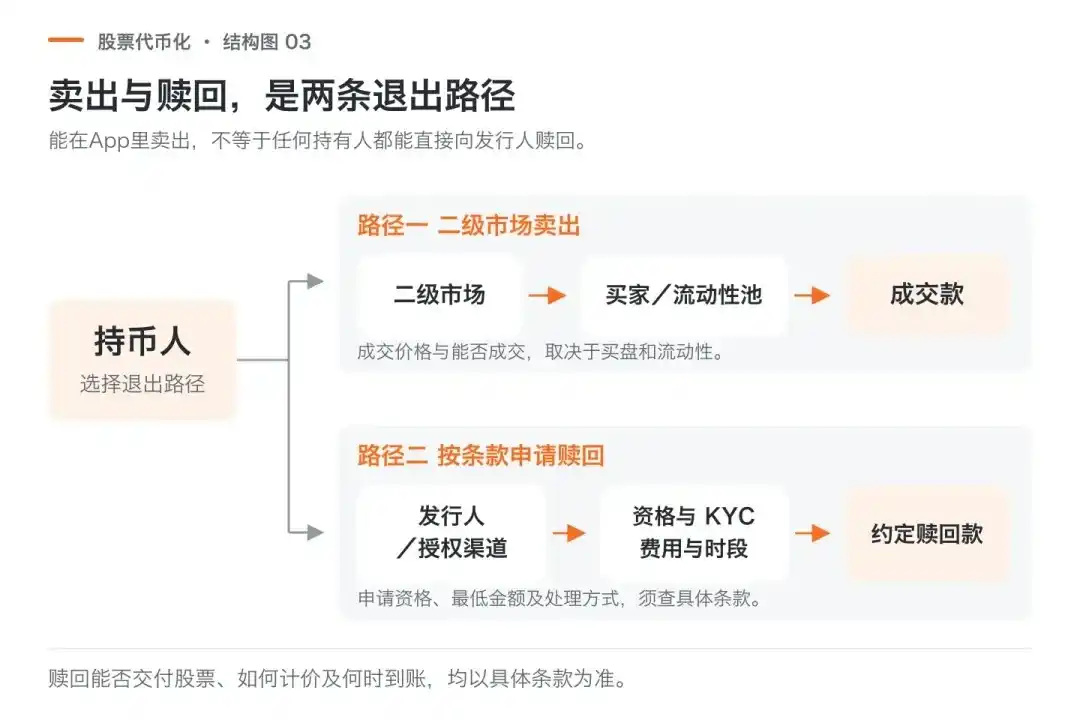
There are usually two ways out. A holder can sell the token in the secondary market to the next buyer, or send it in for redemption to the issuer under the offering documents. In the first case, the money comes from the counterparty. In the second, the issuer processes the supporting assets and settles under the contract. MarsBit says that being able to hold and transfer a token in a wallet does not mean the user automatically meets identity, region, or minimum-size conditions for direct redemption.
TSLAx is given as a direct example. Its final terms say redemption is settled in fiat or cryptocurrency and that the underlying Tesla shares are not physically delivered to the holder. The article quotes the language: 「Physical delivery of the Underlyings ... is excluded」. It dates those final terms to May 8, 2026.
Rights can differ even inside this category. MarsBit says AAPLc from Coinbase Onchain SPV uses a trust arrangement, and only holders who complete the required identity and rights-registration conditions can apply directly for redemption or send in voting instructions. A retail user making small trades in an app may face a very different process from an investor subscribing or redeeming directly with the issuing vehicle.
4. The user buys a contract linked to the stock price
The fourth path revolves around a contract between the user and the platform. Profit and loss are worked out from the price of the referenced stock, and the user gets a settlement amount when the position is closed. Even if the platform buys stock to hedge itself, that is part of its own risk management, not a transfer of ownership to the customer.
The article says Robinhood Europe’s Classic Stock Tokens fit this category as over-the-counter derivatives. Customers get price exposure, but they do not directly own stock, they do not have shareholder voting rights, and they cannot withdraw the underlying shares. MarsBit adds that Robinhood also has RHJ stock tokens using a debt-security structure. Same brand, different legal product.
It quotes Robinhood Classic’s key information document dated July 1, 2026, page 1: 「The Product is an over-the-counter (‘OTC’) derivative」.
In practice, Classic customers send a close request through the app, and Robinhood Europe settles the trade using the prevailing underlying quote and applicable fees. Orders are placed in euros, converted into dollars for position calculations, and converted back into euros when the position is closed. The user exits by dealing with the contractual counterparty.
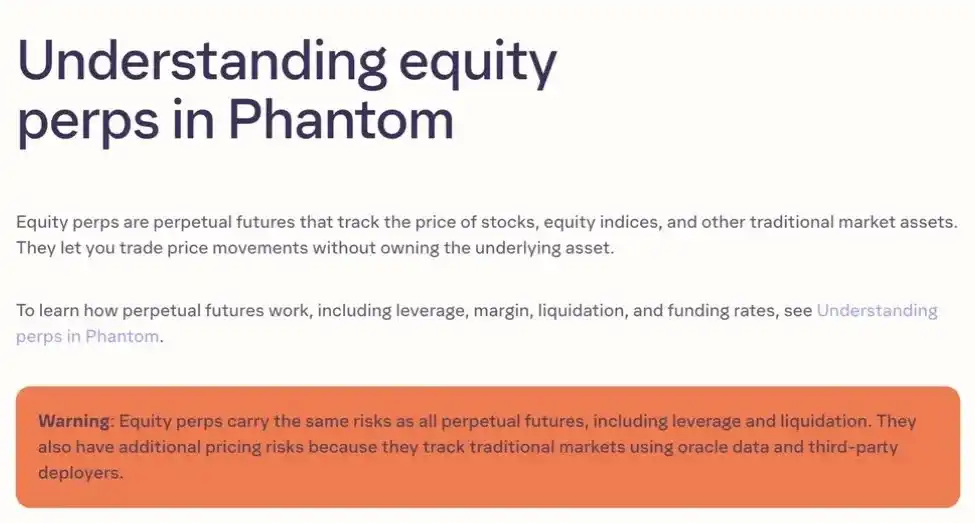
MarsBit then shifts to stock perpetuals offered through wallets. These add margin, leverage, and liquidation mechanics. Using Phantom-integrated stock perpetuals as the example, the article says traders are betting on stock direction, with gains and losses settled through counterparties and trading mechanics. If margin drops too far, the position can be force-closed. That looks much more like leveraged crypto trading than buying stock.
Why stock access now shows up in exchanges, wallets, and onchain apps
The report says common entry points now include project websites, centralized exchanges, Web3 wallets, and onchain trading apps. Ondo Stocks has its own purchase page. Kraken and Bybit put stock tokens inside their trading functions. Bitget Wallet, Solflare, and Wallet in Telegram have built stock sections into wallets, while MetaMask and Trust Wallet mostly route access through existing swap flows.
Behind these very different interfaces, there is often the same small set of products and service providers. The article says issuers such as xStocks or Ondo may be responsible for the certificate itself, while brokers and custodians hold the stock, market makers or onchain trading tools handle pricing, and the app displays the products, collects orders, or connects the user to execution. A stock button in a wallet might mean a full product area. Or just a route into a token that already exists somewhere else.
Once the front end and the backend split apart, user-facing responsibility splits too. The article uses xStocks as the example. Backed bears the issuer’s payment obligation under the certificate contract, while the platform providing the entry point handles its own trading, display, and customer service functions. One buy click can touch issuance, custody, trading, and software layers all at once.
Fees can be spread across those layers too. MarsBit lists conversion spreads, platform trading fees, onchain fees, and subscription, redemption, or management fees charged by the issuing company. A homepage promise of zero commission usually removes only one piece of the total cost stack. Whether the arrangement is compliant depends on what each institution is actually doing.
Compliance depends on both the product and the distributor
The article says compliance has to be checked on two levels. First: can the product itself be issued lawfully? Second: can the institution giving access sell it or arrange trading for this specific user? Real shares, debt-style stock certificates, and stock-price contracts are not governed by the same rules. And a completed issuance process does not mean any app can offer the product in any region.
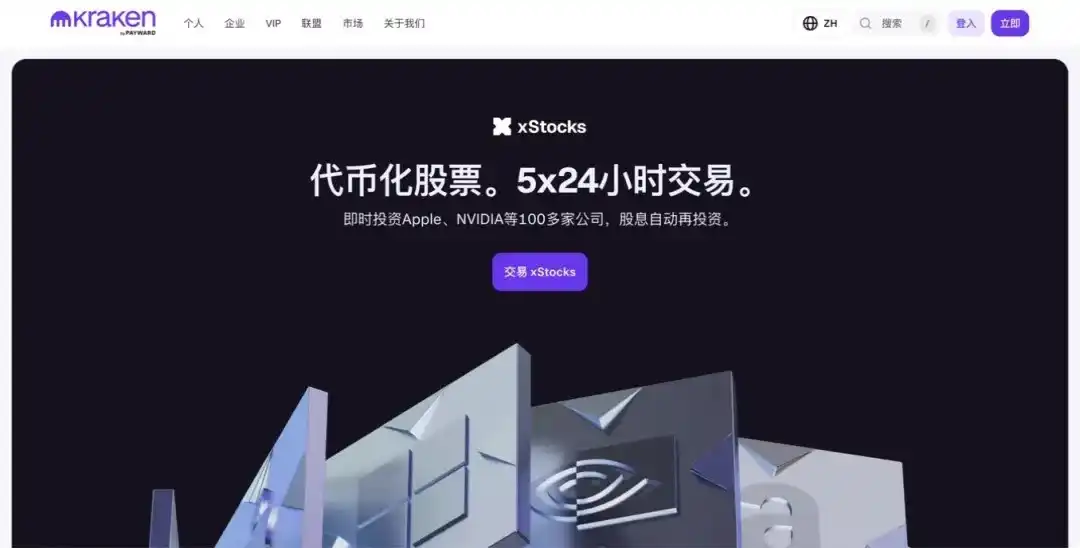
xStocks is presented as one case. MarsBit says the issuer is a Jersey company and that it prepared offering documents covering the issuing entity, holder rights, supporting assets, fees, and risks. In the European Economic Area, Kraken provides related services through a regulated investment company and evaluates product knowledge and risk suitability for retail clients. The article’s point is simple: stock tokens can enter a compliant sales channel, but only through a suitable entity operating under securities-business rules.
Apps can also outsource securities accounts, identity checks, and trade execution to licensed brokers. Dinari’s U.S. integration model, according to the article, requires a securities account for each customer and reviews the interface and marketing used by partner apps. Some self-custody wallets, by contrast, stress that they only provide software and transaction connectivity while users sign onchain trades themselves. But even there, MarsBit says the real function is what matters: whether the app receives or transmits orders, controls client assets, or takes promotion fees. Calling an interface a wallet does not automatically erase securities sales or marketing obligations.
In cross-border business, issuers and distributors may need to satisfy both the rules where the product is issued and the rules where it is sold. The article flags three recurring trouble spots: soliciting, taking orders, or arranging transactions without permission; selling products intended only for professional investors to ordinary retail users; and marketing an issuer certificate as if the user directly owned listed-company stock. Compliance turns on the real business conduct, not the label attached to the product in an app.
Who can buy, and why different access points give different answers
MarsBit says retail eligibility depends on where the user is, which channel the user is using, and what investor status the user has. Secondary-market trading inside a platform, wallet-based swaps, and direct subscription or redemption with an issuer often come with different thresholds. Getting a token onchain does not mean the issuer must honor a redemption request.
The report uses xStocks as an example. Kraken gives retail users access in some jurisdictions, but restricts markets including the United States, the United Kingdom, Canada, and Australia. Clients in the European Economic Area also have to complete a questionnaire and use specified trading methods. Ondo Stocks lets eligible non-U.S. users who pass review buy or redeem directly. The MetaMask entry point is open in a narrower group of regions. Same product. Different answer, depending on the doorway.
For readers in mainland China, the article says an offshore platform showing a product as available does not replace a domestic legal assessment. It says that Yinfa [2026] No. 42, released in February 2026, continues prohibitions on virtual-currency-related business in the mainland and restricts RWA tokenization business. Offshore projects that solicit mainland clients or illegally provide related services also fall within the regulatory scope described by the article. If a person joins this kind of trading and the contract is found invalid for violating public order or good morals, that person may have to bear the investment loss.
If the product follows the model where stablecoin funding is routed into a broker to buy real stock, cross-border securities business rules may apply as well. The article says unapproved marketing, account opening, trading, or assistance aimed at mainland clients may trigger regulatory action. Platform region limits, domestic rules, and source-of-funds requirements all have to be assessed together.
Dividends, exits, and default handling are different across structures
The article says the “dividend” tied to a stock certificate often does not show up as a cash payment in a wallet. xStocks, Ondo, and Robinhood RHJ usually reinvest after-tax dividends into the relevant stock and reflect that through token quantity or value adjustments. What the user gets is the economic benefit after reinvestment.
It also draws a hard line between selling and redeeming. Selling means transferring the token to another buyer, with the money coming from that counterparty. Redeeming means returning the certificate to the issuer and receiving stablecoins, fiat, or another agreed asset under the product terms. Tokens may move onchain 24/7. But the secondary market and the issuer’s subscription-redemption windows each run on their own timetable. If liquidity is thin, both price and settlement timing can move against the user.
If an issuer defaults, holders of stock certificates have to enforce claims through the contract chain. Using xStocks as the example, MarsBit says a security agent would manage the supporting assets for holders, deduct enforcement and related costs first, and then distribute what remains. That takes time. And the eventual recovery also depends on disposal prices and costs.
Real stock held through a broker follows a different customer-asset protection framework. The report says the Nest Trading and Alpaca terms treat users as Alpaca customers for SIPC protection purposes. That framework mainly deals with missing customer securities or cash when a broker is liquidated. It does not cover stock-price declines, and loaned securities come with separate exceptions. If the front-end app goes offline, the stock may still remain with the broker, but the user may need to finish identity checks, account transfer steps, or position transfers. Once stock has been sold and converted into USDC in a platform account, that asset no longer sits inside the SIPC-protected securities account.
The article’s closing test: who got the money, what right did you receive, and who pays you on exit
The report comes back to the opening example of 1,000 U. One buy button may send funds into a brokerage account. Another may send the money to the issuer of a stock certificate. A third may do nothing except create a contract that settles against the stock price. The ticker and the chart can look nearly identical on screen. The rights attached to the product can be completely different.
MarsBit says users should ask three questions before buying: who gets the money, whether the user is receiving shares, a certificate, or a contract, and who the user must turn to for payment on exit. Stablecoins and blockchains change how money is paid, recorded, and transferred. But dividends, redemptions, and what happens after an intermediary fails are still decided by the account structure, the contract, and the custody arrangement.
The article says products issued and sold under securities rules already exist, and wallets, exchanges, and onchain apps are widening the access points. Each participant in the chain remains responsible for the issuance, promotion, order taking, trading, or custody functions it actually performs. Where mainland China is involved, virtual-currency restrictions, RWA tokenization limits, and cross-border securities rules still have to be part of the analysis. In the article’s view, users only understand the “stock” inside an app once those layers are pulled apart clearly.