
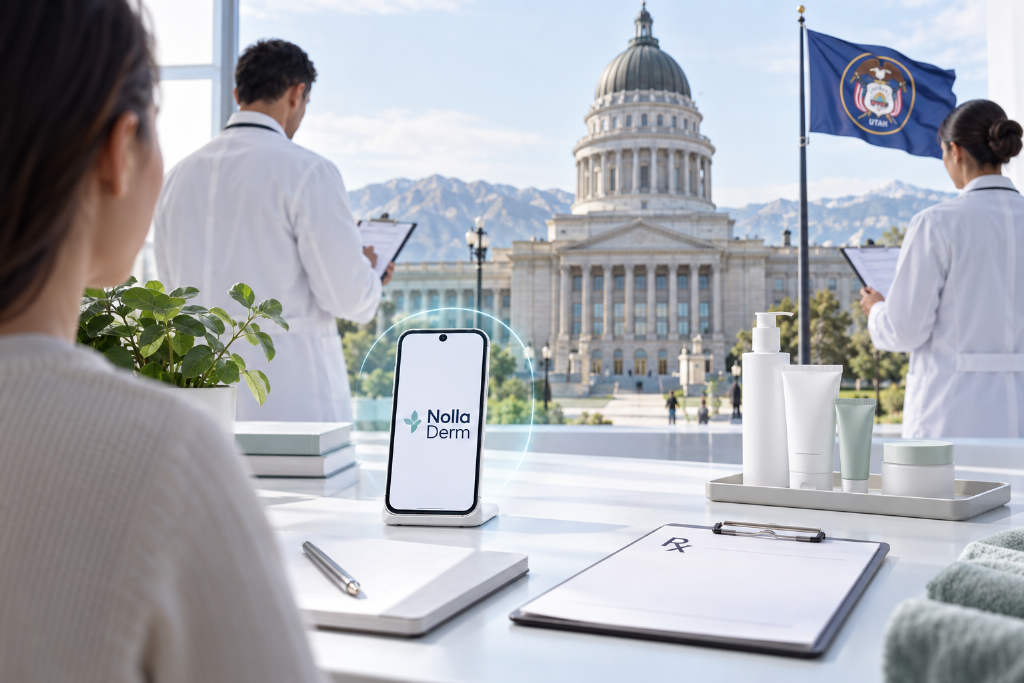
Utah has started a pilot that lets artificial intelligence generate initial prescriptions for acne treatment, though the system is not yet prescribing on its own.
New York startup Nolla Health said on Oct. 5 that its app, Nolla Derm, has begun issuing AI-generated initial prescriptions for Utah residents age 18 and older with mild to moderate acne. The service is priced at $4.99 a month.
Pilot runs through Utah’s AI regulatory sandbox
The agreement was signed on Sept. 22 and sets a 12-month demonstration period, with up to two extensions of 12 months each allowed under the law. The signatories are the Utah Office of Artificial Intelligence Policy, or OAIP, under the state Department of Commerce, the Division of Professional Licensing, and Magic Health, Nolla’s operating entity.
The structure comes from Utah’s AI regulatory sandbox created under 2024 legislation. Under the agreement, the licensing division said it will not take enforcement action, within the stated scope, over unlicensed practice or telehealth rules against the company or physicians who rely on the AI system.
Use is limited to adult patients with mild to moderate acne
The pilot has three core limits. It is restricted to Utah residents, adults 18 and older, and cases involving mild to moderate acne. The medication list is limited to eight topical formulations, including topical tretinoin, benzoyl peroxide, and azelaic acid. Two of the listed options already have over-the-counter retail equivalents available directly from pharmacies.
Oral drugs, oral isotretinoin, systemic hormone therapy, severe acne, and minors are excluded. The process must also stop if a patient is pregnant or breastfeeding, immunosuppressed, or has serious liver or kidney disease.
First 100 patients require two physician approvals per prescription
The meaning of “unsupervised” depends on the stage.
Stage one lasts at least four weeks and applies to the first 100 patients. In that phase, every AI-generated prescription must be independently reviewed and approved by two physicians licensed in Utah before it is sent to a pharmacy.
Stage two lasts at least eight weeks and runs through 500 cumulative patients. At that point, the AI can send prescriptions directly, while physicians conduct retrospective review at least once a week.
In stage three, physicians must sample and review at least 10% of cases each month.
Moving from one stage to the next requires several conditions to be met at the same time: at least 95% agreement between the AI and physicians, no missed hard-stop cases, no serious adverse events, and written approval from OAIP. That means the system was not independently prescribing when it went live on Oct. 5.
In its proposal, the company said that across its most recent 1,000 real treatment cases, agreement between clinical staff and the AI was about 96%. The remaining 4% involved dose-strength adjustments within the same drug class.
Agreement spells out liability and insurance terms
The contract also addresses responsibility in direct terms. Section 3(E) says the agreement does not amount to a state endorsement of the company’s use of AI. Section 4(D) preserves a user’s right to seek damages from the company under the law in cases of bodily injury. Section 6(B)(3) bars the service terms from disclaiming liability for harm caused by AI output. Section 8 requires the company to hold OAIP and the licensing division harmless against any claims. Section 20(B) requires proof of professional liability insurance before launch and ongoing coverage afterward.
Adverse events must be reported within 24 hours. Quarterly reports will be made public by the state government, and either OAIP or the company can terminate the agreement at any time.
Nolla chief medical adviser Zaid Fadul said in a news release, “The real test of AI in medicine is not how smart it is, but whether someone outside the company can turn it off.”
Wait times and access costs form part of the backdrop
The test is being launched against a strained care environment. The report said average wait times for dermatology in Utah are about 61 days, nearly double the U.S. median. Eleven counties in the state have no dermatologist, and an in-person visit costs at least $150 to $300.
Nolla co-founder and CEO Luis Wenus wrote on X that Nolla is “the first ever actual end-to-end AI doctor.” In a video, he said, “Until now, every prescription had a licensed clinician sign off before it went out. In the future, our AI can make prescribing decisions on its own.”
He also wrote that Nolla Health had become the first organization in the U.S., and “possibly the world,” to receive regulatory approval for an AI to issue initial prescriptions.
Report also notes Wenus’ Worldcoin background
The report said Wenus’ X profile lists Worldcoin as a former employer. A September 2025 article from General Catalyst described him as Worldcoin’s first employee focused on market expansion.
Worldcoin, now renamed World, is a project built around iris scans to verify human identity and aimed at supporting a universal basic income system. Sam Altman is listed as a co-founder.