
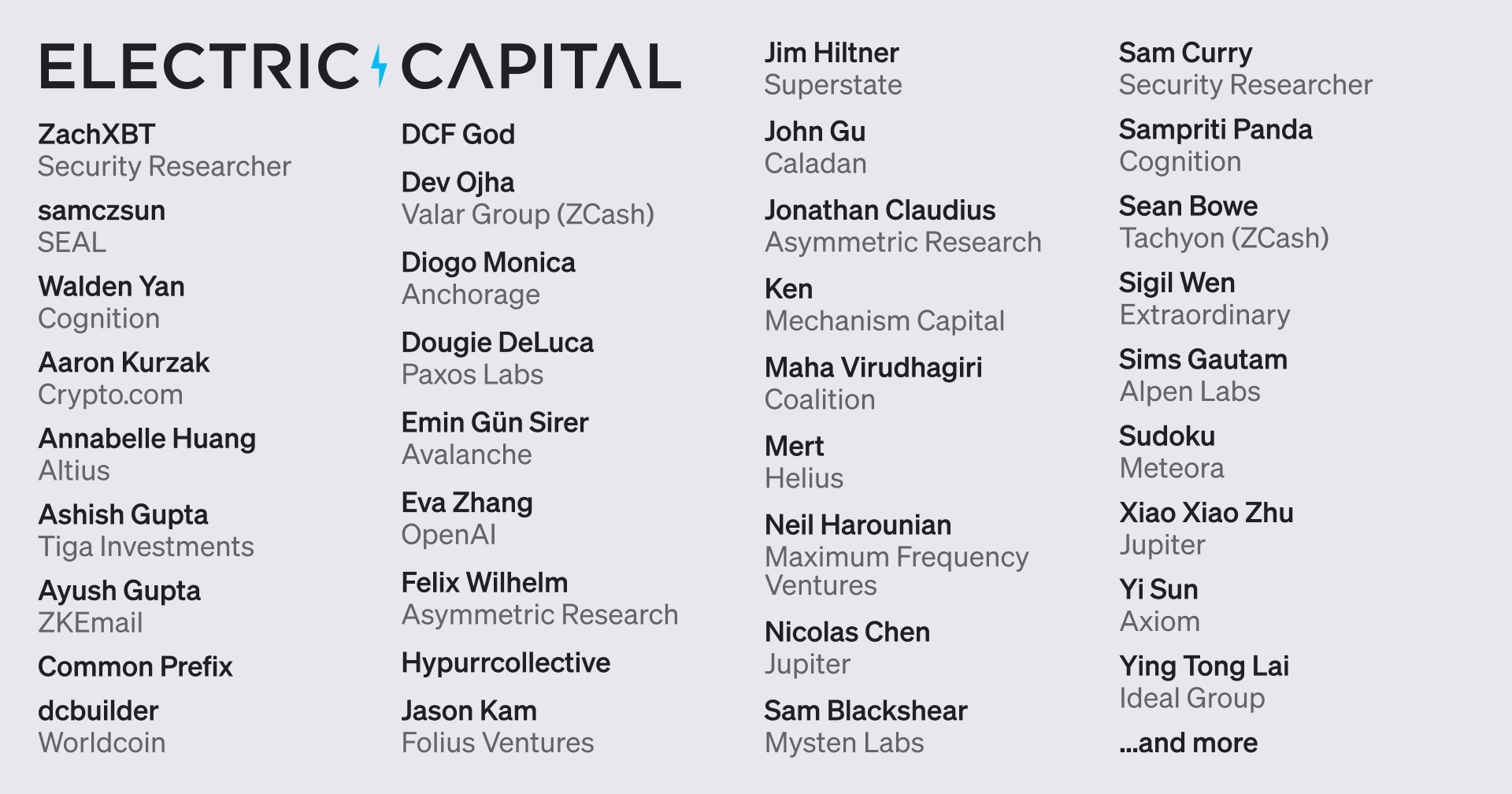
Security AI agent V12 said on July 30 that it has closed a $10 million seed round led by crypto venture firm Electric Capital. Participants included on-chain investigator ZachXBT, white-hat security researcher samczsun, Cognition co-founder Walden Yan, and more than 30 individual investors with backgrounds in security research or ties to Anchorage Digital, Avalanche, OpenAI, Jupiter, and Mysten Labs.
In the same announcement, V12 said it independently found a vulnerability on a major public blockchain earlier this month that exposed more than $100 million to risk. The company said the finding earned it a $2.5 million bounty, which it called the largest bug bounty ever paid to an AI agent. The vulnerability has since been fixed in coordination with the project team.
Roots in Zellic and competitive security research
V12 presented itself not as a newly assembled startup, but as a team that has been obsessed with vulnerability discovery for nearly a decade.
According to the Zellic website, the team’s lineage goes back to perfect blue, a security team that finished No. 1 on the CTFtime annual rankings in 2020 and 2021 under the perfect blue name, then returned to the top in 2023 as part of the merged team Blue Water.
CTF is a common competition format in cybersecurity, and CTFtime is one of the field’s best-known ranking systems. It scores teams across dozens of public events over the course of a year, weighting placements by the size of the field, so it rewards sustained output rather than a single strong finish.
The article also noted that CTFtime and DEF CON CTF are separate systems. Blue Water reached the DEF CON CTF finals in 2025 and finished as runner-up.
Two core perfect blue members, Luna Tong and Jasraj Bedi, founded Zellic. Tong is listed as Zellic’s co-founder and chief executive officer, while Bedi, also known as Jazzy, is co-founder and chief technology officer. Zellic focuses on audits for smart contracts and emerging technologies. By its own disclosure, the firm has completed more than 1,500 security audits for more than 500 high-risk clients, including exchanges, cross-chain protocols, public blockchain projects, and open-source operating systems.
V12 first appeared in September 2025 as an internal Zellic tool and was then hosted under the v12.zellic.io domain. Records from the United States Patent and Trademark Office show that the V12 trademark was filed in March 2026 by a newly registered entity, Zellic AI Inc. The product later moved to its own domain, v12.sh, and now operates through a separate X account.
The Zellic team page still shows Tong and Bedi as co-founders of both companies.
Track record includes Linux, QEMU, Redis, and PostgreSQL findings
V12 said every member of its team comes from either CTF or vulnerability research. The company listed several past findings, including three named Linux local privilege escalation zero-days — Fragnesia, Pintheft, and DirtyDecrypt — as well as a QEMU virtual machine escape and a bidirectional remote code execution issue spanning Redis and PostgreSQL. It also referenced work involving MariaDB and AnyDesk.
The article described those classes of bugs as high-severity or even critical in traditional cybersecurity. A Linux local privilege escalation bug can let a regular user obtain root access directly. A QEMU escape can break isolation and attack the host machine, a serious risk in multi-tenant cloud settings where other tenants on the same physical hardware may also be affected. A bidirectional remote code execution flaw involving Redis and PostgreSQL means an outside attacker could take full control of key database services.
That history, the piece argued, suggests V12 is not confined to smart-contract auditing and instead spans a much broader system software attack surface.
Why crypto is the first market
Independent figures cited in the article show that crypto hacking losses reached about $972 million to more than $1.1 billion in the first half of 2026. TRM Labs counted 207 incidents totaling about $972 million, while Blockaid counted 212 incidents with losses above $1.1 billion. Both datasets point to a record high number of incidents for the period.
V12 argued that a severe vulnerability in crypto can carry a bounty worth tens of millions of dollars or even more than $100 million. Outside crypto, by contrast, $50,000 is already considered substantial. The company said that gap is why it is starting in the crypto market.
It also pointed to codebase size as evidence of the complexity involved. Solana client Firedancer has roughly 722,000 lines of C code, according to the company, while Geth and Prysm together account for about 1.1 million lines of Go code. V12 said that complexity is comparable to general-purpose software such as Postgres.

At the product level, V12 currently offers a self-serve web app and a command-line tool. New users receive $200 in free credit for seven days. The web interface is organized around modules including Runs, Findings, Artifacts, and Autopilot, and each finding is categorized by severity.
As of publication, the company’s official blog and product pages did not mention any token launch or airdrop plan. The article said the business model is built on a usage-based subscription.
Its argument against traditional gatekeeping and bounty mechanics
V12 said in its announcement that “irresponsibly unleashing offensive power the world is not prepared for is wrong.” It then took aim at many current access controls and security credential checks, saying they often use safety as a justification to keep ordinary developers away from offensive capabilities and function more as public relations than caution.
From there, the company drew a sharper conclusion: putting vulnerability-finding capability in the hands of as many people as possible is the most effective way to get bugs found and fixed quickly, even if that also means more people gain access to attack tools.
V12 said its own three Linux privilege-escalation zero-days show why. In those cases, it said, patches had already leaked through public commit records before they were merged into the mainline Linux kernel, which meant weaponization risk existed before official remediation was in place.
The company went further, arguing that coordinated disclosure and bug embargo periods will eventually become obsolete, and that bug bounty systems themselves are already struggling in the AI era. As an example, it cited curl ending its bounty program. Curl maintainer Daniel Stenberg said on Jan. 21, 2026, that the program, which had run for about six years and paid roughly $86,000 in total, would be shut down at the end of that month because low-quality AI-generated reports were overwhelming the review team.
In V12’s view, once vulnerability reports can be produced in bulk at very low cost, the economics of traditional bounty programs begin to break down and can even be exploited against the defenders who run them.
The broader bet on AI security
V12 is still at the seed stage, and it acknowledged in its announcement that the goal of finding every bug has a hard theoretical limit. The company said proving that a system has no vulnerabilities is mathematically equivalent to the halting problem and therefore cannot be fully solved.
The halting problem was introduced and proven by Alan Turing in 1936. It shows that no general algorithm can determine whether any arbitrary program will run forever, one of the foundational results in computability theory.
V12 also pointed to the 2024 XZ Utils incident, which nearly introduced a large-scale backdoor through the OpenSSH dependency chain. The article treated that case as an example of supply-chain attacks spreading beyond crypto into foundational software more broadly.
It added that V12 is not the only company built around that thesis. In 2026, Beacon Security raised a $13 million seed round to build a data layer that organizes and cleans security telemetry for human analysts and AI agents. Onyx Security raised a $113 million Series B to build a control plane for governing the behavior of AI agents inside enterprises.
Those companies operate in different segments, but the article grouped them under the same capital bet: AI is set to remake the security industry. The more decisive issue, in V12’s framing, is not the financing tally itself but whether the industry’s basic assumptions are changing. If AI sharply lowers the cost of finding vulnerabilities, then security systems designed around the scarcity of capable attackers may stop working as intended.
That would put pressure on both bounty programs that wait for white hats to submit reports and disclosure processes that depend on vendors choosing to coordinate. The article’s closing point was that these mechanisms were built for a period when offensive capability was scarce, and that period may be ending faster than many developers and project teams expect.