
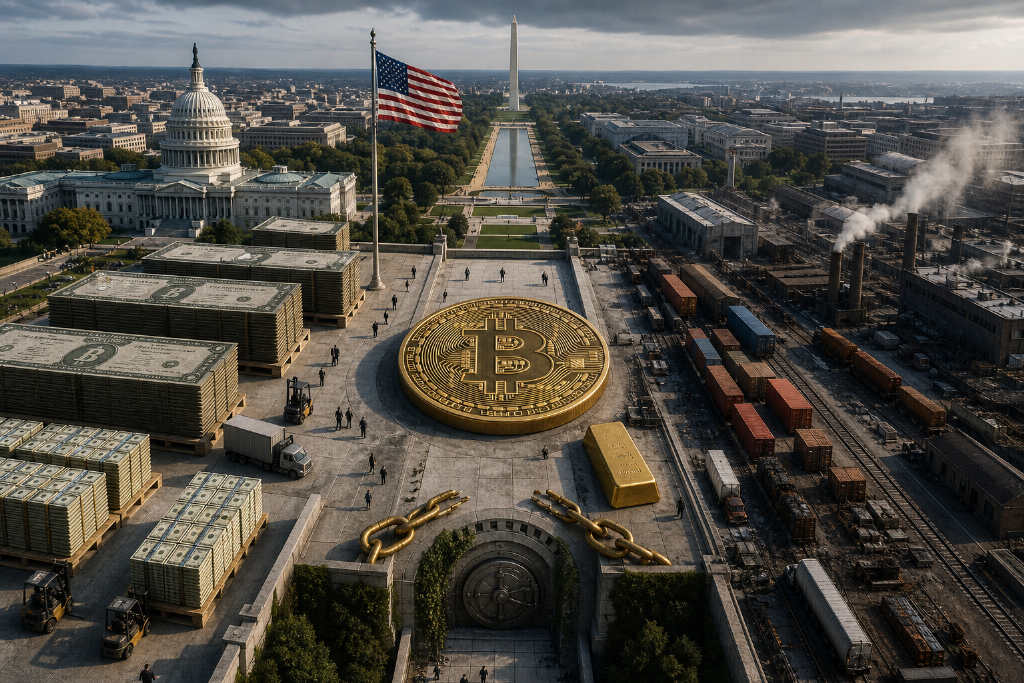
A resurfaced video involving U.S. Vice President J.D. Vance has put an old question back into circulation: is the dollar’s role as the world’s reserve currency an unqualified advantage for the United States?
In an article cited by TechFlowPost, Forbes contributor Dave Birnbaum argues that Vance raised a point that is rarely addressed head-on in Washington. A strong dollar makes imported goods cheaper for U.S. consumers. It also makes U.S. factories, exporters and workers less competitive abroad. Reserve-currency status brings visible benefits, the article says, but it also carries costs.
The upside and the cost of reserve-currency status
The article says the standard case for dollar dominance is familiar: the U.S. can borrow cheaply and buy foreign goods using its own currency. Those advantages are real. At the same time, persistent global demand for dollar assets pushes up the dollar’s exchange rate.
That leaves Americans paying less for imports while domestic manufacturing and export competitiveness come under pressure. The piece adds that many people do not connect the loss of industrial jobs with reserve-currency mechanics, even if the two sit in the same system.
It also argues that this helps explain why Vance’s line of thinking can coexist with policy instincts associated with the Trump administration. Protecting U.S. manufacturing, using tariffs and preserving dollar hegemony pull in different directions. The article says the U.S. may be able to operate within that tension for some time, but the monetary structure producing it has not changed.
The Triffin dilemma and the 1971 break with gold
Birnbaum’s piece returns to the Triffin dilemma, first laid out more than six decades ago. The basic problem is that a national currency cannot indefinitely meet domestic economic needs and serve as the world’s reserve asset without running into conflict.
Under the Bretton Woods system after World War II, the dollar was linked to gold and other currencies were linked to the dollar. As trade expanded, the world needed more dollars for settlement. The United States could supply them only by sending more dollars abroad through money creation and persistent deficits.
The article notes that in 1960, economist Robert Triffin told Congress that if the U.S. did not supply enough dollars, world trade would be constrained; if it supplied too many, foreign dollar holdings would eventually exceed U.S. gold reserves and trigger a run on convertibility.
By the late 1960s, foreign-held dollars had already surpassed U.S. gold reserves. In August 1971, President Richard Nixon closed the gold window, ending the dollar’s convertibility into gold. According to the article, that did not remove the Triffin dilemma. It only changed its form.
Today, foreign investors hold about $9.3 trillion in U.S. Treasuries. In that sense, the article argues, the world still obtains dollars by holding U.S. liabilities, while the United States still uses debt to exchange for goods and capital.
A more flexible post-1971 system, but the same underlying strain
The post-1971 order is more flexible, the article says. Offshore banks can create dollar credit. The Federal Reserve can use swap lines in periods of stress. Foreign economies can acquire dollars through exports, borrowing or asset sales.
But flexibility did not erase the tension between domestic policy goals and international reserve obligations. Global demand for safe dollar assets channels capital into the U.S., supports Treasuries and strengthens the currency. The result, in the article’s framing, is an economy tilted toward consumption over production and a tougher environment for exporters.
Persistent deficits then leave foreigners holding larger and larger claims on the United States. The value of those claims depends on confidence that the U.S. can continue to honor them.
Stablecoins widen the dollar system without fixing the contradiction
The article also folds stablecoins into the same structure. Treasury-backed stablecoins have brought more users into the dollar orbit and created another source of demand for U.S. government debt.
That does not solve the core problem, it says. Every such stablecoin still rests, in the end, on U.S. liabilities. Stablecoins expand demand for dollars and Treasuries; they do not remove the logic behind the Triffin dilemma.
The piece goes on to say that replacing the dollar with the euro or the renminbi would not resolve the issue either. It would shift the burden to another economic bloc, which would then face the same pressure from capital inflows and the same conflict between domestic priorities and global liquidity needs.
It points back to John Maynard Keynes’s proposed supranational currency, bancor, at Bretton Woods. That plan would have separated reserve functions from any single country, but it failed because states did not trust one another enough to make it work.
Gold offers a clue; Bitcoin is presented as another tool
The article says central banks have already been buying more gold in recent years. Citing World Gold Council data, it notes that annual central-bank gold purchases averaged more than 1,000 tons over the three years after 2022.
It also says the freezing of Russia’s reserves underscored a point for many countries: sovereign assets can be frozen, while gold has no issuer and cannot be altered by one at will.
Still, gold has practical limits. Moving it across borders requires ships, planes, guards and vaults. Verification is costly. Supply is scarce, but mining output can still respond to price changes, so the flow is not fixed. Gold may be politically neutral, yet it is cumbersome to settle with.
Bitcoin, in the article’s view, combines neutrality with operational convenience. It belongs to no state. Its new supply follows a fixed schedule rather than national policy. Anyone running software on a computer can verify the total supply. It can move across borders without banks and without physically transporting a commodity.
On that basis, the article argues that a reserve asset built around Bitcoin would not require one country to run ongoing debt and deficits to provide liquidity to the rest of the world.
What still stands in the way
The article does not ignore the constraints. Bitcoin remains highly volatile, and very few central banks use it as a formal reserve asset. Reserve managers tend to prefer deep liquidity and mature custody arrangements.
Bitcoin is only 17 years old, the piece notes, and that makes it hard to compare with the centuries of institutional history behind gold. Even so, it argues that changes in reserve practice often begin before the old system openly concedes ground.
A split model: dollar for transactions, Bitcoin for neutral reserves
The article ends with a possible division of roles. The dollar could remain the main medium for transactions and pricing, while Bitcoin gradually takes on part of the role of a neutral reserve asset. Stablecoins could broaden the operational reach of the dollar. Governments, in this framework, could hold gold and Bitcoin as long-term reserves, one backed by historical trust and the other by verifiable scarcity and faster settlement.
The core Triffin insight, as the article presents it, is straightforward: no national currency can serve the whole world forever without creating friction between domestic interests and international obligations. Bitcoin, in that argument, offers a way to separate reserve assets from any single sovereign balance sheet. The world could continue using the dollar, the piece says, without relying on U.S. deficits as the foundation of the global monetary order.
