ChainFeeds Research on Nov. 1 published a new edition of its "VC Says" series, a roundup of crypto venture commentary, recent research, and primary-market fundraising activity.
What this edition covers
The Nov. 1 issue is organized into three parts.
- Topics crypto VCs are discussing, including the Binance hack and whether Hyperliquid is moving into the U.S. market.
- Recent research output, including 1kx on how crypto’s revenue map is being reshaped, IOSG Ventures on who is still building after KBW and 2049, and Galaxy on whether Bitcoin has already found a bottom.
- A list of notable primary-market financings disclosed from Oct. 19 to Oct. 25.
ChainFeeds says 15 public fundraising events were disclosed during that one-week period, with total funding above $100 million. The projects named in the roundup are Meow, Erebor, Mural, Dataline, Orochi Network, HoneyB, VerityAI, X Pay, Hylo, Peso, Lighthouse, RedotPay, Zeal Wallet, Zodia Custody, and GMO-Z.com.
Binance hack dominates the discussion section
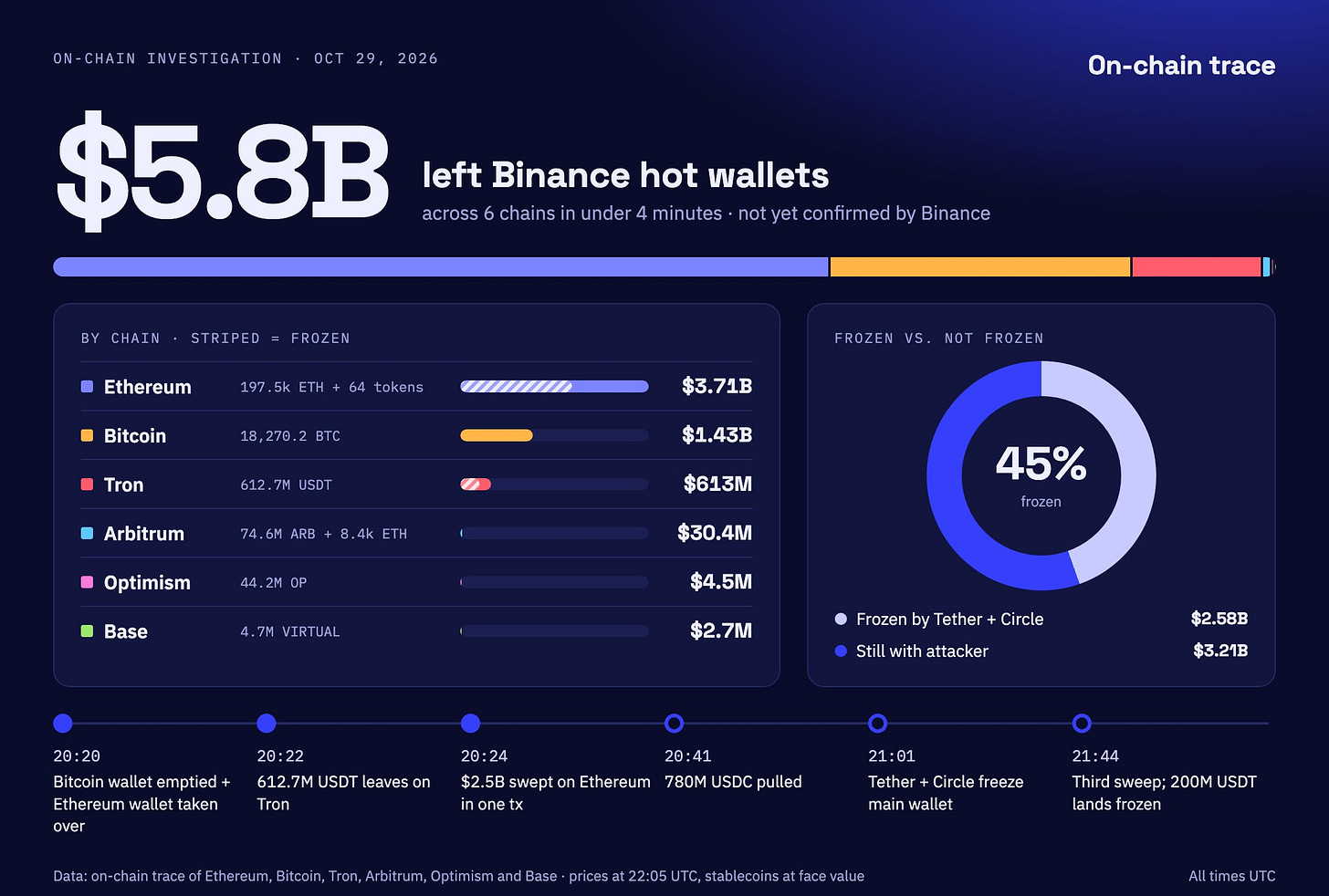
In the first topic, ChainFeeds frames the discussion around a large-scale hack at Binance, saying losses exceeded $6 billion and asking how the incident could affect market sentiment and the industry structure.
Haseeb Qureshi of Dragonfly said the attack felt very different from the FTX episode. He wrote that the market fell only by a few percentage points and stayed unusually calm. Even with a weak macro backdrop, buyers stepped in on the dip and capital outflows remained fairly limited. He also said altcoins directly affected by the incident held up well because the market had already priced in expectations that Binance would make users whole through full buybacks.
Qureshi added that the losses came in at a little over $6 billion, only 25% smaller than the funding hole left by FTX in absolute terms. Even so, he said the market’s confidence in Binance’s business strength helped the industry rally quickly and take action to protect itself. In his words, the market response was: 「It’s okay, everything will be fine.」 He concluded, 「Our industry has matured. This is a good thing.」
Ryan Watkins of Syncracy Capital said he did not expect the Binance hack to become the climax of the latest pullback, but that is what happened. He argued that a large amount of froth had been cleared out after a string of negative developments, while higher-quality assets once again led during the decline.
Watkins also said volatility could increase over the coming weeks as the market digests the hack and macro uncertainty grows. Still, he described the move as more of a necessary reset, the kind of correction he had expected within what he still sees as an early-stage bull market.
Arthur of DeFiance Capital said that despite the Binance hack, weak performance in U.S. tech and AI-related stocks could become a strong tailwind for crypto markets over the next six months. He said many native crypto participants who had previously pulled capital out of the sector could return and reallocate into an asset class they know better, rather than continue serving as exit liquidity for fast money in traditional finance.
Rui of HashKey Capital said he believes Binance does not have a deeper balance-sheet hole, adding that the exchange has been under pressure from the U.S. Securities and Exchange Commission for years and that any major issue would likely have surfaced earlier. At the same time, he said losing $6 billion is not a small matter for any company and that the incident will lead to some capital outflows.
Rui also said Binance has made solid progress on compliance, and that if U.S. regulators act, the move would serve as a warning to later entrants. He added that the banking system has many vulnerabilities and ultimately relies on state power to maintain order.
Lao Bai of Amber Group wrote that he was stunned when he first saw the news, saying he did not expect even Binance to be hacked. He said he had thought the previous $1.5 billion Bybit incident was already the limit, only to see this one reach $5.6 billion. He added that 40% of USDT and USDC had been frozen, which in his view showed that a degree of centralization can be useful at times like this.
Lao Bai also said his standing buy orders for UNI, NEAR, and MET were filled, and that he was comfortable continuing to hold them. He added that he also bought some INTC at $72.
Hyperliquid U.S. market question appears in the table of contents
The second discussion topic in the roundup asks whether Hyperliquid is entering the U.S. market. As background, ChainFeeds says Intercontinental Exchange, the parent company of the New York Stock Exchange, has partnered with Trade.xyz and plans to build a new perpetual futures trading market based on Hyperliquid.
The table of contents links that topic to Syncracy Capital and Delphi Ventures. The input provided here does not include their detailed comments on that subject.
Research and fundraising items also featured
Beyond market commentary, the issue lists three recent research pieces.
- 1kx: Who is really making money? Crypto’s revenue map is being reshaped.
- IOSG Ventures: After KBW and 2049, with crypto cooling off, who is still building?
- Galaxy: Has Bitcoin already bottomed? Four checks, from the 50-week moving average to institutional holdings.
On financing activity, ChainFeeds says 15 public fundraising events were disclosed between Oct. 19 and Oct. 25, with aggregate funding above $100 million. The named projects are Meow, Erebor, Mural, Dataline, Orochi Network, HoneyB, VerityAI, X Pay, Hylo, Peso, Lighthouse, RedotPay, Zeal Wallet, Zodia Custody, and GMO-Z.com.