
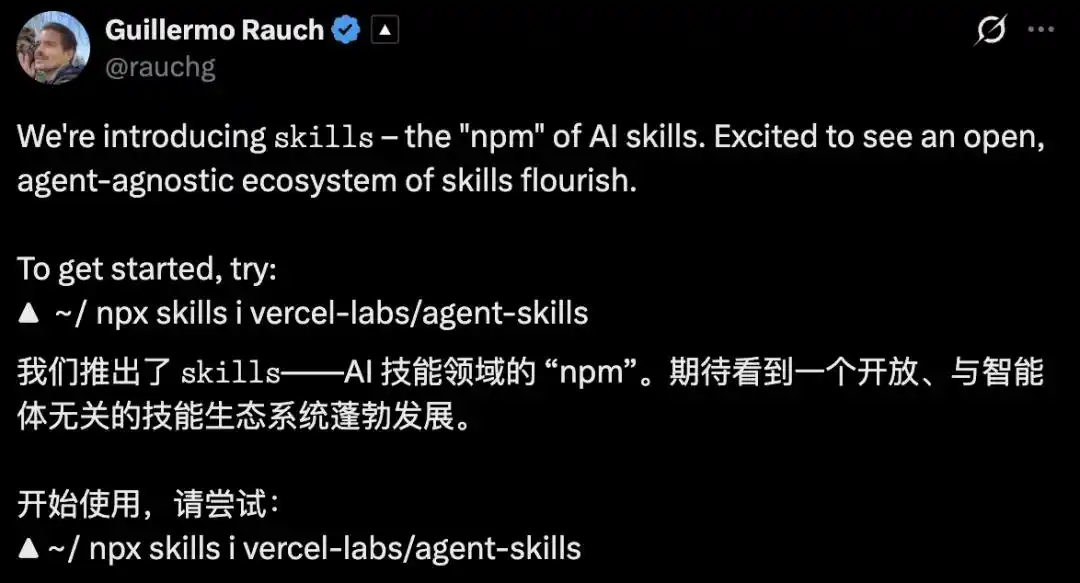
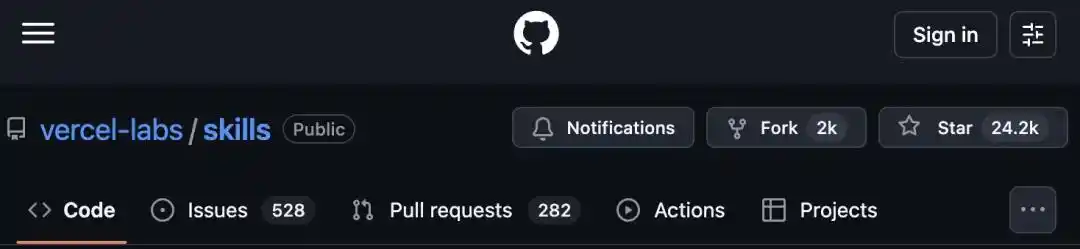
Vercel is pushing AI agent tooling toward an npm-like distribution model with the release of skills, a CLI utility for installing, managing, and reusing standardized capability packages. On January 17, Vercel founder and CEO Guillermo Rauch described the product on X as “npm for AI skills.” The company later formalized the launch in its changelog, positioning skills as a cross-tool package layer for agent workflows. The official repository, vercel-labs/skills, has reached 24,000 GitHub stars in just five months.
The developer experience is intentionally simple. Users can install a package with npx skills add <package>, then manage installed packages with commands such as list, update, and remove. In practice, the product does not install a traditional code dependency as npm would. Instead, it installs a reusable capability bundle for an AI agent. For example, running npx skills add vercel-labs/agent-skills can add React and Next.js engineering conventions, along with design rules, to Claude Code so that later code generation follows those standards by default.
Vercel is trying to turn AI capabilities into installable modules
Under Vercel’s format, a skill is essentially a folder built around a SKILL.md file with YAML front matter. That file defines what the skill does and when it should be used. A package can also include reference documents, templates, and a scripts directory containing commands that can be executed directly. The goal is to move teams away from repeatedly restating coding style, naming conventions, internal best practices, and known pitfalls in every new AI conversation. Instead, those rules can be packaged once and reused over time.
The product is not framed as a closed feature for a single assistant. According to the source article, skills already supports more than 68 agent tools, including Claude Code, Cursor, Codex, GitHub Copilot, Windsurf, and Gemini CLI. That cross-compatibility is central to Vercel’s pitch: one capability package can run across multiple agent environments, giving developers a single distribution format rather than tool-specific plugins and prompt libraries.
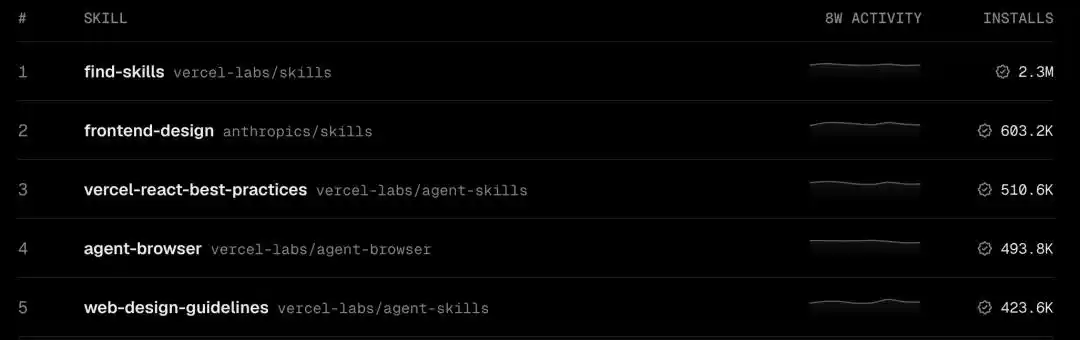
To support that ecosystem, Vercel also launched skills.sh, a public directory and ranking board that shows package popularity and install counts. The site effectively gives AI coding capabilities a “download chart” for the first time. The top-ranked package is currently find-skills, which the article says has reached 2.3 million installs. Other packages such as frontend-design and vercel-react-best-practices also rank near the top, reinforcing the idea that AI workflows are becoming modular and discoverable rather than remaining buried in ad hoc prompts.
find-skills turns skill discovery into an agent capability
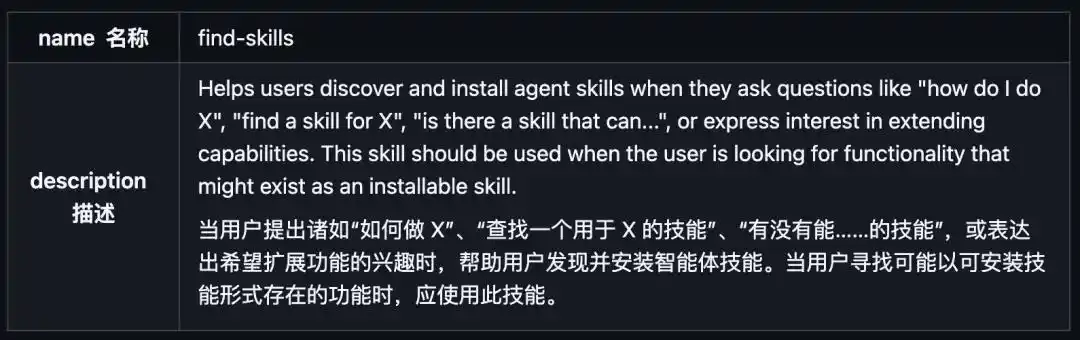
The most forward-looking part of the stack may be find-skills, which is described as a skill for finding other skills. When a user asks how to do something or whether a suitable capability already exists, the package can search, evaluate, and install a matching skill. That changes the onboarding flow significantly: users no longer need to know package names, publishers, or even whether a capability exists before they can make use of it. They simply describe the task they want completed.
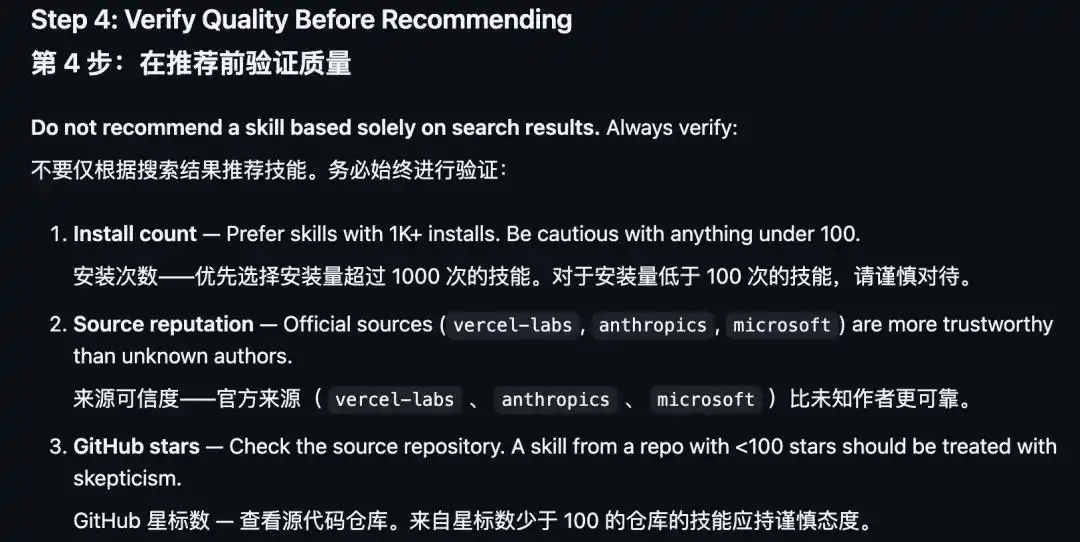
According to the published definition cited in the article, find-skills applies basic quality filters before recommending a package. It prioritizes skills with installation counts above 1,000+, treats those under 100 with more caution, and prefers official or better-known publishers such as Vercel, Anthropic, and Microsoft. It also treats repositories with fewer than 100 GitHub stars as more questionable. In effect, that gives AI tooling an early-stage capability search engine with lightweight trust heuristics built in.
The implications go beyond software engineers. Designers, product managers, content creators, and other non-engineering users are often among the most dependent on AI-assisted coding and workflow automation, yet they are the least likely to navigate Git conventions, package registries, or technical setup details comfortably. A package such as find-skills creates a lower-friction entry point for those users by letting the agent discover and install building blocks on their behalf.
Security is emerging as the biggest constraint on the model
The same features that make the ecosystem useful also make it risky. Unlike plain prompt snippets, a skill can include executable logic in its scripts directory. That means a third-party package may run commands locally, access files, make network requests, and interact with developer environments in ways that go well beyond harmless instructions. Vercel itself has warned users to treat skills like code and to inspect packages carefully before installing them, with special attention to what is present in the scripts directory.
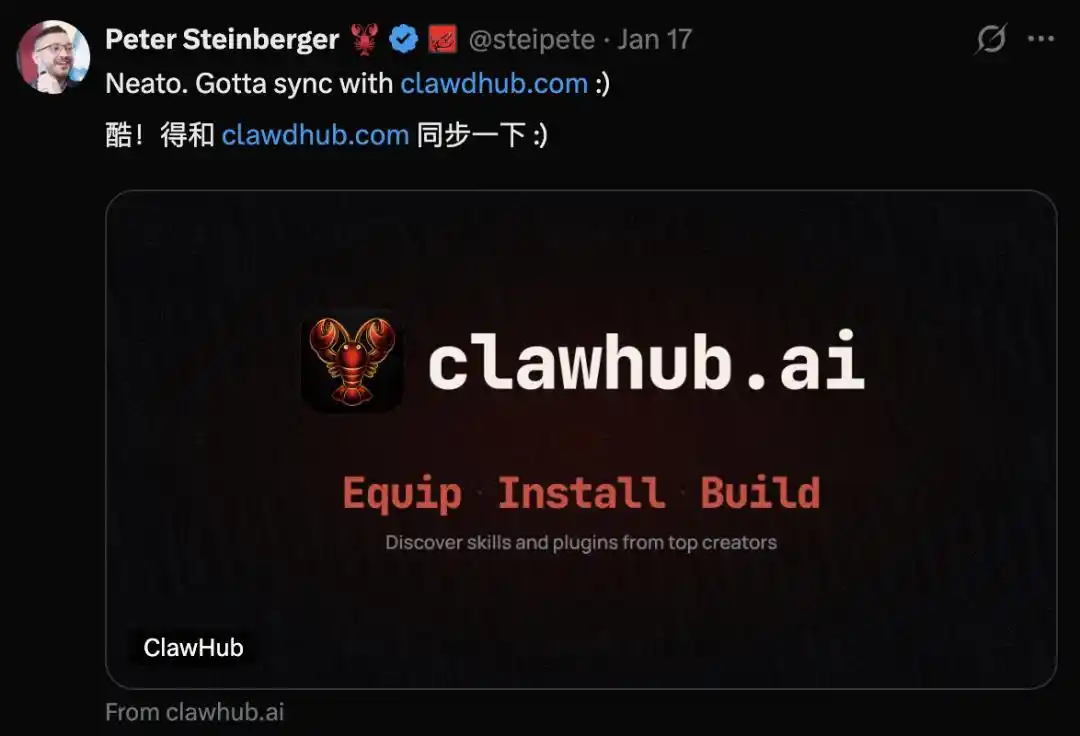
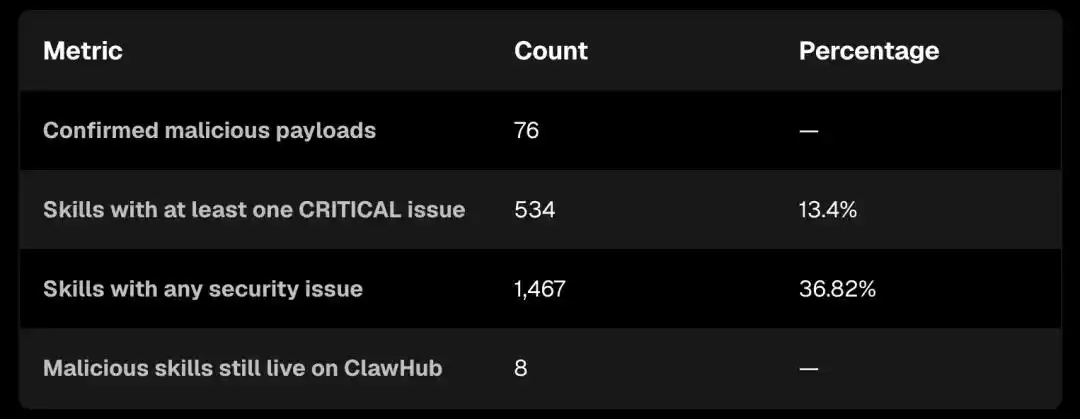
Those warnings are supported by early security research. In its ToxicSkills study, Snyk audited 3,984 skills from ClawHub and skills.sh. The firm found 1,467 skills, or 36.82%, with at least one security issue, and 534 of them, or 13.4%, were classified as critical. Reported issues included malware distribution, prompt injection, and credential leakage. Snyk also said it confirmed 76 malicious payloads, while 8 remained available on ClawHub at the time referenced by the article. In practical terms, that suggests roughly one out of every seven or eight skills could expose users to severe risk.
A separate audit by Koi Security reviewed 2,857 skills and identified 341 malicious samples. The article outlines two main attack paths. One relies on scripts that instruct an agent to contact unknown IP addresses, download and execute external content, or read sensitive local configuration such as SSH or AWS credentials. The other is more subtle: malicious instructions are embedded directly inside SKILL.md, causing an agent to interpret attacker-controlled content as legitimate task guidance. Some samples reportedly went even further and attempted to exfiltrate memory files containing private user conversations.
That risk profile differs from traditional package managers in an important way. npm packages are code dependencies, but skills collapse prompts, execution logic, and access permissions into a single unit. A single SKILL.md file can alter agent behavior, while bundled scripts can reach into the local filesystem, shell, and network stack. As a result, the consequences may extend beyond a broken build pipeline to compromised credentials, exposed repositories, and contaminated local development environments.
Vercel is extending its distribution playbook from web tooling to AI agents
Viewed strategically, skills is more than a convenience layer. Vercel previously used Next.js and its deployment platform to insert itself into the core workflow of frontend developers, making the path from writing code to previewing and shipping it dramatically simpler. With skills, Rauch appears to be applying the same playbook to the AI agent layer: package informal know-how, conventions, and task logic into versioned modules, then make them installable through one familiar command-line interface.
That approach aligns closely with Rauch’s broader career. Public background referenced in the source article notes that he came up through open source, worked on MooTools, and moved into frontend engineering at an early age. One of his better-known projects is Socket.io, the real-time communication library used by products including Notion’s real-time sync and early Coinbase trading infrastructure. He later founded Vercel and helped build Next.js, which now underpins online properties for organizations such as The Washington Post, Porsche, Under Armour, and Nintendo.

The article’s broader point is that Rauch has spent roughly two decades reducing complicated engineering work into commands developers are willing to run with confidence. From earlier deployment flows to Next.js and now npx skills add, the pattern is the same: compress complexity into a standardized interface. What has changed is the object being packaged. Instead of infrastructure or frontend frameworks, Vercel is now packaging agent behavior itself.
That is why the launch matters beyond a single product update. Skills gives AI tooling an installation model, update path, popularity ranking, and cross-tool compatibility that begin to resemble the software package ecosystems developers already understand. But it also imports the same supply-chain problems, permission questions, and trust issues that long haunted npm, with potentially higher stakes because the package can directly influence an autonomous agent. The result is a familiar trade-off in a new layer of the stack: one-line convenience on one side, and the need for source verification, permission review, and package scrutiny on the other.