

Nancy, writing for PANews, said a shutdown wave among small and mid-sized centralized exchanges is adding fresh pressure to a crypto bear market already short on momentum. In recent weeks, veteran venues including BitMEX, BitMart and AscendEx have announced plans to stop operating, while several other exchanges have surfaced in sale or merger discussions.
The article says this round of contraction looks different from earlier exits driven by blowups, hacks or regulatory punishment. Instead, it is tied more closely to a shift in industry conditions. Exchanges that expanded rapidly on the back of bull-market cycles and traffic-driven growth are now facing longer-term operating strain, and some smaller CEXs are choosing to leave the market on their own.
BitMEX, BitMart and AscendEx join the retreat
Since the start of July, BitMEX, BitMart and AscendEx have each announced shutdowns, according to the article.
All three platforms were launched in the industry’s early years or during its rapid expansion phase. BitMEX, founded in 2014, is described as one of the most recognizable veteran exchanges. It has operated for roughly 12 years, pioneered 100x perpetual contracts and was once a heavyweight in crypto derivatives. AscendEx, founded in 2017 under the former name BitMax, and BitMart, launched in 2018, are presented as mid-generation exchanges that rose during a period of fast market growth and have each been operating for more than eight years.
The article notes that all three survived multiple bull and bear cycles and built up a measure of user scale and market influence over time. Even so, years of experience and accumulated brand recognition did not keep them from eventually exiting the market.
Based on public information, the main forces behind the current wave are changing market conditions, heavier compliance pressure and rising operating costs. BitMEX and BitMart chose to pull back after reviewing their business conditions, the market environment and future strategic direction. AscendEx said licensing and compliance issues, together with weaker trading activity and pressure on liquidity, led it to halt platform services.
Direct shutdowns are only one part of the picture. The article says multiple CEXs have also recently been linked to sale talks or acquisitions, a sign that industry consolidation is speeding up.
- Institutional crypto trading platform LMAX Group has reportedly been evaluating a range of strategic options with Morgan Stanley and investment bank KBW, including a sale, a SPAC merger, and a listing in the United States or Europe.
- South Korea’s Mirae Asset Group acquired a 97.15% stake in Korean crypto exchange Korbit in a deal worth about KRW 141.367 billion, or roughly $102 million.
- Japan’s financial group SBI acquired Singapore-based platform Coinhako and Japanese exchange Bitbank.
- South Korean payments solutions company WeHub also acquired crypto platform Flybit.
The article stresses that M&A in the exchange business is not just about buying assets or users. Buyers also take on operating history, technical security and compliance systems. Binance founder CZ recently made the same point publicly, saying an exchange acquisition is different from other deals because if a hack happens after a purchase, it can be hard to tell whether the issue came from a backdoor left by the previous team or from a new problem. He said acquisitions are still possible, but due diligence and risk controls are more complicated.
In that framing, the structure of the CEX market is entering another reshuffle. For smaller platforms without scale, brand barriers or compliance capability, the survival challenge may get tougher, and both consolidation and resource concentration are likely to continue.
Liquidity is concentrating more heavily in the largest exchanges
The article argues that the latest exchange exits did not come with a blowup, a hack or a sudden regulatory crisis. They are better understood as voluntary contraction and market clearing after the industry moved into a phase of competition over existing demand rather than new expansion.
In earlier cycles, exchanges often disappeared after security incidents, misuse of funds or regulatory sanctions. Now, with crypto in a slower-growth phase, weaker user activity, shrinking trading volume, tougher competition and tighter global regulation are all putting pressure on CEX profit margins.
As the sector enters a new cycle, the article says reserve assets, market depth and user fund flows are becoming core measures of an exchange’s overall strength and ability to survive.
On reserves, asset size is described as a key indicator of risk-bearing capacity. Strong reserves mean an exchange is better positioned to keep meeting withdrawals and maintain stable operations during extreme volatility, violent market swings or concentrated customer outflows.
DeFiLlama data cited in the article shows a clear concentration of exchange assets at the top end of the market. Binance holds $138.718 billion in reserve assets, accounting for about 58.4% of the total tracked figure and far outpacing every other platform.
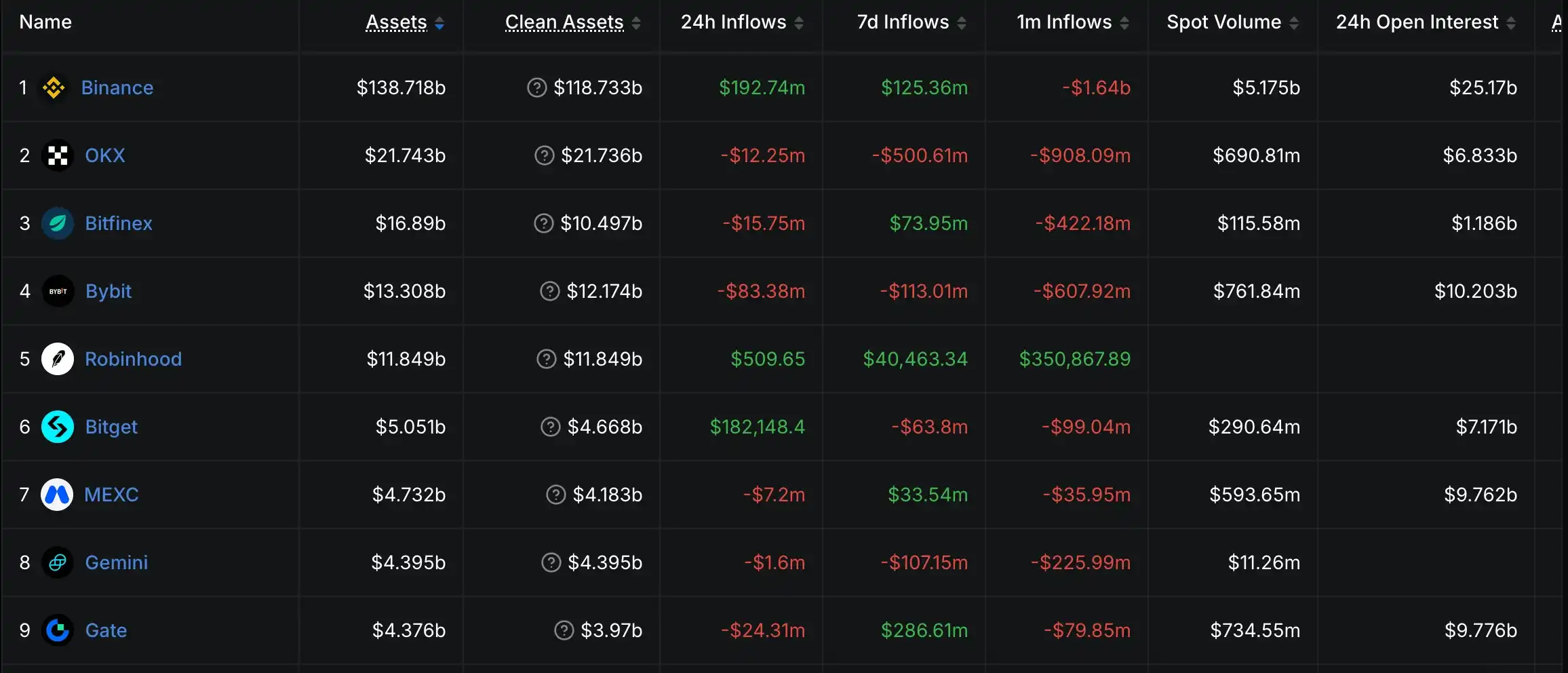
Other exchanges near the top include OKX, Bitfinex, Bybit and Robinhood, with asset sizes of $21.743 billion, $13.308 billion, $16.89 billion and $11.85 billion, representing about 9.1%, 7.1%, 5.6% and 5%, respectively. The article adds that Bitget, MEXC, HTX, Gate, Deribit and KuCoin each hold reserves in the billions of dollars and retain a degree of competitiveness. Smaller exchanges, by contrast, face a much clearer funding gap. That leaves them under greater strain in liquidity management and risk absorption during market shocks or clustered withdrawals.
Trading volume tells a similar story. The article says spot volume remains an important gauge of user activity and market liquidity. Higher spot turnover usually points to deeper books, steadier liquidity and more consistent user participation.
DeFiLlama data shows Binance ranking first with $5.175 billion in 24-hour spot trading volume, about 34% of the tracked total, preserving its status as the largest spot trading platform globally. Bybit, Gate, KuCoin, MEXC, Upbit, OKX and Coinbase each posted 24-hour spot volume in the $600 million to $800 million range, with shares of around 3.7% to 6.4%.
Derivatives are also highly concentrated. Binance’s open interest stood at $25.17 billion, about 27.5% of the total. Bybit ranked second at $10.203 billion, equal to about 11.1%, while Gate followed at $9.776 billion, or around 10.7%. MEXC, Bitget, OKX and Deribit each accounted for open-interest shares in the 7% to 10% range.
Overall, the article says liquidity is continuing to gather around the largest exchanges, creating stronger competitive barriers. At the same time, the broader crypto market remains in a low-activity phase. Investor participation has cooled and capital inflows have slowed noticeably, leaving the CEX sector with limited growth momentum.
DeFiLlama data shows that the ten exchanges with the largest outflows over the past month recorded combined net outflows of about $3.91 billion. The article adds a qualification: outflows do not necessarily mean users are leaving outright. Some movement may reflect asset transfers, active position adjustments or capital reallocation as the market cycle changes.
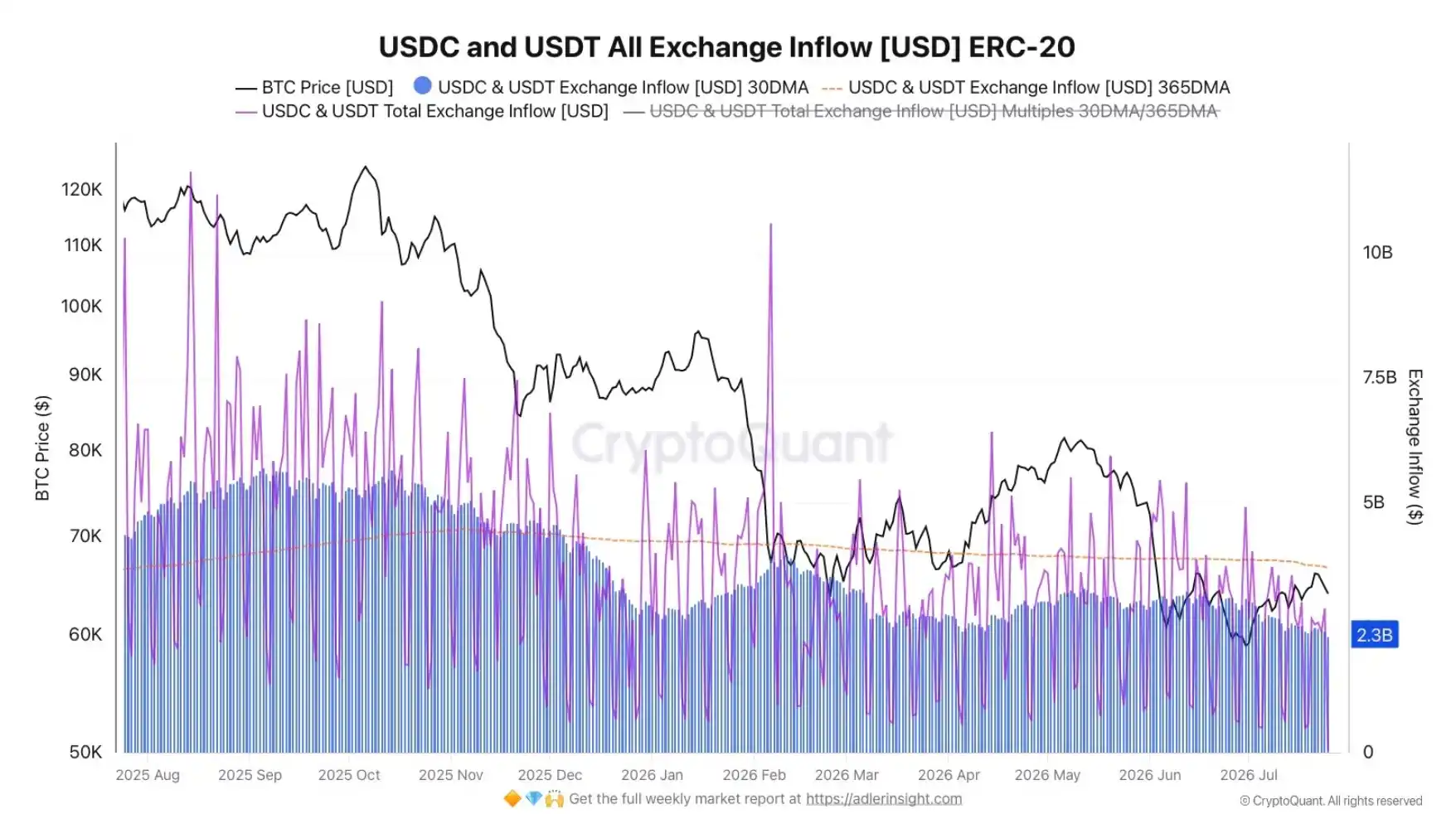
Stablecoin flows to exchanges also point to soft demand. CryptoQuant analyst Darkfost recently wrote that stablecoin inflows to exchanges have kept falling and are now at their lowest level since 2025. Current monthly average inflows for USDT and USDC are about $2.3 billion, while the annual average stands near $3.7 billion. When Bitcoin reached its all-time high, monthly average inflows were $5.6 billion and the annual average was $4.3 billion. The article says that trend reflects lower risk appetite and weaker trading demand among investors.
TradFi-linked products are turning into a new growth battleground
In the past, small and mid-sized CEXs leaned mainly on listing fees for long-tail tokens, trading fees and bursts of market attention to drive growth. With the market staying weak and the Meme wave shifting more toward on-chain DEX activity, the article says that model is fading quickly. Platforms without scale, brand strength or product differentiation are starting to leave under long-running operating pressure.
Against that backdrop, TradFi business lines are becoming a new growth battlefield for major exchanges.
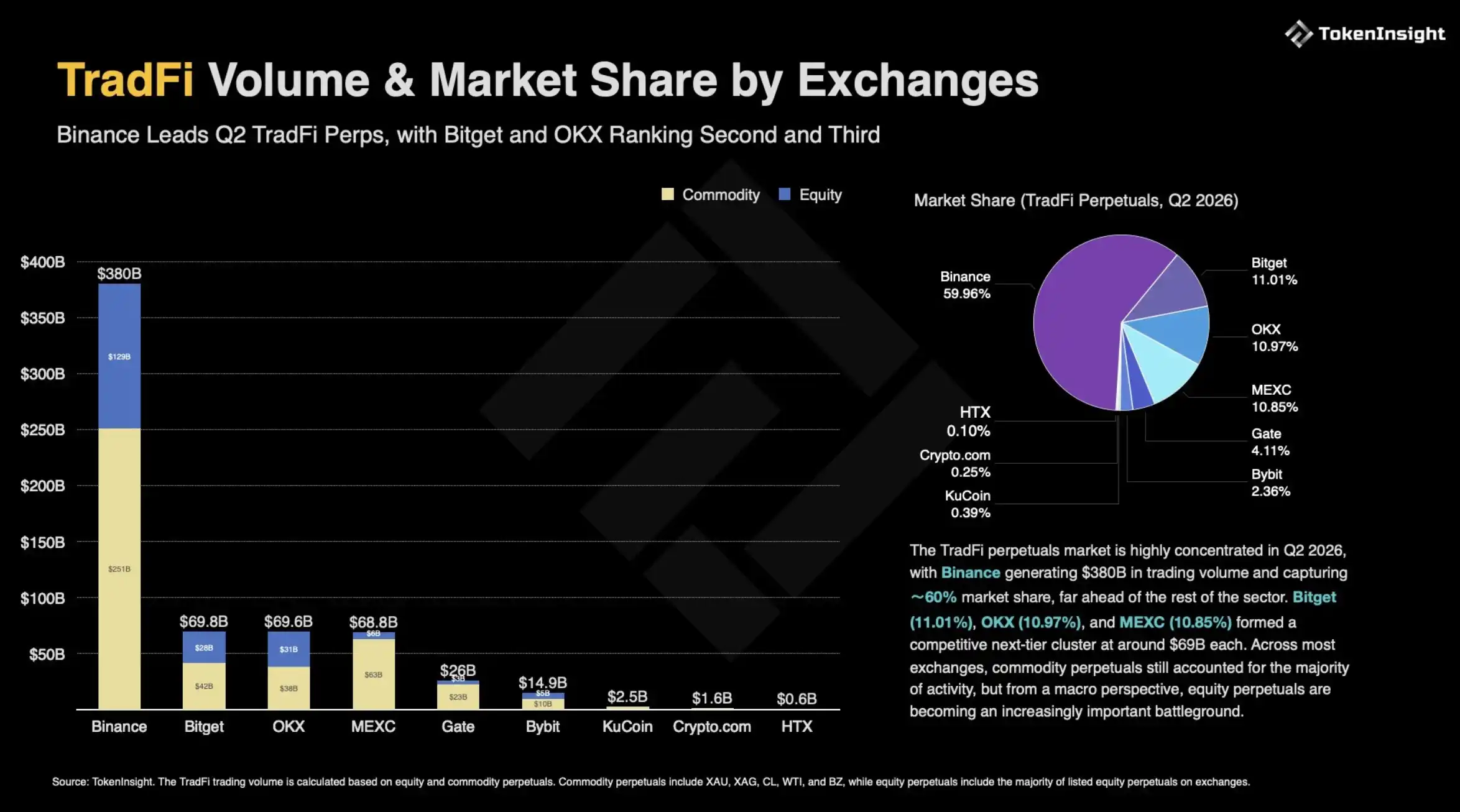
TokenInsight’s latest report, cited in the article, shows that TradFi perpetual contracts became the clearest growth segment for CEXs in the second quarter. Monthly total volume rose from $52 billion in January to $268 billion in June. Equity perpetuals were the main growth engine, with trading volume jumping from $45 billion in May to $141 billion in June.
At the exchange level, the share of TradFi perpetuals within derivatives business kept increasing during Q2. Binance, Bitget and MEXC posted TradFi perpetual volume equal to 8.65%, 8.61% and 7.22% of their total derivatives volume, putting them near the top of the field.
By market share, Binance recorded $380 billion in Q2 TradFi perpetual trading, taking about 60% of the market. Bitget, OKX and MEXC formed a second tier with shares of 11.01%, 10.97% and 10.85%.
The article reads this as a sign that user demand is moving away from exclusive exposure to native crypto assets and toward access to traditional financial assets, while CEXs are trying to reposition themselves from pure crypto trading venues into broader financial gateways.
For smaller CEXs, the proposed path forward is licenses, localization and niche focus
Crypto researcher Haotian said in the article that exchanges are turning to tokenized U.S. equities, ETFs and Pre-IPO assets because they are searching for new growth space. But he also argued that the replacement of native crypto assets by traditional financial products shows CEXs losing ground in pricing power and settlement power.
In his view, perpetuals may help sustain volume and revenue in the short run. Over a longer period, though, exchanges still have to confront the cost of becoming a channel or entry point rather than the center of price formation. He said the fiercer the competition around tokenized U.S. stocks becomes, the greater the survival pressure on CEXs, and exchanges that are not qualified to compete there will struggle to stay alive.
The article also says the compliance trend is widening the gap across the sector. As global regulation tightens, leading exchanges are holding their ground in mature financial markets by leaning on compliance planning, capital strength and established brands. Exchanges that once relied on offshore markets and regulatory arbitrage are seeing their room shrink. Markets in higher-risk regions such as Iran and Russia are also facing stronger compliance challenges, making growth models built on sensitive jurisdictions harder to sustain.
Haotian said competition among CEXs is harsher than it may appear under the broader compliance push. Licensing, proof of reserves, KYC/AML/KYT and segregation of customer assets have become basic requirements for staying in business. That, he said, has sharply reduced the room for classic exchange blowups, and the old zero-sum logic in which one player’s collapse opened room for many others has largely faded. In that sense, he argued, these closures are better seen as voluntary shutdowns under severe competitive pressure rather than outright blowups, and as a result of healthier market competition.
For smaller CEXs, he said survival is no longer about simply scaling trading volume. It is about building a differentiated edge. Just as smaller exchanges in the previous cycle used IEOs and quality on-chain assets to attract traffic and users, the article says today’s path narrows to a few options: deepen work around licenses in specific regions and localized services, or focus on a particular vertical product such as TradFi assets, perpetuals or RWAFi, or move more decisively toward crypto-native directions including DeFi, the Agentic Economy and MEME, using community strength to endure the cycle.
The article closes with a broader conclusion. Continued homogenized competition among CEXs will only speed up elimination, although clearing out weaker platforms is not necessarily negative. The sector is moving from an era of scale expansion to one of capability competition. In the past, exchanges expanded quickly on bull-market momentum, market narratives and user growth. Now, reserve strength, liquidity depth, compliance capability and business innovation are becoming the core factors that determine competitiveness.
If the crypto market enters a longer adjustment period from here, the article says, smaller CEXs that fail to establish a differentiated position and open up new growth directions may lose what remains of their survival space in a tougher industry reshuffle.